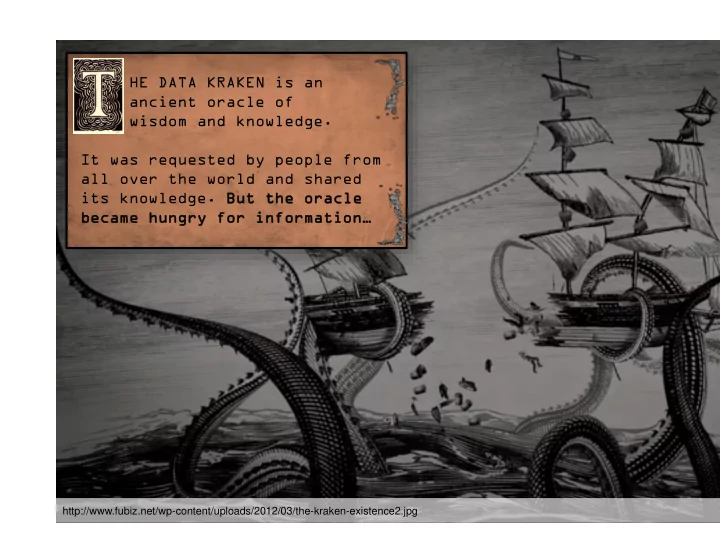
SLIDE 1 HE DATA KRAKEN is an ancient oracle of wisdom and knowledge. It was requested by people from all over the world and shared its knowledge. Bu But t th the e or
acle le became hungry for information…
http://www.fubiz.net/wp-content/uploads/2012/03/the-kraken-existence2.jpg
SLIDE 2 Modern Mix Network Design
David Stainton
This project has received funding from the European Unions Horizon 2020 research and innovation programme under the Grant Agreement No 653497, Privacy and Accountability in Networks via Optimized Randomized Mix-nets (Panoramix).
SLIDE 3
“we kill people based on metadata” –Michael Hayden (Ex-NSA and Ex-CIA Director)
SLIDE 4
SLIDE 5 Meta-data leakage
Encryption is NOT sufficient! Leaked meta-data:
◮ Geographical location ◮ Message sender ◮ Message receiver ◮ Message send time ◮ Message receive time ◮ Frequency of received messages ◮ Frequency of sent messages ◮ Size of the message ◮ Message sequence
SLIDE 6 Meta-data leakage
Why not use a VPN? Major problems:
◮ Plaintext intermediary ◮ Traffic fingerprinting ◮ Possible leakage of client identity keys
SLIDE 7
Existing solutions?
SLIDE 8
You only need one side if the other side behaves predictably, like a website. Admit defeat on the web for now..
SLIDE 9
Should we message our friend’s over Tor? Should we send crypto currency transactions over Tor?
SLIDE 10 David Chaum. Untraceable electronic mail, return addresses, and digital pseudonyms, Comm. ACM, 24, 2 (Feb. 1981); 84-90 Chaum came up with many big ideas in this paper such as:
◮ Sender anonymity ◮ Anonymous replies ◮ Message receipts for reliability ◮ Pseudonyms for persistent communication
SLIDE 11 Mix Properties
Required mix properties to defeat global passive adversaries:
◮ Bitwise unlinkability between input and output messages ◮ Latency (aka mixing)
SLIDE 12
n-1 attack on threshold mix strategy
SLIDE 13
n-1 attack on threshold mix strategy
SLIDE 14
n-1 attack on threshold mix strategy
SLIDE 15
n-1 attacks against continuous time mix strategies
SLIDE 16
Tor is not a mix network.
See: Claudia Diaz & Andrei Serjantov. Generalising Mixes. PETS 2003
SLIDE 17 What is a mix network?
◮ A closed network (no exit relays) ◮ Message oriented ◮ Unreliable packet switching network ◮ Layered encryption in a single packet ◮ Added latency per hop, aka they mix ◮ Can optionally use route unpredictability ◮ Can optionally use decoy traffic
SLIDE 18
Topology: Cascade
Diagram borrowed from wikipedia.
SLIDE 19
Topology: Free route
SLIDE 20
Topology: Stratified
Diaz, Murdoch, Troncoso. Impact of Network Topology on Anonymity and Overhead in Low-Latency Anonymity Networks PETs 2010
SLIDE 21
Don’t roll your own packet format!
Sphinx is a remarkably compact and secure packet format designed by George Danezis and Ian Goldberg. Security proof in the universal composability model, using earlier work by Camenisch & Lysyanskaya 2005.
SLIDE 22
Don’t roll your own packet format!
Sphinx is a remarkably compact and secure packet format designed by George Danezis and Ian Goldberg. Security proof in the universal composability model, using earlier work by Camenisch & Lysyanskaya 2005. Header Body
SLIDE 23 Sphinx features
◮ per hop bitwise unlinkability ◮ Single Use Reply Blocks ◮ indistinguishable replies ◮ hidden the path length ◮ hidden the relay position ◮ tagging attack detection ◮ replay attack detection
SLIDE 24 Compulsion Attacks
Mix key compromise can take several forms such as:
◮ Compromising mixes through software vulnerabilities ◮ Compel the mix operator to hand over the keys (legal action) ◮ Physical access to the mix (police raid)
SLIDE 25 Forward Secrecy
◮ Under the compulsion threat model Tor is more secure
because interactive bidirectional circuits allow for frequent ephemeral key exchanges.
◮ Mix key erasure reduces possible flight time of messages
SLIDE 26 Compulsion Attacks Defenses via Mix Key Erasure
◮ Mix key rotation ◮ Forward secure mixes
“Forward Secure Mixes” by George Danezis, Proceedings of 7th Nordic Workshop on Secure IT Systems, 2002 “Xolotl: A request-and-forward mixnet format with selective statefulness for forward secure and hybrid post-quantum anonymity” by Jeffrey Burdges and Christian Grothoff
SLIDE 27 Other Defenses for Compulsion Attacks
◮ multicast routing hops ◮ compulsion traps ◮ plausibly deniable routing
”Compulsion Resistant Anonymous Communications” by George Danezis and Jolyon Clulow, Proceedings of Information Hiding Workshop, June 2005
SLIDE 28
Other Considerations for Compulsion Attacks
“No right to ramain silent: Isolating Malicious Mixes” by Hemi Leibowitz, Ania Piotrowska, George Danezis and Amir Herzberg “Two Cents for Strong Anonymity: The Anonymous Post-office Protocol” by Nethanel Gelernter, Amir Herzberg, and Hemi Leibowitz
SLIDE 29
Epistemic Attacks
PKI Mix Nodes Clients
SLIDE 30
Statistical disclosure attack on p2p mixnet
Diagram borrowed from “The Hitting Set Attack on Anonymity Protocols” by Dogan Kesdogan and Lexi Pimenidis
SLIDE 31
Statistical disclosure attack on mixnet with Provider model
Diagram borrowed from “Dummy Traffic Against Long Term Intersection Attacks” by Oliver Berthold and Heinrich Langos
SLIDE 32
Katzenpost is Loopix
Ania Piotrowska, Jamie Hayes, Tariq Elahi, Sebastian Meiser, and George Danezis. The Loopix Anonymity System Usenix 26, 2017.
SLIDE 33
client decoy drop messages
SLIDE 34
client decoy loop messages
SLIDE 35
Loopix Provider to Client traffic padding
SLIDE 36 Automatic Repeat reQuest protocol schemes using mixnets?
The case of the lost packet The case of the lost ACK
receiver Packet 0
ACK 0
* dropped Timeout sender Packet 1 Packet 1
ACK 1
* dropped Timeout Packet 1 Time
ACK 1
SLIDE 37
Loopix: Alice sends a message to Bob
SLIDE 38
Loopix: Bob retreives message from his Provider.
SLIDE 39
Stronger location hiding properties.
SLIDE 40 Network privacy for crypto currency transactions?
Does it make sense to use mixnets with Bitcoin? Yes! We get pseudonymity. With Zcash we get anonymity.
◮ use-case is tolerant of latency ◮ needs reliability but doesn’t need explicit ACKs ◮ only needs one or two kinds of Loopix decoy
traffic
◮ minimal exposure to statistical disclosure attack
SLIDE 41
SLIDE 42
Thanks to the rest of the Katzenpost design team: Yawning Angel George Danezis Claudia Diaz Ania Piotrowska