Its YOURS! And from 20-9-309, MCA: (4) The legislature shall - - PowerPoint PPT Presentation

it s yours
SMART_READER_LITE
LIVE PREVIEW

Its YOURS! And from 20-9-309, MCA: (4) The legislature shall - - PowerPoint PPT Presentation

Montana School Funding 101 and 201: A Workshop for the Education Interim Committee prepared and presented by Pad McCracken, LSD Research Analyst, and Nick VanBrown, LFD Analyst, March 2018 Whether you view Montanas K-12 funding formula as an


slide-1
SLIDE 1

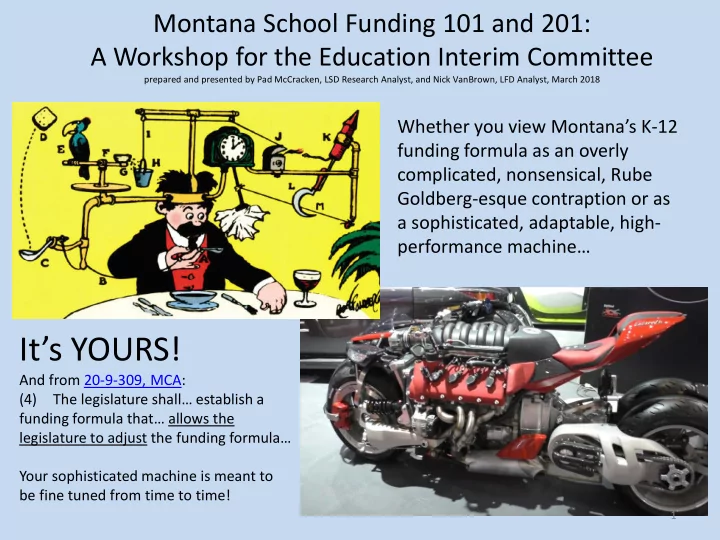
Whether you view Montana’s K-12 funding formula as an overly complicated, nonsensical, Rube Goldberg-esque contraption or as a sophisticated, adaptable, high- performance machine…

It’s YOURS!

And from 20-9-309, MCA: (4) The legislature shall… establish a funding formula that… allows the legislature to adjust the funding formula… Your sophisticated machine is meant to be fine tuned from time to time!

Montana School Funding 101 and 201: A Workshop for the Education Interim Committee

prepared and presented by Pad McCracken, LSD Research Analyst, and Nick VanBrown, LFD Analyst, March 2018

1

slide-2
SLIDE 2

Itinerary:

  • 1. School funding 101—the basics

a) 50,000’ overview b) Review District General Fund formula c) Why did school property taxes go up this year?

  • 2. School funding 201—switches, levers, and dials

a) Equality, Equity, and the Montana Constitution b) Guaranteed Tax Base (GTB) generally, county retirement GTB example c) Direct State Aid (DSA), GTB, and Special Education d) Oil and Natural Gas Production Tax Distribution 2011-2017

Objectives:

  • Refresh your memory of

school funding in Montana

  • Deepen your understanding of

school funding in Montana

  • Cultivate your appreciation

for the sophistication of Montana’s school funding formula(s)

  • Nurture legislative ownership
  • f the school funding formula

2

slide-3
SLIDE 3

Montana K-12 Funding from 50,000’

http://www.arcgis.com/home/webmap/viewer.html?webmap=e7f4bb1ca51948f6819 2cffc35287a9b

Prepared for the School Funding Interim Commission by Pad McCracken, LSD Research Analyst, Sept 2015 Updated for Joint House and Senate Education, Jan 2017 And updated again for the Education Interim Committee, March 2018

3

slide-4
SLIDE 4

Technically we fund school districts, not schools. “[The Montana Legislature] shall fund and distribute in an equitable manner to the school districts the state's share of the cost of the basic elementary and secondary school system.” Montana Constitution, Article X, section 1(3)

http://www.arcgis.com/home/webmap/viewer.html?webmap=e7f4bb1ca 51948f68192cffc35287a9b

399 School Districts 239 Elementary 100 High School 60 K-12

https://gems.opi.mt.gov/StudentCharacteristics/D ashboards/Student%20Characteristics%20Dashboa rd/Student%20Characteristics%20Dashboard.aspx

4

slide-5
SLIDE 5

104,317 41,985

Total Enrollment of 146,302 for the 2016-2017 school year

EL HS

Montana school districts serve about 146,000 students in 818 schools and graduated 9,316 students in 2016.

http://www.arcgis.com/home/webmap/viewer.html?webmap=e7f4 bb1ca51948f68192cffc35287a9b Info from Facts About Montana Education 2017

5

slide-6
SLIDE 6

Enrollment peaked in the mid-1990s, but is growing again as of 2012.

FY19 97 FY19 98 FY19 99 FY20 00 FY20 01 FY20 02 FY20 03 FY20 04 FY20 05 FY20 06 FY20 07 FY20 08 FY20 09 FY20 10 FY20 11 FY20 12 FY20 13 FY20 14 FY20 15 FY20 16 FY20 17 Total 164.4162.2159.8157.4154.7151.8149.8148.2146.6145.3144.3143.3142.0141.7141.6142.2142.8144.0144.4145.9146.8 High School 42.7 43.2 42.9 42.4 42.7 42.3 42.1 41.6 41.7 41.5 41.3 40.5 39.2 38.2 37.7 37.2 36.8 36.9 36.6 37.0 37.2 Elementary 102.4 99.0 97.3 95.2 92.7 90.6 89.3 88.6 87.4 86.6 86.0 86.0 86.4 86.9 87.5 88.7 89.5 90.6 91.4 92.3 92.9 K-12 19.3 19.9 19.6 19.8 19.3 18.8 18.4 17.9 17.5 17.1 17.0 16.7 16.5 16.6 16.3 16.4 16.5 16.6 16.5 16.6 16.7 0.0 20.0 40.0 60.0 80.0 100.0 120.0 140.0 160.0 180.0 Enrollments in Thousands

Montana Student Enrollments K-12 (in thousands) 6

slide-7
SLIDE 7

A district’s finances are accounted for in numerous district-level funds which are funded by varying blends

  • f local, state, federal, and private dollars.

7

slide-8
SLIDE 8

These district funds are either budgeted or non-budgeted. Budgeted funds are funded in whole or in part by local property tax levies which can be either voted, permissive (nonvoted), or required. This pie chart shows the relative size of each of the budgeted funds.

http://opi.mt.gov/pdf/SchoolFinance/Budget/15JanSchoolFundingBasics.pdf

For excellent overviews of district funds, see these two charts from MASBO:

  • Budgeted funds
  • Nonbudgeted funds

8

slide-9
SLIDE 9

Retirement $171 ($40)

Budgeted District Funds in Perspective

(dollar amounts are statewide adopted budgets in millions from OPIBUD18; dollar amounts in red are state support amounts reported in GEMS for 2018 in budgeted funds with a mechanism for state support)

Building Reserve $81 ($0)

District General Fund $1,113 ($740)

Transpo $97 ($14) Tuition $18 Debt Service $98 ($0) Bus Depreciation $56 Technology $34 ($0) Flexibility $51

9

slide-10
SLIDE 10

A school district’s largest fund, for general operations, is called the general fund and is made up only of local and state dollars.

https://gems.opi.mt.gov/SchoolFinance/Pages/GeneralFundRecap.aspx

Nonlevy revenue is mostly oil and natural gas production tax and coal gross

  • proceeds. Prior to 2018, school general fund block grants and the NRD payment

were a large source of nonlevy revenue.

10

slide-11
SLIDE 11

Statewide, the funding blend in ALL school funds has looked like this over the last 20 years

Data from: https://gems.opi.mt.gov/SchoolFinance/Pages/RevenueTrendsRecap.aspx

44% 43% 44% 44% 44% 44% 44% 45% 45% 45% 45% 45% 46% 44% 44% 44% 44% 45% 46% 44% 44% 47% 47% 45% 45% 45% 43% 42% 40% 41% 41% 42% 43% 42% 42% 43% 43% 44% 44% 42% 44% 44% 9% 10% 11% 11% 11% 13% 14% 15% 14% 14% 13% 12% 12% 14% 13% 13% 12% 11% 12% 12% 12%

F Y 1 9 9 7 F Y 1 9 9 8 F Y 1 9 9 9 F Y 2 0 0 0 F Y 2 0 0 1 F Y 2 0 0 2 F Y 2 0 0 3 F Y 2 0 0 4 F Y 2 0 0 5 F Y 2 0 0 6 F Y 2 0 0 7 F Y 2 0 0 8 F Y 2 0 0 9 F Y 2 0 1 0 F Y 2 0 1 1 F Y 2 0 1 2 F Y 2 0 1 3 F Y 2 0 1 4 F Y 2 0 1 5 F Y 2 0 1 6 F Y 2 0 1 7

LOCAL, STATE, AND FEDERAL SHARES

Total Local State* Federal

11

slide-12
SLIDE 12

The state money for K-12 comes from a variety of sources

(Amounts listed are in millions, from FY 17, and heavily rounded to reflect 50,000’ view!)

Guarantee Account

State General Fund

$260

$790 $40 $830

Public School Fund

(aka Common Schools Permanent Trust)

School Trust Lands

Royalties

http://leg.mt.gov/content/Publications/fiscal/other-interim-reports/School-Funding- Presentation-Sept-2012-ELG.pdf (originally by Jim Standaert; modified for this presentation)

$2,140

$1,170 $135 $45 Vehicle $60 $75 $110 Insurance Video Gaming $285

*Up to $56 million/year. Any GA revenue above $56 million goes to new (SB 307, 2017) State Major Maintenance Account for state aid to districts for major maintenance projects. Income Tax Corporate Tax

12

$650 95% to GA; 5% back to Permanent Trust $20 $20 $15

slide-13
SLIDE 13

K-12 funding is a large part of the state’s general fund budget.

13

slide-14
SLIDE 14

Let’s build and fund a district general fund budget!

Building block style and based on ROUNDED 2017 entitlement amounts

prepared by Pad McCracken for the House and Senate Education Committees, January 2017

14

slide-15
SLIDE 15

15

slide-16
SLIDE 16

Let’s pick a hypothetical EL district of 200 ANB in grades K-8; a district similar in size to say: Centerville, Charlo, Blue Creek, or Culbertson.

Five state-funded components

First we need to establish the BASE (minimum) and MAX general fund budget limits. Starting at the bottom of the BASE budget column with the five state-funded components:

  • 1. Data for Achievement (D4A) $20 x 200 ANB =

$4,000

  • 2. Indian Education for All (IEFA) $20 x 200 ANB = $4,000
  • 3. Achievement Gap $210 x 15 Indian students =

$3,150

  • 4. Quality Educator (QE) $3,200 x 18 QEs =

$57,600

  • 5. At-risk $5 million statewide distributed =

$10,000 similarly to Title 1 $ (poverty) Total = $78,750 5 Comps $78,750

16

slide-17
SLIDE 17

5 Comps $78,750 Special Ed $49,000 The Special Education payment is a little complicated, but largely driven by ANB; our hypothetical district belongs to a co-op and receives for its general fund:

  • Instructional Block Grant $150 x 200 ANB =

$30,000

  • Reimbursement for Disproportionate Costs =

$ 5,000 In establishing a BASE budget this $35,000 x 140% = $49,000

Special Education Payment

17

slide-18
SLIDE 18

5 Comps $78,750 Special Ed $49,000

Basic Entitlement

As a K-8 EL district with an accredited middle school program, the district’s Basic Entitlement (BE) is:

  • $50,000 for its EL
  • $100,000 for its MS

The BASE budget is established on 80% of the BE so: 80% x $150,000 = $120,000 Bonus information: The high school basic entitlement is $300,000. Double bonus information: Basic entitlements are for the district, not per school. Triple bonus information: Senate Bill No. 175 (Jones, 2013) created basic entitlement “increments” that increase the basic entitlement when ANB thresholds are reached, providing more budget authority and state and local funding through the basic entitlement component as districts grow in size. Our fairly small hypothetical EL district does not receive a BE increment. Basic Entitlement $120,000

18

slide-19
SLIDE 19

5 Comps $78,750 Special Ed $49,000 Per-ANB Entitlement $928,000 The final block in establishing a district’s BASE budget is the per- ANB entitlement. $5,500 x 160 ANB in grades K-6 = $880,000 $7,000 x 40 ANB in grades 7-8 = +$280,000 $1,160,00 Note—these round number calculations ignore the “decrement” which is a $0.20 decrease per ANB in the entitlement amount up to a stop loss point of 1,000 ANB. In high schools the decrement is $0.50 up to 800 ANB. The BASE budget is established on 80% of the per-ANB so: 80% x $1,160,000 = $928,000 So, adding up these building blocks results in this district’s BASE or minimum general fund budget totaling $1.175 million Basic Entitlement $120,000

BASE budget = $1.175 million

Per-ANB Entitlement

19

slide-20
SLIDE 20

5 Comps $78,750 100% Special Ed $49,000 140%

Per-ANB Entitlement $928,000 80%

Basic Entitlement $120,000 80%

BASE budget = $1.175 million

5 Comps $78,750 100% Special Ed $70,000 200%

Per-ANB Entitlement $1,160,000 100%

Basic Entitlement $150,000 100%

MAX budget = $1.460 million The district’s maximum (MAX) budget is built

  • n the same components or building blocks,

but at different percentages. This creates about a 25% range between a district’s BASE and MAX budget limits. That said, the MAX cap is not a “hard cap”— there are exceptions that allow districts to adopt overMAX general fund budgets.

20

The MAX general fund budget limit

slide-21
SLIDE 21

5 Comps $78,750 100% Special Ed $49,000 140%

Per-ANB Entitlement $928,000 80%

Basic Entitlement $120,000 80%

BASE budget = $1.175 million

OK, we’ve established the BASE and MAX budget limits, now let’s walk through how the district’s adopted GF budget is funded.

5 Comps $78,750 100%

Special Ed $35,000 100%

  • 5. The GTB* Area is first filled with a

district’s fund balance reappropriated (FBR) and then available nonlevy revenues such as

  • il and gas and coal. This

hypothetical district has “average” access to these types of revenues— say $50,000

Direct State Aid (DSA) for 44.7%

  • f the Basic and per-ANB

entitlements 44.7% x $150,000 = $67,050 44.7% x $1,160,000 = $518,520 Total DSA = $585,570

  • 1. These 5 components are 100% state

funded—easy!

  • 2. The state provides 100% of the special

ed allowable cost payment; because the BASE budget is built on 140%, this ensures a local match. 4. The total of the 5 state-funded components, sp ed, and DSA leave a portion of the district’s BASE budget unfilled. The unfilled area is called the GTB* Area and it equals 35.3% of the BE and per-ANB entitlements plus 40% of the special ed allowable payment.

  • 6. The remaining $425,000 in the BASE

budget needs to be funded by local property taxes, and if the district qualifies, a GTB per mill subsidy from the state. This district qualifies and the state provides $175,000 in GTB Aid while the district levies for the remaining $250,000. FBR and other Nonlevy $50,000 * GTB stands for Guaranteed Tax Base. It’s a mechanism that subsidizes districts with lower property value compared to their funding need. MT’s GTB formula ensures a revenue-generating capacity in the BASE budget of almost twice the statewide average (193%) which means that about 320 out of 400 districts are eligible for GTB. This “multiplier” of 193% is ratcheting up over the next few years to 232% in FY 2021.

  • 7. This district has adopted an overBASE

budget that is under the MAX cap. The district funds this portion of the budget with a bit of tuition money it receives for educating out-of-district students, but mostly through a voted levy approved by voters. Local property taxes $250,000 GTB Aid $175,000 OverBASE budget area Local Property taxes $115,000 Tuition payments $10,000 Adopted budget = $1.3 million GTB Area

  • 3. The state provides 44.7% of the

district’s total per-ANB and basic

  • entitlements. This is called Direct State

Aid (DSA).

21

slide-22
SLIDE 22

$70 million including:

  • $54 million in block grants
  • $8 million in NRD payment

GTB Aid $163 million Local Prop Tax $134 million

The elimination of block grants and the NRD payment in 2018 decreases nonlevy revenue significantly and results in increases in both GTB and local property taxes (BASE mills).

Nonlevy revenue

GTB Aid will increase to about $195 million Local Prop Tax will increase to about $166 million

But as the state funding that previously went to districts as block grants is redistributed by increasing the GTB multiplier over the next few years, GTB aid will increase and local property taxes (BASE mills) will generally decrease. More districts will be eligible for more GTB aid. However, some wealthy districts will still not be eligible for GTB aid and will pay more in BASE taxes than before. This is the result of distributing more state aid through equalizing GTB aid.

Nonlevy revenue GTB Aid: 2019 - $216 2020 - $224 2021 - $234 Local Prop Tax: 2019 - $153 2020 - $149 2021 - $148

2017 (GTB 193%) 2018 (GTB 193%) 2019 (GTB 216%) 2020 (GTB 224%), 2021… (GTB 232%)

The share of GTB and local taxes varies from district to district based on local property tax wealth. Wealthier districts receive less or no GTB Aid; poorer districts receive more.

Nonlevy revenue

(in $ millions)

Data as per model 05-02-17K-12ModelMaster Note—statewide local taxes are not expected to return to 2017 level due to projected ANB increases and inflationary adjustments to entitlement amounts

Why did my school property taxes go up this year? Changes in property taxes depend on MANY factors, including changes in individual property valuation relative to total property valuation within a taxing jurisdiction. One factor that impacted taxes in every school district was the elimination of the general fund block grants and the Natural Resource Development (NRD) payment by the 2017 Legislature.

GTB Area

22

slide-23
SLIDE 23

Equity means the quality of being fair and impartial; justness. The picture below is often used to help illustrate the differences between “equity and equality.” It gets at the distinction between an equal allocation of resources and an equitable allocation of resources. It also reinforces that allocating resources equitably is about allocations based on NEED.

23

slide-24
SLIDE 24

THE CONSTITUTION OF THE STATE OF MONTANA ARTICLE X. EDUCATION AND PUBLIC LANDS Section 1. Educational goals and duties. (1) It is the goal of the people to establish a system of education which will develop the full educational potential of each person. Equality of educational opportunity is guaranteed to each person of the state. (2) The state recognizes the distinct and unique cultural heritage of the American Indians and is committed in its educational goals to the preservation of their cultural integrity. (3) The legislature shall provide a basic system of free quality public elementary and secondary schools. The legislature may provide such other educational institutions, public libraries, and educational programs as it deems desirable. It shall fund and distribute in an equitable manner to the school districts the state's share of the cost of the basic elementary and secondary school system. Section 8. School district trustees. The supervision and control of schools in each school district shall be vested in a board of trustees to be elected as provided by law. Is this an accurate paraphrase of the bolded language? The legislature needs to allocate a reasonable amount of the total cost of the K-12 system fairly to each district so that locally elected boards of trustees have the ability to offer educational programs so that every student across the state has the same chance to maximize the student’s individual potential.

24

slide-25
SLIDE 25

25

slide-26
SLIDE 26

Each of Montana’s 400 school districts is unique. Some require more state resources than others based on size. Some of equal size require more state resources based

  • n student needs and/or the

availability of local resources.

26

slide-27
SLIDE 27

In relation to school funding, it might be nice to think about two types of need that go into equitably distributing resources:

  • 1. The first is based on costs of providing education. Districts that have more

kids have higher costs. Districts with more kids with special needs have higher

  • costs. Districts might have higher costs due to geography and demographics.

These are all examples of “educationally relevant factors” (20-9-309, MCA).

  • 2. The second is based on resources. Because we raise local revenue for schools

largely through property taxes, and because some districts have greater taxable valuations (property wealth) relative to their educational costs than

  • thers, some districts have greater access to resources than others.

In striving for an equitable distribution of the state’s share of the costs of Montana’s K-12 system, we need to consider both of these types of need. And we do to some degree. In our formula, districts with higher costs have larger BASE (and MAX) general fund budgets, and districts with fewer resources receive a larger proportion of state aid for their BASE budgets through GTB or guaranteed tax base aid…

27

slide-28
SLIDE 28

GTB Basics

28

slide-29
SLIDE 29

GTB is often set higher than the average revenue-generating capacity by using a

  • multiplier. In Montana, BASE GTB is

193% of the statewide average (but increasing over the next few years to 232%), county retirement GTB is 121%, and debt service GTB is 140%. These multipliers are one of many fine-tuning dials within our formula(s). These two charts display the effects of adjusting the GTB multiplier. When the GTB is lowered as shown above, fewer districts are eligible for less aid. The number of advantaged districts is increased along with their degree of

  • advantage. Equity is diminished.

When the GTB is raised as shown to the right, more districts receive more GTB aid. State costs are higher, but the field is more level and equity is increased.

29

slide-30
SLIDE 30

A Short Field Trip into the GTB Weeds (or, Why Denominators Matter)

How do we measure a district’s revenue generating capacity? It’s not simply the district’s mill value. If it was, Billings HS would be Montana’s “wealthiest” school district. We need to evaluate the district’s revenue capacity (MV) compared to its funding need. Typically GTB formulas use enrollment (what we call ANB) as a measure of funding need to establish a ratio of: revenue-generating capacity

  • r MV

funding need ANB When a district’s numerator (MV) shrinks or the denominator (ANB) grows, the ratio and the district’s revenue generating capacity decreases. We might refer to this as a “poorer” district. But sometimes a different proxy for funding need is used in the denominator. For example in Montana, BASE GTB is calculated based on: MV GTB Area Where the GTB Area is that part of a district’s BASE budget that is NOT funded by the five components, the special education payment, and direct state aid. In this sense, the GTB Area is not a proxy for funding need, it is the district’s funding need.

Remember—the mill value in any taxing jurisdiction is simply the district’s taxable valuation divided by 1000

30

slide-31
SLIDE 31

Smaller districts generally have lower student (ANB) to teacher (QE) ratios, maybe 5:1 to 10:1. Larger districts can often maintain ratios closer to 15:1. This means that smaller districts generally have more QE (and likely higher retirement costs) relative to ANB. Considering concerns about recruitment and retention and teacher salaries, especially in isolated rural districts, the committee may want to examine the impacts of “flipping the switch” in this mechanism from ANB to QE or to actual retirement costs, if possible. County Retirement GTB Because school retirement costs are pooled and paid for at the county level, the state provides GTB support for counties with lower revenue capacity (mill value) compared to funding need. For county retirement GTB, we measure a county’s funding need by ANB, which is an imperfect proxy for retirement costs.

31

slide-32
SLIDE 32

32

Half of Montana counties do not receive state GTB aid for school retirement. (Blue-shaded counties receive retirement GTB; unshaded counties do not.)

slide-33
SLIDE 33

5 Comps $78,750 100% Special Ed $49,000 $35,000 x 140%

Per-ANB Entitlement $928,000 80%

Basic Entitlement $120,000 80%

BASE budget = $1.175 million Over the past two interims, funding for special education has been a priority topic. A number of proposals have been made to increase the state special education payment, currently about $43 million/year. Let’s take a look at the impacts of increasing the payment, using familiar slides from earlier. Remember, this is a hypothetical EL district of about 200 ANB.

5 Comps $78,750 100%

Special Ed $35,000 $50,000 100%

Direct State Aid (DSA) for 44.7%

  • f the Basic and per-ANB

entitlements 44.7% x $150,000 = $67,050 44.7% x $1,160,000 = $518,520 Total DSA = $585,570

FBR and other Nonlevy $50,000 Local property taxes $250,000 $254,000 GTB Aid $175,000 $177,000 OverBASE budget area Local Property taxes $115,000 Tuition payments $10,000 GTB Area 5 Comps $78,750 100% Special Ed $70,000 $50,000 x 140%

Per-ANB Entitlement $928,000 80%

Basic Entitlement $120,000 80%

BASE budget = $1.196 million

1. Increasing the state sp ed payment, increased this district’s sp ed payment by $15,000, from $35,000 to $50,000, but the 140% calculation means this impacts the BASE budget by $21,000, not just $15,000. 2. This district’s sp ed payment increased from $35,000 to $50,000. While this does not increase DSA, increasing sp ed payment moves both lines higher. 3. But remember, this change increased the BASE by $21,000, not just $15,000, so both local taxes and GTB aid go up a bit too.

Takeaway—increasing the special education payment increases funding for special education without forcing greater competition between regular and special education expenditures; it increases local taxes and GTB as well

33
slide-34
SLIDE 34

Is there a way to increase special education funding (or create a component for ELs, or fund the teacher loan forgiveness program, etc.) without decreasing school budgets AND without increasing state education funding? Yes, there are likely a number of ways, but remember: The Law of Conservation of School Dollars: Any School Dollar Created comes from Somewhere. Let’s look briefly at the “DSA Dial” within your formula

5 Comps 100%

Special Ed Payment 100%

FBR and other Nonlevy State GTB Aid OverBASE budget area Local Property taxes Tuition payments

Reducing the DSA % reduces the amount

  • f state funding

required. This would not lower BASE budgets, it would increase the amount of local property tax and GTB aid to fill a larger GTB area.

5 Comps 100%

Special Ed 100%

Direct State Aid (DSA) for 44.7% of the Basic and per- ANB entitlements

FBR and other Nonlevy Local prop tax State GTB Aid OverBASE budget area Local Property taxes Tuition payments GTB Area 5 Comps 100%

Special Ed 100%

Direct State Aid (DSA) for 40% of the Basic and per-ANB entitlements

FBR and other Nonlevy State GTB Aid OverBASE budget area Local Property taxes Tuition payments GTB Area

Direct State Aid (DSA) for XX% of the Basic and per-ANB entitlements

Increasing special education and reducing the DSA % could be done in a way to hold state the state funding requirement steady, but the sum total of any increase would come from local taxes.

GTB Area Local prop tax Local prop tax

34

slide-35
SLIDE 35

1st cap/excess 2017 GA GA 2017 1.1 CC CC CC Rule 70-5-25

35

slide-36
SLIDE 36

How to learn more:

  • Ask your Legislative staff: Laura, Pad, Nick Van

Brown in LFD

  • Talk to your school district business officer or

superintendent

  • Talk to OPI school finance folks and education

stakeholders

  • Lots on the School Funding Interim

Commission webpages

  • GEMS

36