SLIDE 1
‘The musician as creative entrepreneur’ – Royal Conservatoire The Hague Presentation Susanne van Els – 19 September 2014
Susanne van Els Head of Classical Music, Royal Conservatoire The Hague www.koncon.nl Susanne van Els was one of the leading musicians in The Netherlands. She was awarded the Alcuinus Prize of the City of Nijmegen in 1998, for her outstanding merits as a performing artist. Amongst others she was a member of String Trio Holland, Ives Ensemble, Sinfonietta Amsterdam and Schönberg Ensemble. A multitude of composers, including Louis Andriessen, have written solo pieces and concerts for her. A series of remarkable solo CDs was released internationally. Van Els played the Dutch premiere of Ligeti’s solo viola sonata, which she recorded on a Capella Amsterdam CD for harmonia mundi – it was awarded the Deutscher Schalplattenpreis and the Diapason d’Or d’annee. www.susannevanels.com Welcome to the Royal Conservatoire The Hague. I am Susanne van Els, Head of the Classical Music Department. This is classical instrumental, no voice, no composition: 19 instruments (all orchestra instruments including bass trombone, plus piano, guitar, accordion). One of my tasks, next to everything to do with teachers, students and money, is to make sure the curriculum is performed in the best possible way, and to keep the curriculum up to date. This places me in the centre of this ongoing discussion between students (what do they want, do they know what they want?), staff (we know what students need, but do we know what students want and is our knowledge about what they need not based on our own notions from when we were students?), and government. And government says: entrepreneurship.
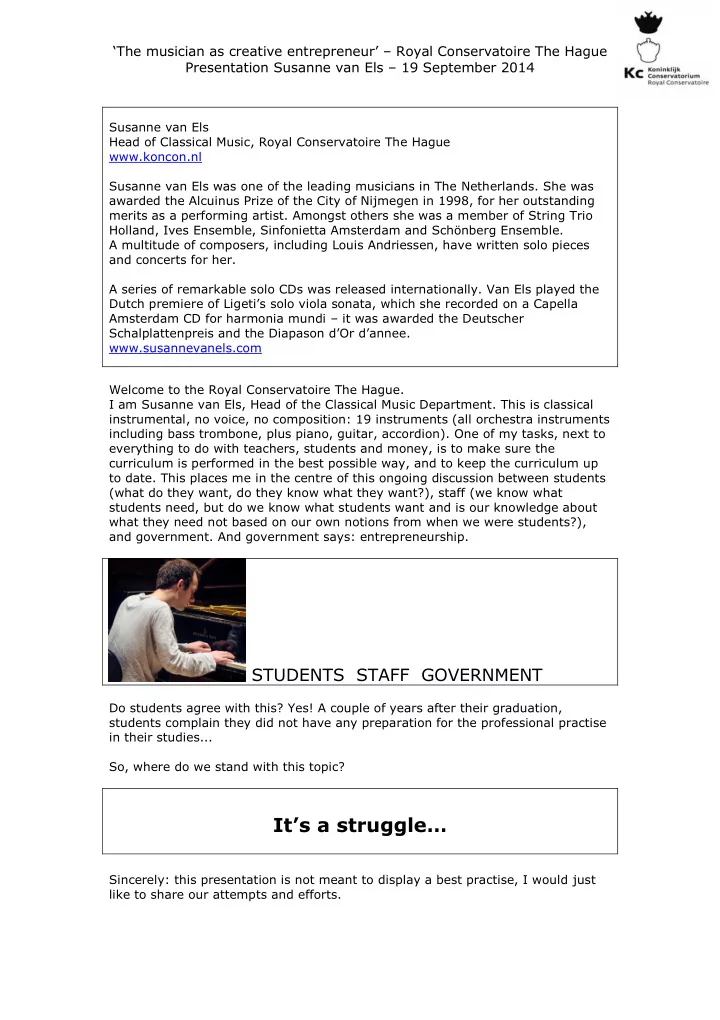
STUDENTS STAFF GOVERNMENT
Do students agree with this? Yes! A couple of years after their graduation, students complain they did not have any preparation for the professional practise in their studies... So, where do we stand with this topic?
It’s a struggle…
Sincerely: this presentation is not meant to display a best practise, I would just like to share our attempts and efforts.
SLIDE 2 ‘The musician as creative entrepreneur’ – Royal Conservatoire The Hague Presentation Susanne van Els – 19 September 2014
SCORE ------ AUDIENCE
A classical musician is responsible for the whole terrain between score and
- audience. We need to be dedicated to the score, we should do anything to be
able to understand and perform music. Of course, our core business is to play the right notes in the right way, with craftsmanship and artistry, but an instrument is an instrument: our task is to bring good music and to find and develop an audience for it. One of the lovely things of being a classical musician is that you can be in contact with both composers and audience, and that you are the one to think of the best ways to bring them together. Every musician needs to think about his audience, could at moments even start with thinking about the audience first! A concert cannot do without an audience, wherever you place or find an audience music can
- be. Informed musicians become better performers when they can communicate,
about their music, with an audience, not just by playing but also by organizing, programming, talking, writing, advertising their love for music in any way. I show you my first solo cd, one of a series of five, and it would have been a completely different thing when I would not have started acting as an artistic producer while this was made: the label was very nice towards me as a young creative musician, and they had good contacts with the press and great international distribution, but there was no one there who could really connect with my urge to reach an audience. The photo would maybe have had something to do with the title 'waterworks', but it might at best have been a painting with some water. There would not have been an extra DVD with short movies to go with the piece Louis Andriessen wrote for me which live had a theatrical element. And the texts for sure would not have been interviews in which all the 'makers', either composers or film makers, would say something about the other works on the cd, including those of the dead composers. But the label responded to my drive and enthusiasm, and I found myself organising, communicating about my music with a photographer, looking for a designer, fundraising.
SLIDE 3 ‘The musician as creative entrepreneur’ – Royal Conservatoire The Hague Presentation Susanne van Els – 19 September 2014
I learnt the hard skills the working group mentions, and let's be honest: bookkeeping isn't that hard, not at all as difficult as playing the violin or having an artistic idea.... and to me the essence of this personal story is that I became a better musician, better in communication, more expressive and stronger. All right, back to daily life at the conservatoire! It is clear we are very convinced
- f the important task we have to teach our students to be entrepreneurial, but
are we going to put this kind of activity in (yet another) subject? At the Royal Conservatoire, we have just made an enormous effort to reunite all the separate music theory subjects together and bring in more aural training using the instrument, more improvisation, more piano skills, all of this to make the connection with the main subject more evident. We know that classical music students do not simply suffer from teachers telling them to make more practising hours, they themselves just want to play. Quality Assurance results show that while studying, students reply 'yes' when we ask whether a curriculum subject prepares them for professional life, but when they have graduated they say we did nót properly prepare them for it.
no student wants to study the subject entrepreneurship
SLIDE 4 ‘The musician as creative entrepreneur’ – Royal Conservatoire The Hague Presentation Susanne van Els – 19 September 2014
We had a course which gave a lot of information about the hard skills of entrepreneurship and starting a business but for the majority of our students it was useless because it was all information for the Dutch situation.
and we cannot teach it
A separate subject might not be the solution. So, when we look at the curriculum, what could we point out as contributing to
- ur students’ entrepreneurship? It makes sense to come up with our co-
- perations with professionals: students performing side by side with the A|S
ensemble, or the Orchestra Master we run with the The Hague Philharmonic. I am very happy, because last week one of our Master II students who is in this Orchestra Master programme won the audition for a job with the violas, and earlier one of our violin students entered the orchestra as first violin. We are talking about serious professional chances and career development, but I would say this is employability, not pure entrepreneurship.
EMPLOYABILITY ------ ENTREPRENEURSHIP??
The specific education in this fantastic program is actually a kind of copy- education in which students learn to act exactly the way professionals do. The most entrepreneurial element in the Orchestra Master is that the feedback form, that students receive after every project they have participated in as a regular member of the The Hague Philharmonic, also contains a part for the orchestra manager who can comment on whether the student answered his phone, was in time, behaved and shaved... We organized a seminar, together with the The Hague Philharmonic and the National Youth Orchestra: a couple of weeks ago students, alumni and professionals formed an orchestra and worked with Benjamin Zander on Beethoven and Brahms. They stayed together at the venue, discussed stuff at the bar and over breakfast, did masterclasses amongst themselves and played public performances - a great project. My great production leader was an enthusiastic part of the seminar and she called me, shocked: the professional musicians did not take care of their sheet music, something she is so keen on getting our students do well! And of course it is a normal thing in a professional orchestra that the orchestra librarian puts the
SLIDE 5 ‘The musician as creative entrepreneur’ – Royal Conservatoire The Hague Presentation Susanne van Els – 19 September 2014
notes on the stand, and I don't want to deride these lovely musicians; they were raised and treated this way always, but them narrowing their profession to reproducing the notes placed before them by someone else (not just the librarian but also the conductor/orchestra manager/halls who decide on what is to be played when and where) makes me think there might be a relation between that attitude and the gap between orchestras and their audience. So, what do others in the working field say? Impresarios told us that our graduates are fine musicians, but that they could not write a letter or a CV, that they did not provide good publication material. So now, after students will have worked with their tutor on their portfolio in the first 3 Bachelor years, focusing on reflection, in Bachelor IV this work continues by making a CV, delivering a good photo and writing a project proposal, all of which is being coached and assessed (Preparation to the Professional Practise, 3 EC). Festival Classique, a great The Hague festival in summer, which programs combining arts and disciplines in unusual places in town, offers an opportunity to young ensembles: they invite them to live in one house together, for 10 days, working on a cross-discipline program for the festival, meanwhile being trained, also receiving information and training from businessmen and commercial
- professionals. The people from Festival Classique mention students can talk about
music and about what they play or want to play, but the search for a Unique Selling Point starts from zero.
WHO ARE YOU WHERE ARE YOU WHAT DO YOU DO
So what we need to do is train our students so that they will have an entrepreneurial attitude: collaboration and communication skills, being active, making choices, getting stuff done. Within the curriculum we have this PPP which I mentioned. Our CDO (Career Development Office) is quite nice too: students need to collect 6 EC in Bachelor IV and 10 in every Master year with activities outside
SLIDE 6 ‘The musician as creative entrepreneur’ – Royal Conservatoire The Hague Presentation Susanne van Els – 19 September 2014
the conservatoire. They bring a description and some proof along with a self- evaluation form to receive the credit. In the classical department we make sure the activities are not too close to the main subject ("I did a competition and practised a thousand hours!"): building a website or organizing concerts is worth more credit than playing a lunch concert or doing a masterclass in a summer course. the elective 'concert production', taught by this great production leader of my department, is very practical: students 'help Else'. They learn to make rehearsal schedules, to write clear mails and that every artistic wish or idea leads to practical production activity. For the department this elective functions as having a nurse in the house: once students have been called from their sleep when they are late for orchestra by fellow students they will never be late again (and for sure the ones who did the phone calls will neither!). with final exams we ask students to take care of a good program booklet, or
- ther presentation of the program. The program itself and these 'program
notes' are being assessed, each contributes for 5% to the final grade. When we say 'attitude' this means 'general' and 'always'. And when looking for
- pportunities, for space between the lines, for moments outside the teaching
situation we find there are plenty!:
- rchestral and other projects rules (professional behaviour ánd being much
more active, with more responsibilities and student tasks) teachers who inform us on which student needs to be exempted from which project receive the answer that we look forward to the exemption form filled in by the student, with good motivation students are invited to contribute to the department and their study, but when they pop up with sole wishes to be fulfilled we point out what they can do themselves students who ask for a letter of support write one themselves first after which I either correct it or send them my text make students responsible for stage presentation of Royal Conservatoire concerts and productions they are in make students responsible for Facebook publicity for these concerts actually in every contact with students AND teachers it is possible to emphasize the entrepreneurial attitude we strive for...
SLIDE 7 ‘The musician as creative entrepreneur’ – Royal Conservatoire The Hague Presentation Susanne van Els – 19 September 2014
I found, while reading the report of the Polifonia working group, that every effort that we do to make our students adopt an entrepreneurial attitude is beneficial to
- ur department as well. Lately we have developed new assessment criteria, and
we have performed some feedback and assessment pilots which will lead to changes in how we perform feedback after exams and how we try to make students and teachers understand the continuous process of learning - keywords in these new elements are peer-to-peer feedback, transparency, active role of the student, student ownership of exam and feedback/assessment situations. We invite students to feel ownership for their studies - another example: I have started a small soundboard group of students which discusses Quality Assurance
- utcomes of enquiries with me - and this involves and requires the
entrepreneurial mind-set mentioned by the working group. This leads to the following conclusion:
We should bring young musicians to the professional practise who have an entrepreneurial attitude which will make them more successful in making a living and which will keep them healthy and happy
…and we want students with an entrepreneurial attitude in
SLIDE 8 ‘The musician as creative entrepreneur’ – Royal Conservatoire The Hague Presentation Susanne van Els – 19 September 2014
Summary of audience discussion After this short presentation, we discussed the following questions:
- 1. Should / could we teach entrepreneurship in a separate subject?
- 2. Do we (staff / teachers) have an entrepreneurial attitude (towards our
students)?
- ne member of our group teaches a subject entrepreneurship, with good
- results. Keywords: mixed groups (especially a combination with pop music
students), practical work. It is a Master course (so students are a bit older) and phases are: attitude - communication - dream - project and project management - practical assignment
- thers in the group promote the idea of creating entrepreneurial attitude with
- ur students by incorporating entrepreneurship throughout the curriculum and
by being alert in other contact moments with our students Other contributions:
- wnership: 'do things yourself'
'changes in attitude require long lines within an organization' 'learn as we do, and learn together' many examples were given of entrepreneurial initiatives on the artistic side which lead to new practises students (from the boot camp) talked about the idea of the portfolio career which is new and attractive to them audience!!! we need to include thinking about audience with everything we do as a (classical) musician Susanne van Els, September 2014