SLIDE 5 MARK BITTMAN
Neuforkhnui
NEWYORK, WEDNESDAY, AUGUST24, 2011
Food’s New
Foot Soidlers
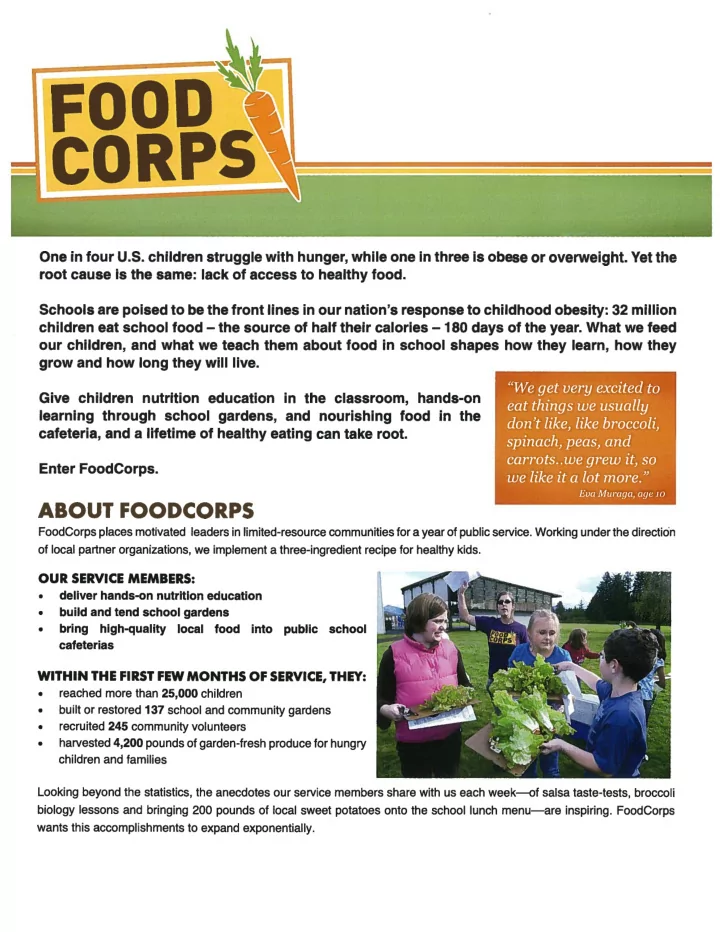
FoodCorps, which started last week, is symbolic of just what we need: a na tional service program that aims to im prove nutrition education for children, develop school gardening projects and change what’s being served on school lunch trays. I’ve been looking forward to this for months, because it’s such an up: 50 new foot soldiers in the war against igno rance in food. The service members, most of them in their 20s, just went to work at 41 sites in 10 states, from Maine to Oregon and Michigan to Mississippi. (FoodCorps concentrates on communi ties with high rates of childhood obesity
- r limited access to healthy food, though
these days every state has communities
like that.) I’d be even more elated if there were
50 FoodCorps members in each state. Or 5,000 in each, which approaches the
number we’re going to need to educate
- ur kids so they can look forward to a
lifetime of good health and good eating. But FoodCorps is a model we can use to build upon. Curt Ellis, co-creator of the movie, “King Corn,” is running the show with Debra Eschmeyer, formerly of the Na tional Farm to School Network, and Cec ily Upton, formerly of Slow Food USA. FoodCorps is part of the AmeriCorps, from which it receives about a third of its
- budget. Most of the money comes from
sources like the W.K. Kellogg Founda tion and individual donors. Is FoodCorps necessary? The organ izations that are fighting childhood obes ity on the front lines seem to think so:
108 groups from 39 states and the Dis
trict of Columbia applied to host Food- Corps, which chose to work at locations that had already begun
to improve school food and needed help in expand ing their work. Potential participants were turned away at a crazy rate: More than 1,230 people applied for 50 positions. (It’s easi er to get into Harvard.) Nor is this a pro gram for the college grad who wants to do some soul-searching by playing in a garden for a year. “Many service mem bers,” says Ellis, “have firsthand experi ence with the communities they’re serv
Getting kids smarter about good eating.
- ing. Some are going back to the towns
they grew up in; others were raised on
food stamps or overcame obesity. They
understand these challenges from the in
side.”
They’re also smart, well informed, and articulate; Ellis told me there wasn’t a day last week that he didn’t tear up from something that one of them said. (I’m going to post some of their initial sets of beliefs and, I hope,
- ngoing reports from the field on my
blog: nytimes.com/bittman.) FoodCorps members will be paid
$15,000 for the year. On this they must
find places to live and pay for food, though those without other sources of in come are being encouraged to apply for help from the Supplemental Nutrition As sistance Program (usually called SNAP, and formerly known as food stamps), so they’ll live like many of those they’re
- serving. (Those eligible will also receive
a $5,550 federal education award to apply to their student loans when they finish.)
How, I asked Ellis, will we know if FoodCorps is successful? “This year we
expect about 60,000 kids to benefit from improved food education,” he says. (This
will be sadly easy to achieve: currently,
elementary-age kids typically get less than five hours of nutrition education an nually.) “Gardens will be begun or forti fied to try to get kids more excited about fruits and vegetables; fresh food will be sourced from local farms; and parents and community members will be more invested in school food.” FoodCorps will cost less than $2 mil lion for the first year. Thus for less than a million bucks of our money we are get ting a program that will start to roll back the $147 billion it costs us each year to deal with the health consequences
- f
- besity, while changing the way thou
sands of young people grow up thinking about food. Not to burst any bubbles, but let’s note that this in no way levels the playing
- field. That $2 million invested in Food-
Corps
— well conceived, raised with the
best possible nonprofit intentions, and ul timately well spent (a bargain!)
— was
starkly contrasted last week with the $30 million that a new group of corporate farmers and ranchers intend to spend to promote the idea that they’re “commit ted to providing healthy choices.” As any
- ne who’s followed the news in recent
years knows, agribusiness has done pret ty much the opposite, relying on direct federal subsidies (also our money) to the tune of at least $5 billion annually to produce precisely the kind of junk food that is largely responsible for the tripling
- f childhood obesity in the last 30 years.
Here’s the problem: raising $30 million for a corporate public relations campaign to defend the rights of Big Food to contin ue to produce junk is easy; raising $2 mil lion to promote healthy eating in our chil dren is hard. Ellis says that his dream is to have 1,000 service members a year working in all 50 states by 2020. I say let’s have 10,000 by 2015. But let’s end on a happy note: Food Corps is up and running. Hallelujah!
E1