SLIDE 1
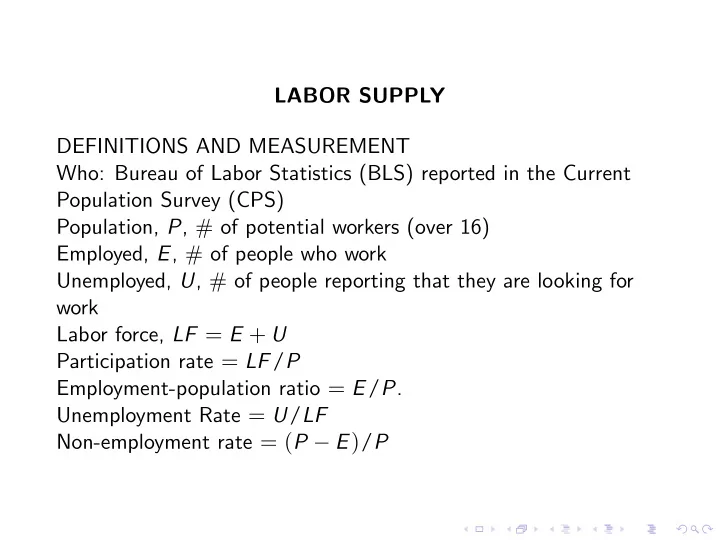
LABOR SUPPLY DEFINITIONS AND MEASUREMENT Who: Bureau of Labor Statistics (BLS) reported in the Current Population Survey (CPS) Population, P, # of potential workers (over 16) Employed, E, # of people who work Unemployed, U, # of people reporting that they are looking for work Labor force, LF = E + U Participation rate = LF/P Employment-population ratio = E/P. Unemployment Rate = U/LF Non-employment rate = (P E)/P
SLIDE 2
ISSUES:
I Finding the right measure of labor market activity
SLIDE 3
ISSUES:
I Finding the right measure of labor market activity I International comparisons
SLIDE 4
ISSUES:
I Finding the right measure of labor market activity I International comparisons I Discouraged workers (the hidden unemployed)
SLIDE 5
BASIC FACTS Caveat: these are realized (equilibrium) values of labor supply Labor force participation rates over recent history by
I age and gender
SLIDE 6
BASIC FACTS Caveat: these are realized (equilibrium) values of labor supply Labor force participation rates over recent history by
I age and gender I by education levels
SLIDE 7
BASIC (STATIC) MODEL OF LABOR SUPPLY
I One person (or household)
SLIDE 8
BASIC (STATIC) MODEL OF LABOR SUPPLY
I One person (or household) I preferences over consumption, C ($) leisure, L (hours)
SLIDE 9
BASIC (STATIC) MODEL OF LABOR SUPPLY
I One person (or household) I preferences over consumption, C ($) leisure, L (hours) I utility function representation: U = f (C, L)
SLIDE 10
BASIC (STATIC) MODEL OF LABOR SUPPLY
I One person (or household) I preferences over consumption, C ($) leisure, L (hours) I utility function representation: U = f (C, L) I U increases with both C and L
SLIDE 11
BASIC (STATIC) MODEL OF LABOR SUPPLY
I One person (or household) I preferences over consumption, C ($) leisure, L (hours) I utility function representation: U = f (C, L) I U increases with both C and L I a combination of C and L is preferred to C or L alone
SLIDE 12 Indi¤erence Curve Representation of preferences De…nition: graphical representation of schedule of values of C and L which give the person the same level of utility Previous assumptions imply:
- 1. Indi¤erence curves slope downward
SLIDE 13 Indi¤erence Curve Representation of preferences De…nition: graphical representation of schedule of values of C and L which give the person the same level of utility Previous assumptions imply:
- 1. Indi¤erence curves slope downward
- 2. Curves further form the origin represent higher levels of utility
SLIDE 14 Indi¤erence Curve Representation of preferences De…nition: graphical representation of schedule of values of C and L which give the person the same level of utility Previous assumptions imply:
- 1. Indi¤erence curves slope downward
- 2. Curves further form the origin represent higher levels of utility
- 3. Indi¤erence curves do not cross
SLIDE 15 Indi¤erence Curve Representation of preferences De…nition: graphical representation of schedule of values of C and L which give the person the same level of utility Previous assumptions imply:
- 1. Indi¤erence curves slope downward
- 2. Curves further form the origin represent higher levels of utility
- 3. Indi¤erence curves do not cross
- 4. They are convex to the origin
SLIDE 16 What the slope of an indi¤erence curve means: How much consumption am I prepared to give up for another hour’s leisure? (aka marginal rate of substitution) Representing di¤ering tastes; di¤erent slopes Upshot: It is not how much you like leisure or consumption per se that matters but how much more consumption you need to be
- ¤ered in order to give up one hour of leisure
SLIDE 17
The budget constraint: C = wh + V h is hours spent working w is the hourly wage V is other income you get whether working or not. (what about saving?) To represent this equation on the same graph as preferences we need leisure, L. L = T h T is the amount of non-sleeping time in a particular time-interval So, C = wT + V wL (opportunity set)
SLIDE 18
Individual optimization: how many hours should I work?
I Individual seeks to maximize utility but is constrained by hours
SLIDE 19
Individual optimization: how many hours should I work?
I Individual seeks to maximize utility but is constrained by hours I Interior solution and the ‘tangency’ condition
SLIDE 20
Individual optimization: how many hours should I work?
I Individual seeks to maximize utility but is constrained by hours I Interior solution and the ‘tangency’ condition I Corner solutions (retirement, Goldman Sachs)
SLIDE 21
Individual optimization: how many hours should I work?
I Individual seeks to maximize utility but is constrained by hours I Interior solution and the ‘tangency’ condition I Corner solutions (retirement, Goldman Sachs) I (Worked Example)
SLIDE 22
Comparative statics in the labor supply model
I The income e¤ect
SLIDE 23
Comparative statics in the labor supply model
I The income e¤ect I (the income e¤ect is assumed to be positive - leisure is normal
good)
SLIDE 24
Comparative statics in the labor supply model
I The income e¤ect I (the income e¤ect is assumed to be positive - leisure is normal
good)
I The substitution e¤ect
SLIDE 25
Comparative statics in the labor supply model
I The income e¤ect I (the income e¤ect is assumed to be positive - leisure is normal
good)
I The substitution e¤ect I Change in nonlabor income: a pure income e¤ect
SLIDE 26
Comparative statics in the labor supply model
I The income e¤ect I (the income e¤ect is assumed to be positive - leisure is normal
good)
I The substitution e¤ect I Change in nonlabor income: a pure income e¤ect I Change of wage rate: both income and sub. e¤ects
SLIDE 27
I The reservation wage
SLIDE 28
I The reservation wage
I De…nition: the Reservation wage is that which makes it just
worthwhile to work the …rst hour
SLIDE 29
I The reservation wage
I De…nition: the Reservation wage is that which makes it just
worthwhile to work the …rst hour
I What is the e¤ect of an increase in the wage at the reservation
wage?
SLIDE 30
I The reservation wage
I De…nition: the Reservation wage is that which makes it just
worthwhile to work the …rst hour
I What is the e¤ect of an increase in the wage at the reservation
wage?
I The individual labor supply curve
SLIDE 31
I The reservation wage
I De…nition: the Reservation wage is that which makes it just
worthwhile to work the …rst hour
I What is the e¤ect of an increase in the wage at the reservation
wage?
I The individual labor supply curve
I Changes in the wage rate trace out the individual labor supply
curve
SLIDE 32
I The reservation wage
I De…nition: the Reservation wage is that which makes it just
worthwhile to work the …rst hour
I What is the e¤ect of an increase in the wage at the reservation
wage?
I The individual labor supply curve
I Changes in the wage rate trace out the individual labor supply
curve
I When is the income e¤ect likely to dominate?
SLIDE 33
I The reservation wage
I De…nition: the Reservation wage is that which makes it just
worthwhile to work the …rst hour
I What is the e¤ect of an increase in the wage at the reservation
wage?
I The individual labor supply curve
I Changes in the wage rate trace out the individual labor supply
curve
I When is the income e¤ect likely to dominate?
I The market labor supply curve
SLIDE 34
I The reservation wage
I De…nition: the Reservation wage is that which makes it just
worthwhile to work the …rst hour
I What is the e¤ect of an increase in the wage at the reservation
wage?
I The individual labor supply curve
I Changes in the wage rate trace out the individual labor supply
curve
I When is the income e¤ect likely to dominate?
I The market labor supply curve
I To get Market labor supply curve add everyone’s individual
labour supply curves horizontally.
SLIDE 35
MEASURING THE RESPONSIVENESS OF LABOR SUPPLY TO CHANGES ON THE WAGE RATE Labor supply elasticity, σ De…nition: σ = proportional change in hours worked proportional change in the wage rate = ∆h/h ∆w/w = ∆h ∆w w h Why not just use ∆h ∆w ? Why does Borjas (among others) say percentage change? Measured labor supply elasticities: Measurement is hard to obtain in practice. Consensus for prime age males σ is close to 0.