Finding the right path Finding the right path Finding the right - - PDF document

finding the right path finding the right path finding the
SMART_READER_LITE
LIVE PREVIEW

Finding the right path Finding the right path Finding the right - - PDF document

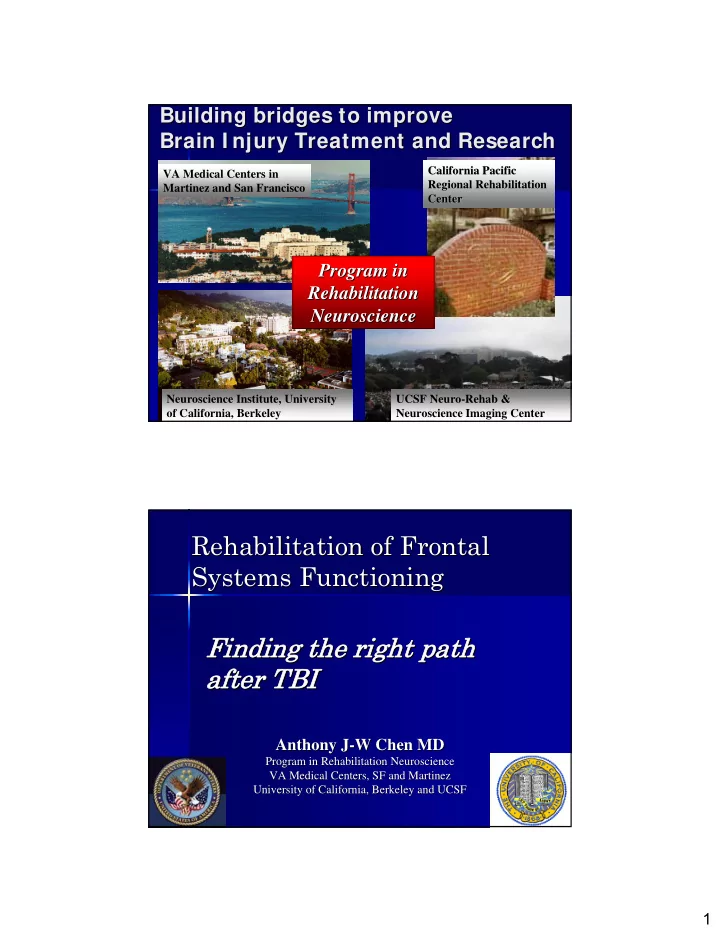
Building bridges to improve Building bridges to improve Brain I njury Treatment and Research Brain I njury Treatment and Research California Pacific California Pacific VA Medical Centers in Regional Rehabilitation Regional Rehabilitation


slide-1
SLIDE 1

1

Building bridges to improve Building bridges to improve Brain I njury Treatment and Research Brain I njury Treatment and Research

California Pacific California Pacific Regional Rehabilitation Regional Rehabilitation Center Center UCSF Neuro-Rehab & Neuroscience Imaging Center

Program in Program in Rehabilitation Rehabilitation Neuroscience Neuroscience

Neuroscience Institute, University

  • f California, Berkeley

VA Medical Centers in Martinez and San Francisco

Rehabilitation of Frontal Rehabilitation of Frontal Systems Functioning Systems Functioning

Anthony J Anthony J-

  • W Chen MD

W Chen MD

Program in Rehabilitation Neuroscience Program in Rehabilitation Neuroscience VA Medical Centers, SF and Martinez VA Medical Centers, SF and Martinez University of California, Berkeley and University of California, Berkeley and UCSF UCSF

Finding the right path Finding the right path Finding the right path Finding the right path after TBI after TBI after TBI after TBI

slide-2
SLIDE 2

2

I n the moment of an I n the moment of an instant instant… …

I must have blacked out for a minute I must have blacked out for a minute… … and I can and I can’ ’t remember much of what happened t remember much of what happened in the next half hour in the next half hour… …

  • A

A blas blast blas blast went off went off next to our vehicle next to our vehicle

  • We plowed into a

We plowed into a ditch ditch– – My head My head struck the side of struck the side of the vehicle. the vehicle.

… …to the aftermath to the aftermath

  I vaguely remember getting out of the

I vaguely remember getting out of the vehicle and shooting. vehicle and shooting.

  After the mission, I felt dazed (but we

After the mission, I felt dazed (but we always felt dazed and confused in the always felt dazed and confused in the field.) field.)

  I tried to

I tried to ‘ ‘shake it off. shake it off.’ ’ I think I did my I think I did my job pretty well on job pretty well on ‘ ‘autopilot autopilot. .’ ’

  I really had problems

I really had problems after I got after I got home home… …

slide-3
SLIDE 3

3

… …to the aftermath to the aftermath… …

 Difficulty concentrating, easily

distracted

 Sensitive to non-relevant noise

(environmental or otherwise)

 Easily overwhelmed, especially by

multiple tasks

 Poor organization, difficulty

prioritizing, planning and solving problems

 Can’t get things done…

 Symptoms of

‘executive control dysfunction’

 Often ‘invisible’ yet

extremely disabling. extremely disabling.

  Most apparent in

Most apparent in complex, complex, unstructured unstructured environments environments– – when when we we’ ’re re not not told what told what to do to do

Provided by Tatjana Novakovic-Agopian

slide-4
SLIDE 4

4

… … to Treatment Targets?? to Treatment Targets??

Emotional self-

  • tional self-

regu regula lation

  • n

Reward- Reward-based ased feed feedback back learning learning Goal-s Goal-sub- ub- goa goal ma mana nagement gement Self-Awareness Self-Awareness Adju just stmen ments of s of beh behavior

  • r

Selection of lection of information information base based on d on goal- goal- releva relevance ‘Automatic’ ‘Automatic’ attention a attention and d

  • rienting
  • rienting

Ma Maintena intenance o nce of information information ‘E ‘Exe xecut cutive’ ve’ manipulation of manipulation of information information Motiv tivation tion Energization Energization Establi ablishing ng attentiona attentional s l set Error Error monitor monitoring ng Dis Discrepa crepancy ncy de detection tection Multi- Multi- ta tasking Pr Prior ioritization tization & Se & Sequenci quencing ng Pla Plannin nning Prospective Prospective me memor mory Episo isodic ic me memor mory Sc Schem hematiza tization tion St Stra rategic gic retrieval retrieval

‘ ‘Executive Control Dysfunction??? Executive Control Dysfunction???’ ’

Who cares about cognitive Who cares about cognitive dysfunction? (Why should dysfunction? (Why should we focus on this?) we focus on this?)

  Who solves this person

Who solves this person’ ’s problems? s problems?

– – The brain as its own teacher The brain as its own teacher– –allows the person to allows the person to adapt and learn. adapt and learn. – – E.g. When a limb is injured E.g. When a limb is injured… …adaptation adaptation – – E.g E.g When motor cortex of the brain is When motor cortex of the brain is injured injured… …rehabilitation rehabilitation – – E.g. When cognitive functioning is injured E.g. When cognitive functioning is injured… … ??? ???

  Where is this person going?

Where is this person going?

– – Re Re-

  • integration into the home, work, community

integration into the home, work, community – – What happens if he/she can What happens if he/she can’ ’t take care of herself? t take care of herself?

slide-5
SLIDE 5

5

Treatment Development: From Treatment Development: From Theory to I ntervention, Theory to I ntervention, Measurement and Testing Measurement and Testing

THEORY

  • f Function

(and Dysfunction) Treatment theory Intervention Measurement(s Measurement(s) )

  Aspects of the direction of neural

Aspects of the direction of neural-

  • behavioral processes to achieve

behavioral processes to achieve goals goals

What a What are e ‘Executive control ‘Executive control functions’? functions’?

  • Depend on

Depend on frontal systems frontal systems Basic mechanisms for top Basic mechanisms for top-

  • down

down control control

  • 1. Selection
  • 1. Selection
  • 2. Maintenance and
  • 2. Maintenance and

manipulation manipulation

 Disrupted by not only frontal

Disrupted by not only frontal injuries, but also disconnection injuries, but also disconnection

  • f
  • f networks

networks

slide-6
SLIDE 6

6

Focus on Gateways as Focus on Gateways as Treatment Targets Treatment Targets

WORKING WORKING MEMO MEMORY ATTENTION ATTENTION

Pathway from information to Pathway from information to action and goal attainment: action and goal attainment: Gateway to Executive Control Gateway to Executive Control Selection of information

slide-7
SLIDE 7

7

Guidance Of Neural- Behavioral Processes Maintenance Learning Sequencing Planning Review All information Goal-relevant information Working Memory Goal attainment Off track Selection Guidance Of Neural- Behavioral Processes Maintenance Learning Sequencing Planning, Problem-solving (Review) All information Goal-relevant information

Working Memory

GOAL ATTAINMENT Off track

Selection Target processes: Information Gateway

  I. Targets: Selective information processing for

  • I. Targets: Selective information processing for

goal attainment goal attainment

  II. Intervention: Goal

  • II. Intervention: Goal-
  • directed attentional self

directed attentional self-

  • regulation

regulation

– – “ “Goal Goal-

  • based self

based self-

  • management

management” ” (GBSM) (GBSM)

  III. Measurements:

  • III. Measurements:

– – Neuro Neuro-

  • cognitive test performance

cognitive test performance– – selective selective information processing information processing – – Biomarkers: Goal Biomarkers: Goal-

  • direction of information processing

direction of information processing in the brain ( in the brain (fMRI fMRI ) ) – – Functional Outcomes in the Functional Outcomes in the ‘ ‘real world real world’ ’

Targeting the I nformation GATEWAY Targeting the I nformation GATEWAY to Executive Control to Executive Control-

  • A pilot integrated rehabilitation neuroscience study

A pilot integrated rehabilitation neuroscience study

slide-8
SLIDE 8

8

I NTERVENTI ON I NTERVENTI ON Training of goal Training of goal-

  • directed

directed attention regulation attention regulation

‘ ‘Goal Goal-

  • based Self

based Self-

  • Management

Management’ ’ training protocol training protocol

Novakovic-Agopian, Chen, Rome, 2006

I ntervention synopsis I ntervention synopsis

  Intro of the importance of goal

Intro of the importance of goal-

  • directed

directed selection selection

– – Stop Stop-

  • Relax

Relax-

  • Refocus

Refocus – – Practice holding goal Practice holding goal-

  • relevant information in

relevant information in mind, while mind, while ‘ ‘letting go letting go’ ’ of

  • f distractors

distractors (non (non-

  • relevant)

relevant)

  Application and progressive applied

Application and progressive applied practice practice

– – Apply to progressively more challenging Apply to progressively more challenging situations in training sessions and daily life situations in training sessions and daily life

slide-9
SLIDE 9

9

Training intervention, Training intervention, cont. cont.

  Application to higher level goals:

Application to higher level goals: – – Identify feasible functional goals of personal Identify feasible functional goals of personal interest interest – – Apply to 1) a group goal / project Apply to 1) a group goal / project – – 2) an individual goal / project 2) an individual goal / project

  Execution and completion of projects

Execution and completion of projects

  Training time:

Training time: – – 10 sessions (two hours each) of group training, 10 sessions (two hours each) of group training, – – 3 hours of individual training 3 hours of individual training – – ~ 20 hours of homework over 5 weeks. ~ 20 hours of homework over 5 weeks.

Pilot intervention study Pilot intervention study

  • bjectives
  • bjectives
  • 1:

1: Is the training protocol feasible in a clinical research setting? Are measurement protocols feasible and informative?

  • 2:

2: Does participants’ performance improve in neuro-cognitive domains targeted by training (i.e. complex attention and executive control)?

  • 3:

3: Does the intervention sharpen the neural Does the intervention sharpen the neural processes of goal processes of goal-

  • directed control of information

directed control of information processing? processing?

  • 4:

4: Are participants able to apply the skills learned to their own real-life situations? (Is there generalization…?)

slide-10
SLIDE 10

10

Study Design Study Design

GBSM GBSM 5 week Training

5 week Training One 2 hour One 2 hour EDU

EDU session

session

Group Group 2 2

One 2 hour One 2 hour EDU

EDU

session session

GBSM GBSM 5 week Training

5 week Training

Group Group 1 1 Weeks 6 Weeks 6 -

  • 10

10 Weeks 1 Weeks 1 -

  • 5

5 Baseline Baseline Assessment 1 Assessment 2 Assessment 3

Participants:

  • To date, 13 patients with chronic executive dysfunction

from trauma and other acquired brain injuries

  • 7 participants started with the GBSM, followed by EDU
  • 6 started in the reverse order.

Measurements: Measurements: Mechanisms and Mechanisms and Outcomes Outcomes

slide-11
SLIDE 11

11

Attention and Working Memory

Auditory Consonant Trigrams Letter Number Sequencing Sustained Attention Digit Vigilance Test Inhibition and Mental Flexibility Stroop Inhibition/Switching Design and Verbal Fluency Switching Trails B Multitasking Dual Task – Visual Attention Test

Functional Goal Management Functional Goal Management in in ‘ ‘real life real life ‘ ‘ low structure settings low structure settings Neurocognitive Neurocognitive Domains Targeted Domains Targeted

Multiple Errands Test (MET) Goal Processing Scale (GPS) –in development Self/Significant Other Assessments

Neurophysiology fMRI : Goal-Direction of Neural Processing

Preliminary Results: Preliminary Results: Neuro Neuro-

  • cognitive

cognitive performance performance

slide-12
SLIDE 12

12

Effect of Training on Effect of Training on Selective Working Memory Selective Working Memory

Assessed using Paired Samples t Test

Auditory Working Memory

  • 2.0
  • 1.5
  • 1.0
  • 0.5

0.0 0.5 1.0 1.5 2.0 Baseline GSM Baseline EDU Z-Score Δ 1.1 Δ 0.1 p = 0.000 p = 0.400

Protection of information processing from disruption

Novakovic-Agopian, Chen, et al. in preparation

No Effects of Training on No Effects of Training on Motor Speed of Processing Motor Speed of Processing

Assessed using Paired Samples t Test

Motor Speed of Processing

  • 2.0
  • 1.5
  • 1.0
  • 0.5

0.0 0.5 1.0 1.5 2.0 Baseline GSM Baseline EDU

Z-Score Δ 0.4 Δ 0.0 p = 0.10 p = 0.97

Novakovic-Agopian, Chen, et al. in preparation

slide-13
SLIDE 13

13

Does the intervention Does the intervention change functioning in change functioning in ‘ ‘real real life? life?’ ’

Multiple Errands Test Multiple Errands Test

Multiple-Errands Test

0.0 1.0 2.0 3.0 4.0 5.0 6.0 7.0 8.0 Baseline GSM Baseline EDU

Number of Task Failures

p = 0.039 p = 0.206 Assessed using Wilcoxon’s Matched Pairs Test

slide-14
SLIDE 14

14

Participants Self Rating Participants Self Rating Relative to Baseline Relative to Baseline

7.0 7.0 Ability to Ability to finish

finish something that was started.

something that was started. 7.4 7.4 Ability to Ability to hold and maintain important

hold and maintain important information in mind. information in mind.

7.5 7.5 Ability to divide a complex task into more Ability to divide a complex task into more manageable tasks. manageable tasks. 7.7 7.7 Ability to Ability to stop and refocus

stop and refocus on the current goal.

  • n the current goal.

7.8 7.8 Ability to Ability to stop and relax

stop and relax during stressful times

during stressful times

1 5 10 Much Worse No Change Much Better

Sharpening of distributed Sharpening of distributed neural representations by neural representations by Goal Goal-

  • direction

direction

Translation from concept to Translation from concept to measurement measurement

slide-15
SLIDE 15

15

Neural Biomarkers: Neural Biomarkers: Measuring the gateway Measuring the gateway

  How do we index this

How do we index this ‘ ‘gateway gateway’ ’ process of the goal process of the goal-

  • direction of

direction of information processing? information processing?

Goalrelevant information

???

View these images View these images… …

slide-16
SLIDE 16

16

Dynamic sharpening of Dynamic sharpening of the distinctiveness of neural representations by goal-direction

(b)

Select and hold in Select and hold in mind mind… …SCENES SCENES (I gnore Faces) (I gnore Faces)

slide-17
SLIDE 17

17 Non- relevant Relevant

Dynamic sharpening of Dynamic sharpening of the distinctiveness of neural representations by goal-direction

(b)

Relevant Non- relevant

Dynamic sharpening of Dynamic sharpening of the clarity of neural representations by goal-direction

slide-18
SLIDE 18

18

Conceptual Model: Attentional Selection

  • f Neural Information Representations

(a) (b) (d)

Both (Non-Selective) Select Scenes Select Faces

(c)

Chen, Britton et al. (submitted)

Machine as Machine as Brain Brain Measuring the Measuring the clarity clarity of

  • f

distributed neural patterns distributed neural patterns

From fMRI Patterns to Reading the Neural code Using a neural network pattern classifier

http://www.wachadoo.com/forum/files/brain_as_computer_252.jpg

slide-19
SLIDE 19

19

Multi Multi-

  • Voxel

Voxel Pattern Analysis: Pattern Analysis: Training of Classifier Training of Classifier

Classifier

F A C E F A C E

S C E N E S C E N E S C E N E

F A C E

“ “Certainty Certainty” ” of classification as a

  • f classification as a

measure of the clarity of the measure of the clarity of the information representation information representation

F A C E S C E N E

?

F A C E 90 : 10 Event 1

F A C E S C E N E

?

F A C E 60 : 40 Event 2

Clearer Less clear

slide-20
SLIDE 20

20

(c) (b)

Clarity (Relevant) Clarity (Relevant)

Clarity (Non- Relevant) Clarity (Non- Relevant)

Select SCENES

Clarity of brain patterns for scenes and faces stimuli

Looks like scenes Looks like faces Scenes images Faces images

slide-21
SLIDE 21

21

Select FACES

Classifier certainty

0.5 0.55 0.6 0.65 0.7 0.75 0.8

s

Certainty Index (mean ± SEM) Select Scenes Select Faces

Classifier certainty

  • 0.8
  • 0.75
  • 0.7
  • 0.65
  • 0.6
  • 0.55
  • 0.5

f

Certainty Index (mean ± SEM) Select Scenes Select Faces

*

p = 0.554 p = 0.010 (c)

(b)

Clarity (Relevant) Clarity (Relevant)

Relevant Relevant Non- Non-

slide-22
SLIDE 22

22

Does training in attention Does training in attention regulation regulation enhance the

enhance the goal goal-

  • directed selection

directed selection effect (sharpen the effect (sharpen the goal goal-

  • relevant neural

relevant neural representations)? representations)?

Classifier certainty ABI Pre-GBSM

  • 0.8
  • 0.7
  • 0.6
  • 0.5
  • 0.4
  • 0.3

f

Certainty Index (mean ± SEM) Select Scenes Select Faces Classifier certainty ABI Pre-GBSM 0.3 0.35 0.4 0.45 0.5 0.55 0.6 0.65 0.7 0.75

s

Certainty Index (mean ± SEM) Select Scenes Select Faces

Classifier certainty ABI Post-GBSM

  • 0.8
  • 0.7
  • 0.6
  • 0.5
  • 0.4
  • 0.3

f

Certainty Index (mean ± SEM) Select Scenes Select Faces

Classifier certainty ABI Post-GBSM

0.3 0.35 0.4 0.45 0.5 0.55 0.6 0.65 0.7 0.75

s

Certainty Index (mean ± SEM) Select Scenes Select Faces

Brain I njury Patients Pre- and Post-Training(n= 8)

p = 0.013

*

p < 0.005 p = 0.769 p = 0.254

* Pre- training Post- training

slide-23
SLIDE 23

23

Training increases goal Training increases goal-

  • directed selection of

directed selection of information processing information processing

(c) (b) (c) (b)

Pre-training Post-training

Preliminary conclusions: Preliminary conclusions: Proof of principle Proof of principle

  Intervention designed based on theory

Intervention designed based on theory

  Practically applicable in research

Practically applicable in research setting, engaging setting, engaging

  Preliminary results support effects on

Preliminary results support effects on the targeted the targeted neuro neuro-

  • cognitive

cognitive processes, with processes, with generalization to real generalization to real-

  • world functioning.

world functioning.

slide-24
SLIDE 24

24

Testing of Gateway Testing of Gateway Theory Theory

Guidance Of Neural

  • Behavioral

Processes Maintenance Learning Sequencing Planning Review All information Goal-relevant information Working Memory Goal attainment Off track Off track Selection Guidance Of Neural

  • Behavioral

Processes Maintenance Learning Sequencing Planning (Review) All information Goal-relevant information

Working Memory

GOAL ATTAINMENT Off track Off track

Selection

Neural Neural biomarkers: biomarkers:

Rationally Rationally constructed constructed indices of the indices of the target processes target processes showing increases showing increases in the goal in the goal-

  • direction of

direction of information information processing processing

Current VA study Current VA study

  Current study: Veteran

Current study: Veteran’ ’s with TBI and mild s with TBI and mild cognitive dysfunction cognitive dysfunction

  Goal

Goal-

  • based self

based self-

  • management intervention

management intervention

  Randomized cross

Randomized cross-

  • over study with active
  • ver study with active

comparison intervention matched for time and comparison intervention matched for time and attention attention

  Assessments:

Assessments: Neuro Neuro-

  • cognitive, Brain structure

cognitive, Brain structure and function, Functional outcomes and function, Functional outcomes

slide-25
SLIDE 25

25

Ongoing challenges: Ongoing challenges: sharpen intervention tools sharpen intervention tools

  I ncrease targeted training: Computer

I ncrease targeted training: Computer-

  • assisted

assisted training therapies training therapies

  Specifically target different component processes of

Specifically target different component processes of executive control executive control

  Process targeted, but embedded in the complex

Process targeted, but embedded in the complex scenarios that demand executive functioning scenarios that demand executive functioning

– – (Training specific muscles, but in a functional setting) (Training specific muscles, but in a functional setting)

  Scenarios to intensively practice the application of

Scenarios to intensively practice the application of trained skills and strategies trained skills and strategies

  Progressive, adaptable and individualized

Progressive, adaptable and individualized ‘ ‘dials dials’ ’ for for each patient each patient

  Web

Web-

  • deployed, allows home practice with data tracking

deployed, allows home practice with data tracking

Ongoing challenges: Ongoing challenges: sharpen measurement tools sharpen measurement tools

  Development and validation of

Development and validation of measurements of real measurements of real-

  • world functioning

world functioning

  Combined /concurrent application of

Combined /concurrent application of complementary measures to test complementary measures to test different levels different levels

– – Relationships of neural to behavioral and Relationships of neural to behavioral and functional measurements functional measurements – – Value of biomarkers in understanding Value of biomarkers in understanding sources of variability in treatment sources of variability in treatment responses? responses?

slide-26
SLIDE 26

26

Breaking the barriers of Breaking the barriers of biology biology

  What can be done to improve the

What can be done to improve the benefits of rehabilitation benefits of rehabilitation interventions? interventions?

  What are the neural bases of

What are the neural bases of improvement in a process of improvement in a process of interest (when they do occur?) interest (when they do occur?)

  These become possible new

These become possible new targets for enhancing learning targets for enhancing learning and recovery and recovery

THANKS! THANKS!

Tatjana Novakovic Tatjana Novakovic-

  • Agopian, PhD

Agopian, PhD Co Co-

  • director

director Program in Program in Rehabilitation Rehabilitation Neuroscience Neuroscience Supervisor, Supervisor, Neurobehavioral Neurobehavioral Assessments and Assessments and I nterventions I nterventions Scott Rome, MD Scott Rome, MD

Medical Director Medical Director California Pacific California Pacific Regional Rehabilitation Regional Rehabilitation Center Center

Gary Abrams, MD Gary Abrams, MD

Chief Neurological Chief Neurological Rehabilitation SF VA Rehabilitation SF VA

Mark Mark D D’ ’Esposito Esposito, MD , MD

Director, Brain Imaging Director, Brain Imaging Center, UC Berkeley Center, UC Berkeley Neurobehavioral Neurobehavioral Neurology, VA NCHCS, Neurology, VA NCHCS, Martinez Martinez

slide-27
SLIDE 27

27

THANKS! THANKS!

  Participating patients

Participating patients LAB TEAM LAB TEAM

  Gary Turner, Ph.D.

Gary Turner, Ph.D.

– – Post Post-

  • doctoral Fellow

doctoral Fellow

  Terry

Terry Nycum Nycum

– – Cognitive science, Cognitive science, UCB UCB – – Programmer/Analyst Programmer/Analyst

  Shawn Song

Shawn Song

– – UCSF School of UCSF School of Medicine Medicine

  Michael Britton

Michael Britton

– – Research Assistant Research Assistant

  Jason

Jason Vytlacil Vytlacil

– – Research Assistant Research Assistant

  Michael Souza

Michael Souza

– – Graduate student, Graduate student, UCB UCB

  Deborah Binder

Deborah Binder

– – Vocational Rehab, Vocational Rehab, Study Coordinator Study Coordinator

CLI NI CAL TEAMS CLI NI CAL TEAMS

  Cathy Kennedy, PT

Cathy Kennedy, PT

  Melissa

Melissa Loughlin Loughlin, PT , PT

  Alison Williams, OTR/ L

Alison Williams, OTR/ L

  Holli

Holli Castelli Castelli, OTR/ L , OTR/ L

  Ryan

Ryan McKim McKim, Ph.D. , Ph.D.

  Annemarie Rossi,

Annemarie Rossi, MSOTR MSOTR

  John

John Garfinkle Garfinkle, M.S., , M.S., CCC CCC-

  • SLP

SLP

  Jimmie Muir, PhD

Jimmie Muir, PhD

  Rich Fitzsimmons

Rich Fitzsimmons

  Dani

Dani Binegar Binegar, PhD , PhD

  Susan

Susan Reider Reider, OT , OT

  Jeff Kixmiller, PhD

Jeff Kixmiller, PhD

Support Support

  VA Rehab R and D

VA Rehab R and D

  California Pacific Medical Center

California Pacific Medical Center Foundation Foundation

  Brain Imaging Center (BIC), UC

Brain Imaging Center (BIC), UC Berkeley Berkeley

  Neuroscience Imaging Center (NIC),

Neuroscience Imaging Center (NIC), UCSF UCSF

  DOD/Congressionally

DOD/Congressionally-

  • directed Medical

directed Medical Research Program Research Program

slide-28
SLIDE 28

28 Goal- direction

Neural Processes and Biomarkers Neural Processes and Biomarkers: ‘ ‘Top Top-

  • down

down’ ’ goal-direction of information processing

Information processing

Bottom-up

Goal-directed change in classifier certainty Pre- and Post-GBSM training

Pre Pre Post Post

0.05 0.1 0.15 0.2 0.25 0.3 0.35 s f

Change in mean Certainty Index

Effect of intervention on goal Effect of intervention on goal-

  • directed enhancement of the clarity

directed enhancement of the clarity

  • f representations
  • f representations

p = 0.034 p = 0.026

Scenes stream Faces stream

slide-29
SLIDE 29

29

… …to the aftermath to the aftermath… …

 Trauma to the brain can change the core

  • f a person’s being– their thinking,

memory, personality and behavior.

 Even ‘mild’ trauma can result in brain

injury.

 Most individuals get better, but deficits in

cognitive processes are some of the most persistent and disabling consequences of brain injury.