Issues and Solutions Prof. James Z. Lee (Dean, School of Humanities - - PowerPoint PPT Presentation

issues and solutions
SMART_READER_LITE
LIVE PREVIEW

Issues and Solutions Prof. James Z. Lee (Dean, School of Humanities - - PowerPoint PPT Presentation

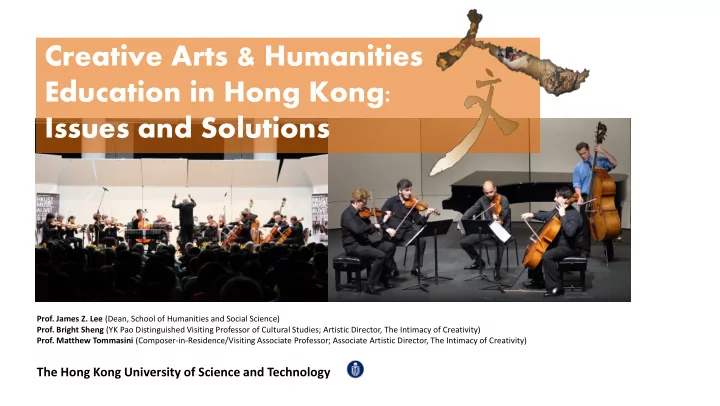
Creative Arts & Humanities Education in Hong Kong: Issues and Solutions Prof. James Z. Lee (Dean, School of Humanities and Social Science) Prof. Bright Sheng (YK Pao Distinguished Visiting Professor of Cultural Studies; Artistic Director, The


slide-1
SLIDE 1

Creative Arts & Humanities Education in Hong Kong: Issues and Solutions

  • Prof. James Z. Lee (Dean, School of Humanities and Social Science)
  • Prof. Bright Sheng (YK Pao Distinguished Visiting Professor of Cultural Studies; Artistic Director, The Intimacy of Creativity)
  • Prof. Matthew Tommasini (Composer-in-Residence/Visiting Associate Professor; Associate Artistic Director, The Intimacy of Creativity)

The Hong Kong University of Science and Technology

slide-2
SLIDE 2

Creative Arts and Humanities in the Past

In the past, the creative arts were holistic

Medieval trivium and quadrivium - grammar, rhetoric, and logic; arithmetic, geometry, astronomy, and music Confucian “six arts” “六藝”, that is ethics, music, archery, chariot-riding, calligraphy, and arithmetic 禮、樂、射、禦、書、數 Specialized instruction for creative arts did exist, but in the form of ateliers or guilds such as the schola cantorum

slide-3
SLIDE 3

Creative Arts and Humanities Issues

Such specialized creative arts education evolved separately from humanities and the university with the formation of formal ‘arts’ schools such as the

École des beaux-arts, 1648 Conservatoire national de musique, 1795

Modern universities did not develop specialized arts education until the late nineteenth century but often firewalled these departments or schools from the ‘Arts and Science’ curriculum

slide-4
SLIDE 4

Creative Arts Education Issues in Contemporary China

In China, ‘arts’ education has remained especially isolated from the university and confined to such dedicated stand-alone schools as the:

Central Academy of Fine Art, 1918/1950- (Shanghai) Conservatory of Music, 1927- Chinese Academy of Art, 1928- Central Academy of Drama, 1950- Beijing Dance Academy, 1954-

slide-5
SLIDE 5

Creative Arts in Contemporary China

And yet, Chinese Visual Art, especially painting, has ironically flourished throughout the twentieth century Chinese Music reached a similar scale of global achievement from the late twentieth century

  • nwards under the leadership of numerous

distinguished performers as well as such composers as Bright Sheng, Chen Yi, Zhou Long, Tan Dun

slide-6
SLIDE 6

Creative Arts Education in China

Chinese achievements in the Creative Arts are demonstrably greater than in the humanities and arguably approach the quality of Chinese achievements in engineering and science However, unlike engineering and science which are taught to train engineers and scientists, humanities faculty generally teach the creative arts as Critics not Creators, as Consumers not Producers

slide-7
SLIDE 7

The HKUST Solution

slide-8
SLIDE 8

HKUST has launched an alternative approach to creative arts education based on the principle of Research Embedded Teaching, by which we mean: Our teachers are active practitioners who teach a curriculum based on their own ‘research,’ that is creativity rather than criticism Our students are taught to understand the arts from the perspective of creators and producers rather than consumers and critics

slide-9
SLIDE 9

Music Programs

Two HKUST Creative Arts Programs

slide-10
SLIDE 10

Our lead program begun in 2010 is in music composition and performance, lead by Bright Sheng, centered around The Intimacy of Creativity We plan to launch in 2014 a successor program in creative writing lead by Liu Zaifu with the participation

  • f Gao Xingjian and Mo Yan
slide-11
SLIDE 11

Bright Sheng

In each program, three to four composers or writers in residence teach and produce research in their respective areas

slide-12
SLIDE 12

Internationally-acclaimed, annual two-week partnership devoted to promoting an intimate dialogue between composers and performers

The Intimacy of Creativity

01 02 03 04

Open Discussions Preview Concerts World Premiere Concerts Lunchtime Lectures

slide-13
SLIDE 13

03 04

Lunchtime Lectures Preview Concerts World Premiere Concerts

02

Open Discussions

01

World-renowned composers and performers, together with emerging composers, present and revise their chamber music compositions after in-depth Open Discussions on the campus of HKUST Lo Ka Chung Building, HKUST

slide-14
SLIDE 14

02

Open Discussions

01

Revised compositions are formally presented at Preview Concerts at HKUST

04

World Premiere Concerts

03

Preview Concerts

Lo Ka Chung Building, HKUST

Lunchtime Lectures

slide-15
SLIDE 15

Open Discussions

01 02 03 04

Lunchtime Lectures

And at World Premiere Concerts in downtown Hong Kong

World Premiere Concerts

Hong Kong City Hall, 2014

Preview Concerts

slide-16
SLIDE 16

Open Discussions

01 02 03 04

Preview Concerts

Lunchtime Lectures

Distinguished Guests are given the

  • pportunity to speak more in-depth about

their work.

World Premiere Concerts

slide-17
SLIDE 17

Press

slide-18
SLIDE 18

The Intimacy of Creativity

All students, as part of their Arts Curriculum, hear and watch the creative process in action Understanding first hand the complexity of the creator/producer perspective of art Experiencing first hand the emerging 21st century collaborative model for the production of art Learning the value of creativity and collaboration and its applications in such other fields of study as the Arts

Open Discussion Broadcast at Radio Television Hong Kong

slide-19
SLIDE 19

HKUST MUSIC ENROLLMENT 2010-2014

100 200 300 400 500 600 700 800 900 Music Participation (theory, composition) Music Appreciation

slide-20
SLIDE 20

Creative Arts Education at HKUST

Student enthusiasm for music participation classes, as opposed to music appreciation and music performance, show their genuine interest in deepening their understanding of the creative process and their willingness even to attempt to be creative themselves Many students who begin with appreciation-oriented courses choose to continue with such participation-oriented courses as Music Theory and Music Composition

slide-21
SLIDE 21

Through music theory and music composition, including The Intimacy

  • f Creativity, the HKUST Arts Program,

in other words, teaches new ways of critical thinking and criticality We thereby challenge the traditional notion of creativity by the “lone genius” and focus on collaborative processes of production We therefore teach the Arts as a continually transforming creative process rather than as a static product

Creative Arts Education at HKUST

slide-22
SLIDE 22

Arts Requirement The HKUST

Currently, approximately 2500 taught UG students, that is

  • ne-quarter our entire student body, take music or visual

arts every year Beginning in 2012, the vast majority of HKUST students now take Arts courses as part of a required Common Core Education.

slide-23
SLIDE 23

2014 Summer Courses

HKUST Summer Music!

A New Approach to Music Making Music of the World Beginning in 2013, the HKUST Summer Music program, lead by Bright Sheng, offers Courses open to students from Hong Kong, mainland China, and beyond, Including A New Approach to Music Making, a course developed and taught by Bright Sheng.

slide-24
SLIDE 24

HKUST Music Alive!

Begun in 2012, the HKUST Music Alive! concert series expands the initiative beyond the classroom by:

Promoting HKUST as a destination for creative, well- rounded global leaders exposed to the power of the arts. The 2012 inaugural event featured the internationally- acclaimed Munich Chamber Orchestra and was attended by

  • ver

800 students and university community members 8-10 concerts per season feature acclaimed international and local artists

slide-25
SLIDE 25

Development of Arts Facilities

slide-26
SLIDE 26

Development of Arts Facilities

Cheng Yu Tung Building (RAB), including a 400-seat Multipurpose Hall and arts classrooms, opened Spring 2015 1000-seat, state-of-the-art HKUST Multipurpose Auditorium, currently being proposed

slide-27
SLIDE 27

HKUST Center for Creative Arts Education

With the development of these facilities, the HKUST Center for Creative Arts Education is currently being proposed to coordinate: Arts education-related programs at HKUST Performing arts initiatives, including The Intimacy of Creativity and HKUST Music Alive! series

slide-28
SLIDE 28

Goals

slide-29
SLIDE 29

Arts Education at HKUST, in other words, serves two different purposes: We offer and produce what the the Financial Times calls “the most innovative music program” in Hong Kong We also use this program to educate our students about the Arts, about creativity, and about collaboration to prepare them for a life-long critical engagement with the aural, the visual, and the world of work

Goals

slide-30
SLIDE 30

Goals

By placing the creative process at the heart of Creative Arts Education at HKUST Our students discover the real inner-workings of creativity Our students learn to value the power of those creative inner-workings in their own lives

slide-31
SLIDE 31

Ideal

The Master said, “Enrich yourself with the

  • Odes. Base yourself on Propriety. Fulfill

yourself through Music.” “興于詩,立于禮,成于樂”《論語》

slide-32
SLIDE 32

THANK YOU