$ISPATCHING 0REDICATE$ISPATCHING Select one case from a generic - - PDF document

ispatching 0redicate ispatching
SMART_READER_LITE
LIVE PREVIEW

$ISPATCHING 0REDICATE$ISPATCHING Select one case from a generic - - PDF document

$ISPATCHING 0REDICATE$ISPATCHING Select one case from a generic function object-oriented dispatch, including multi-methods !5NIFIED4HEORYOF$ISPATCH classifiers, predicate classes pattern matching Michael Ernst,


slide-1
SLIDE 1

Ernst, ECOOP ’ 98, 23 July 1998 1

Ernst, ECOOP ’98, page 1

0REDICATE$ISPATCHING !5NIFIED4HEORYOF$ISPATCH

Michael Ernst, Craig Kaplan, and Craig Chambers

University of Washington Seattle, Washington, USA http://www.cs.washington.edu/research/projects/cecil

Ernst, ECOOP ’98, page 2

$ISPATCHING

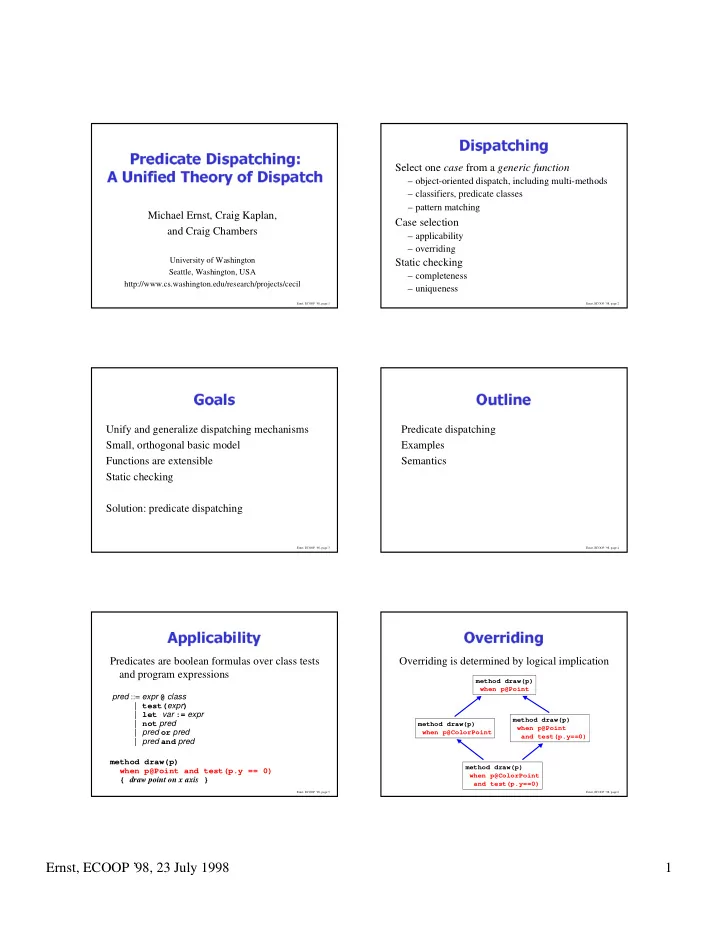
Select one case from a generic function

– object-oriented dispatch, including multi-methods – classifiers, predicate classes – pattern matching

Case selection

– applicability – overriding

Static checking

– completeness – uniqueness

Ernst, ECOOP ’98, page 3

'OALS

Unify and generalize dispatching mechanisms Small, orthogonal basic model Functions are extensible Static checking Solution: predicate dispatching

Ernst, ECOOP ’98, page 4

/UTLINE

Predicate dispatching Examples Semantics

Ernst, ECOOP ’98, page 5

!PPLICABILITY

Predicates are boolean formulas over class tests and program expressions

pred ::= expr @ class | test(expr) | let var := expr | not pred | pred or pred | pred and pred method draw(p) when p@Point and test(p.y == 0) { draw point on x axis }

Ernst, ECOOP ’98, page 6

/VERRIDING

Overriding is determined by logical implication

method draw(p) when p@ColorPoint method draw(p) when p@ColorPoint and test(p.y==0) method draw(p) when p@Point and test(p.y==0) method draw(p) when p@Point

slide-2
SLIDE 2

Ernst, ECOOP ’ 98, 23 July 1998 2

Ernst, ECOOP ’98, page 7

/BJECTORIENTEDDISPATCH

3MALL4ALK#*AVA

Applicability: run-time class is subclass of specializer Overriding: subclassing (most specific specializer)

class Point; method draw(p) when p@Point { … }; class ColorPoint extends Point; method draw(p) when p@ColorPoint { … }; Equivalently: method draw(p@Point) { … }; method draw(p@ColorPoint) { … };

Ernst, ECOOP ’98, page 8

  • ULTIMETHODDISPATCH

#,/3#ECIL$YLAN

Applicability: run-time classes are subclasses

  • f specializers

Overriding: subclassing over all specializers

method equal(p1, p2) when p1@Point and p2@Point { return p1.x==p2.x and p1.y==p2.y; } method equal(p1, p2) when p1@ColorPoint and p2@ColorPoint { return p1.x==p2.x and p1.y==p2.y and p1.color==p2.color; }

Ernst, ECOOP ’98, page 9

#LASSIFIERS

+EA#ECIL

Applicability: boolean conditions of runtime state Overriding: lexical order

classify(w@Window) as FullScreen when test(w.area() == RootWindow.area()) as Big when test(w.area() > RootWindow.area()/2) as Small otherwise; method move(w) when w@FullScreen { do nothing } method move(w) when w@Big { move wireframe outline } method move(w) when w@Small { move opaque window }

Big FullScreen Small Window

Ernst, ECOOP ’98, page 10

0ATTERNMATCHING

  • ,(ASKELL

Applicability: structural equivalence Overriding: lexical order

fun sumList (nil) = 0 | sumList (h::t) = h + sumList(t); method sumList(l) when l@Nil { return 0; } method sumList(l) when l@Cons and let h:=l.head and let t:=l.tail { return h + sumList(t); }

Ernst, ECOOP ’98, page 11

.EWCAPABILITYDISJUNCTION

zip: given a pair of lists, return a list of pairs

method zip(l1, l2) when l1@Nil or l2@Nil { return Nil; } method zip(l1, l2) when l1@Cons and l2@Cons { return Cons(Pair(l1.head, l2.head), zip(l1.tail, l2.tail)); }

Ernst, ECOOP ’98, page 12

0REDICATEABSTRACTIONS

Capabilities of in-line predicates:

– return boolean value – bind variables

predicate On_x_axis(p) when (p@CartesianPoint and test(p.y == 0))

  • r (p@PolarPoint

and (test(p.theta == 0) or test(p.theta == pi))) method draw(p) when p@Point { … } method draw(p) when On_x_axis(p) { … }

slide-3
SLIDE 3

Ernst, ECOOP ’ 98, 23 July 1998 3

Ernst, ECOOP ’98, page 13

2UNTIMEBEHAVIOR

Applicability: evaluate predicates (at run time)

Optimization: common subexpression elimination

Overriding: logical implication

Computed at compile time, used at run time

Ernst, ECOOP ’98, page 14

4YPECHECKING

Completeness:

Informally, disjunction of predicates = true

Uniqueness: for each pair of predicates,

– disjoint, – one subsumes the other, or – their intersection is overridden

Ernst, ECOOP ’98, page 15

#OMPARINGPREDICATES

Consistent classes: complete Compile-time tautology tests In general: undecidable Black-box program expressions: NP-hard Small predicate expressions: fast

Ernst, ECOOP ’98, page 16

&UTUREWORK

More efficient implementation strategies Separate typechecking

Ernst, ECOOP ’98, page 17

#ONTRIBUTIONSOF PREDICATEDISPATCHING

Generalizes and subsumes previous techniques in a common framework Enables new varieties of tests Implementation:

http://www.cs.washington.edu/research/projects/cecil/www/Gud