Isoelectronic centers as building blocks for quantum - - PDF document

isoelectronic centers as building blocks for quantum
SMART_READER_LITE
LIVE PREVIEW

Isoelectronic centers as building blocks for quantum - - PDF document

Isoelectronic centers as building blocks for quantum information processing Recent progress on isoelectronic centers and their applications Sbastien Francoeur Polytechnique


slide-1
SLIDE 1

1

Isoelectronic ¡centers ¡as ¡building ¡blocks ¡ for ¡quantum ¡information ¡processing

Recent ¡progress ¡on ¡isoelectronic ¡centers ¡ and ¡their ¡applications

Sébastien ¡Francoeur Polytechnique ¡de ¡Montréal

|0i |1i |0i |1i |0i |1i |0i |1i |0i |1i |0i |1i |0i |1i |0i |1i |0i |1i |0i |1i |0i |1i |0i |1i

2

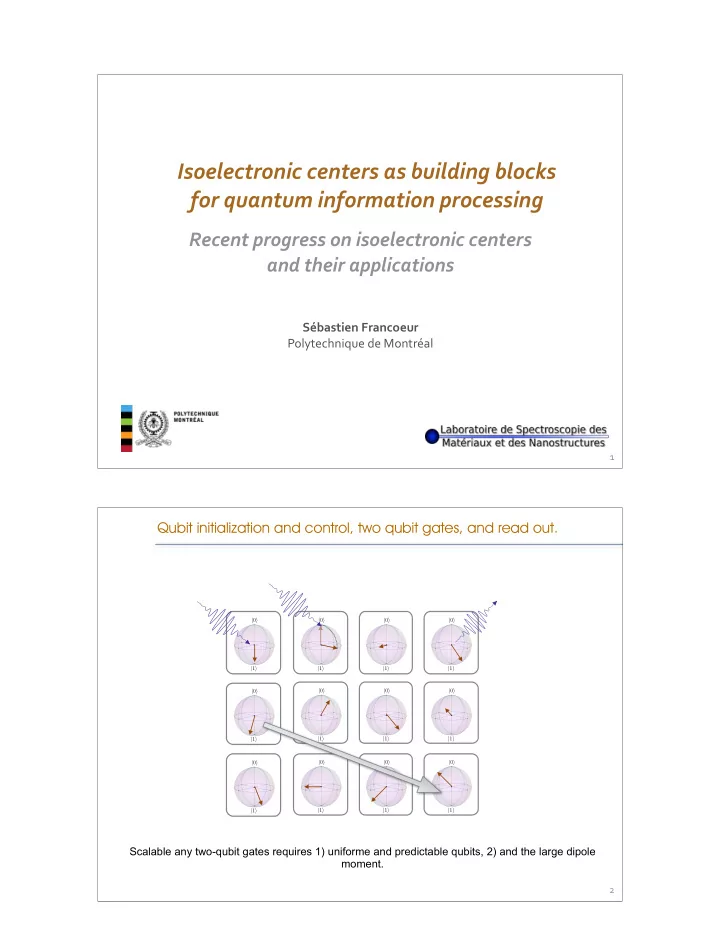
Qubit initialization and control, two qubit gates, and read out.

Scalable any two-qubit gates requires 1) uniforme and predictable qubits, 2) and the large dipole moment.

slide-2
SLIDE 2

3

Well-known families of nanostructure

Quantum ¡dots Atomic ¡defects

Colloidal ¡QD Diamond: ¡NV Epitaxial ¡QD

V N

Si: ¡P

P

Electrostatic ¡QD

4

Isoelectronic centers

  • Atomic or Molecular-sized optically-active defects in

semiconductors

slide-3
SLIDE 3

5

What impurities make Isoelectronic traps?

GaAs:N'

+

Crystal Isovalent impurity 6

1) ¡Primary ¡charge ¡capture 2) ¡Exciton ¡formation

Exciton binding mechanism to isoelectronic traps

~a0

slide-4
SLIDE 4

7

Isoelectronic centers

Single( impurity( Dyad( Tetrad( Triad( 8

Isoelectronic centers

slide-5
SLIDE 5

9

Uniformity and predictability of atomic defects

Dyads ¡of ¡various ¡interatomic ¡separations Tetrads Triads

10 ¡mev 150 meV 250 meV

Exciton ¡ emission ¡ energy

2.17 2.18 2.19 2.20 2.21 2.22 2.23 2.24 2.25 2.26 2.27 2.28 2.29 2.30 2.31 2.32 NN4 + TO/LO A-Line + 2 TO/LO A-Line + TO/LO A-Line

Intensity (a.u.)

Energy (eV)

NN1 NN3 NN4 NN6

Nearest anionic neighbor Infinite separation

10

Optical dipole moment

100 10 1 0.1

Monolayer fluctuations

InAs QDots

Optical dipole moment (Debye)

(D=0.021 e nm)

NV centers Si:P

slide-6
SLIDE 6

11

Optical dipole moment

100 10 1 0.1

Monolayer fluctuations

InAs QDots

Optical dipole moment (Debye)

(D=0.021 e nm)

NV centers Si:P GaAs:NN

12

Sample growth and instrumentation

  • Some experimental details
slide-7
SLIDE 7

13

Samples

Molecular beam epitaxy Thanks ¡to ¡our ¡collaborators: ¡ ¡ ¡ ¡ J.F. ¡Klem ¡ ¡ ¡ Sandia ¡National ¡Lab ¡, ¡USA ¡ ¡ ¡

  • R. ¡André ¡ ¡ ¡

Institut ¡Néel, ¡France ¡ ¡ ¡

  • S. ¡Roorda ¡ ¡ ¡
  • U. ¡de ¡Montréal

¡ ¡ ¡

  • R. ¡Masut ¡ ¡

École ¡Polytechnique ¡ ¡ ¡

  • Y. ¡Sakuma ¡ ¡
  • Nat. ¡Inst. ¡for ¡materials ¡science, ¡Japan

14

Cryogenic confocal microscope

slide-8
SLIDE 8

15

Single isoelectronic center luminescence

500 nm

5 µm

Energy= ¡1.50812 ¡eV

Nitrogen ¡dyad ¡of ¡C2v ¡symmetry ¡in ¡GaAs.

16

Excitonic fine structure

  • Spin and symmetry
slide-9
SLIDE 9

17

Excitonic states in systems of reduced symmetry

18

Experimental spectra of a nitrogen molecule

Energy Polarization angle

Emisson ¡[001]

slide-10
SLIDE 10

19

Coherent optical control of an exciton

  • Rabi oscillations of an exciton qubit.

20

|ψi = cos ✓θ 2 ◆ |0i + (cos φ + i sin φ) sin ✓θ 2 ◆ |1i

1 p 2 (|0i |1i) 1 p 2 (|0i i |1i) ˆ x = 1 p 2 (|0i + |1i) ˆ y = 1 p 2 (|0i + i |1i)

The Bloch sphere

|1i |0i

… is used to represent the superposition states of two eigenstates, e.g. a qubit. θ φ

slide-11
SLIDE 11

21

Rotations on the Bloch sphere (at resonance)

1 p 2 (|0i + |1i) 1 p 2 (|0i |1i) 1 p 2 (|0i i |1i) 1 p 2 (|0i + i |1i)

|1i |0i

1 p 2 (|0i + |1i) 1 p 2 (|0i |1i) 1 p 2 (|0i i |1i) 1 p 2 (|0i + i |1i)

|1i |0i

Ωt = π Ωt = π 2

In a rotating frame, an optical pulse rotates the qubit state counterclock-wise around the x-axis.

Rx Rx

22

Experimental difficulty: rejecting the control excitation pulse

Measured

1507.6 1508.0 1508.4 1508.8 30 60 90 120 150 180 210 240

Energy (meV) Linear polarization angle (degrees) Laser

X Y

∆EL

150 µeV 350 µeV

Control pulse rejection through 1) detection of a witness state of orthogonal polarization and 2) time-selection using an gated ultrafast APD.

Laser ~15 ps PL ~ 6.2 ns 1 ns Time

PL intensity

Gating window

c

y z x dark x z dark y

X

Rabi flopping

ΩR

Measured PL

Y τxy

slide-12
SLIDE 12

23

✓ = µ1 ~ ✓ 2⇡ ln 2 ◆ 1

4 r

⌧p frAcn✏0 √ P IP L ∝ |c1|2 = sin2 ✓µK 2 √ P ◆

Rabi oscillations

For a gaussian pulse of duration 𝞾p, repetition frequency fr, and area A, the rotation angle is

K: pulse characteristics and physical constants Excitation power (W) Dipole moment (Cm)

After the control pulse, the PL intensity is The oscillation period is related to the dipole moment.

|µ| = e| h0|x|1i | = 55 D

a b

Pulse area (π)

I II III

24

Excitation induced dephasing

PRB 72, 35306 (2005)

Raby oscillations in quantum dots are strongly damped. H = ω0 |Xi hX| + Ω(t) cos(ωlt) [|0i hX| + |Xi h0|] + X

k

ωkb†

kbk + |Xi hX| [gkb† k + g∗ kbk]

Two levels system. Phonon bath Exciton-phonon interaction gq = q De − Dh p 2ρ~ωqV

Γ2(t) = KTΩ2(t) = (De − Dh)2 4π~2ρc5

s

kBTΩ2(t)

Coherent interaction term.

Exciton + acoustic phonon hamiltonian

But not in isoelectronic centers

a b

Pulse area (π)

I II III

Deformation potential

slide-13
SLIDE 13

25

Coherent optical control of an exciton

  • Ramsey interferometry

26

3) The second pulse has a phase difference of φ with the wavefunction. This imply that the rotation axis is along θ1 = π 2 θ2 = π 2 φ = ω1 τf R = (cos φ, sin φ, 0) R

Ramsey interference with two π/2 pulses

A sequence of two pulses is necessary to achieve full control of the all possible qubit states.

1) The first pulse creates the superposition state.

x

|1i |0i

y z

2) During time 𝞾f, the wavefunction is free to evolve. In the rotating frame, the Bloch vector is stationary, since δ=0.

x

|1i |0i

y z

Rx

x

|1i |0i

y z

slide-14
SLIDE 14

27

τc = 50 ps

5 4 3 2 1 6

τf (fs) PL intensity (a.u.)

θ2 = π 2 θ1 = π 2 2π 4π π 3π π 2 3π 2 5π 2 7π 2

Full qubit manipulation of bound excitons

φ = ω1 τf

Fringe amplitude 28

θ2 = π 2 θ1 = π 2

Exciton decoherence

φ = ω1 τf

As the time separation between the two pulses increases, the exciton wavefunction loses

  • coherence. The initial pure state transform into a mixed state and the fringe amplitude

decreases.

|1i |0i

Ramsey interference at large delays allows determining the coherence time of the exciton.

slide-15
SLIDE 15

29

Coherence time T2* of 115 ps

τc = 50 ps

5 4 3 2 1 6

τf (fs) PL intensity (a.u.)

a b c

τc (ps)

Exciton Laser

30

Charged exciton

Exciton Charge ¡exciton

slide-16
SLIDE 16

31

Negatively charged exciton

Exciton ¡(not ¡shown) Charged ¡exciton

γ X = 2.0 µeV T-2 γ X* = 5.3 µeV T-2

E X X* XX

Hole Electron

32

Summary

|1i |0i

θ φ

A semiconductor atomic defect with high optical dipole moment. Control over the whole Bloch sphere

τc = 50 ps

5 4 3 2 1 6

τf (fs) PL intensity (a.u.)

Acknowledgements: Gabriel Éthier-Majcher, P. St-Jean, Alaric Bergeron Charged excitons for single electron qubits

slide-17
SLIDE 17

33

Electrons Hole Sum ms1 ms2 mj ms1+mj ¡ ms2+mj 1/2

  • ­‑ ¡1/2

3/2 Forbidden

  • ­‑3/2

Forbidden 1/2

  • ­‑1/2

σ+ σ− Negatively charged exciton

Singlet, ¡S=0

σ+ σ− π π

Heavy-­‑hole ¡X Light-­‑hole ¡X 34

Molecules of various symmetries

Td

Anion

D2d C2v

One ¡impurity Dyads

C3v

slide-18
SLIDE 18

35

Why explore other types of nanostructures?

  • Large-scale quantum computing is a formidable

challenge.

36

Experimental spectra of a nitrogen molecule

H = − ai σi

i=x,y,z

Ji + Fi

i=x,y,z

Ji

2 + µBgeσzBz + K JzBz + L Jz 3Bz + C Bz 2

z z y x x Crystal(field( Exchange) interaction) )Zeeman)0)) electron) Zeeman)0)) hole) Diamagnetic) shift)

slide-19
SLIDE 19

37

Localization of the electron wavefunction

−6 −4 −2 2 4 6 Magnetic field [T] 20 40 60 Diamagnetic Shift [µe V] 1.99±0.06 B2 C = Ce + Ch = 〈re

2〉

me + 〈rh

2〉

mh $ % & & ' ( ) ) Ch =1.27 µeV T2 〈re

2〉 =1.62 nm