
SLIDE 1
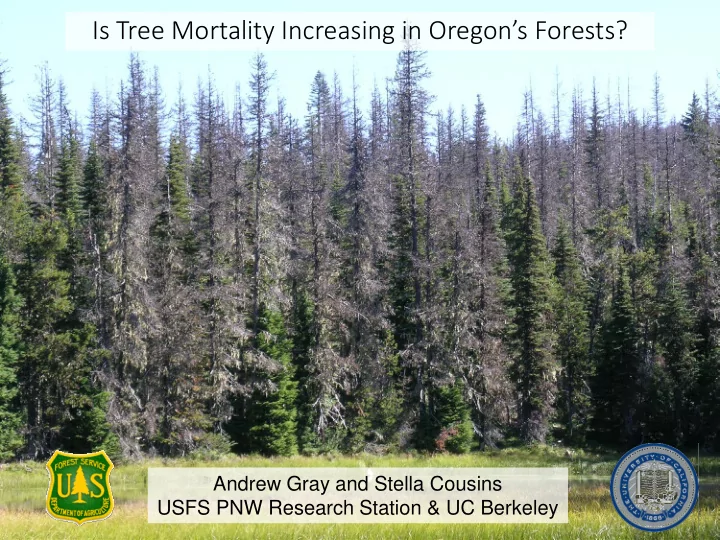
Is Tree Mortality Increasing in Oregon’s Forests?
Andrew Gray and Stella Cousins USFS PNW Research Station & UC Berkeley
Is Tree Mortality Increasing in Oregons Forests? Andrew Gray and - - PowerPoint PPT Presentation
Is Tree Mortality Increasing in Oregons Forests? Andrew Gray and Stella Cousins USFS PNW Research Station & UC Berkeley Outline What is background mortality? What are the patterns of tree mortality over the last decade? What
Andrew Gray and Stella Cousins USFS PNW Research Station & UC Berkeley
What is background mortality? What are the patterns of tree mortality over the
What is driving mortality in Oregon’s forests? How does this compare with the previous decade?
Stand Age 10 60 120 Sparse density Low density High density
1,000 2,000 3,000 4,000 5,000 6,000 7,000 8,000 9,000 10,000 50 100 150 200
Volume (ft3/ac) Stand age
Total volume
20 40 60 80 100 120 140 160 180 50 100 150 200
Volume rate (ft3/ac/yr) Stand Age
Gross growth Mortality Net growth
Annual components
Acres of forestland: 29,195,481 N trees (million) Percent Live 9,674 Mortality / yr 171 1.8% Cut / yr 40 0.4% Volume (million ft3) Percent 98,882 699 0.7% 1,052 1.1% Overstory / yr 53 1.2% 571 0.7% Understory / yr 118 2.4% 128 1.4% Net growth / yr 1,015 1.0%
Causes of mortality
Disturbance Area (1000 ac)SE Percent Percent/yr Cut 3,477.6 152.4 11.9% 1.2% Fire 1,026.1 81.4 3.5% 0.4% Cut + Fire 161.1 33.9 0.6% 0.1% Insect or Disease 4,100.5 148.3 14.0% 1.4% Weather 524.0 62.9 1.8% 0.2% Incidental Cut 373.7 56.3 1.3% 0.1% None 19,532.4 254.0 66.9% Total 29,195.5 182.9
~45% of area burned in fire was moderate or severe (>60% overstory mortality)
Component Means 90s 95% CI 90s Growth 1.73% 0.04% Mortality
0.07% Cut
0.03% Net change 0.50% 0.08% Mean 00s 95% CI 00s 2.01% 0.06%
0.07%
0.03% 0.98% 0.10%
Unburned stands All stands
PIMO3 PIAL ARME TABR2 ABLA PICO PIEN PIMO3 PIAL ARME TABR2 ABLA PICO PIEN
Big losers: madrone, whitebark pine, white pine, subalpine fir, yew, Engelmann spruce, lodgepole
Lintz 2016, Ecol. Ind. 66: 1
All stands
Change in number of trees/yr (%)
2 4
Change in live volume/yr (%)
2 4
PSME PIPO THPL ABCO ABLA LAOC TSME PIEN JUOC CADE27 ACMA3 ARME PIMO3 CHCHC4 PIAL QUCH2 PILA CHNO TABR2 PISI CHLA BEPA PIJE POBAT QUKE CONU4
Unburned stands
Change in number of trees/yr (%)
2 4
Change in live volume/yr (%)
2 4 PSME PIPO TSHE THPL ABCO ABLA LAOC TSME PIEN JUOC CADE27 ACMA3 ARME PIMO3 PIAL QUCH2 PILA CHNO TABR2 PISI CHLA BEPA PIJE POBAT QUKE CONU4
Losers: paper birch, whitebark pine; dogwood + sugar pine losing numbers but gaining volume.
Monleon & Lintz, 2015. Plos One Opportunity to follow-up with ingrowth and mortality
Background mortality is a concept with limited utility Most tree mortality in Oregon is from insects,
Mortality has decreased on National Forests from