Is there a new infinitive in Russian Romani?: a corpus-based study - - PDF document

is there a new infinitive in russian romani a corpus
SMART_READER_LITE
LIVE PREVIEW

Is there a new infinitive in Russian Romani?: a corpus-based study - - PDF document

Corpus-Based Approaches to the Balkan Languages and Dialects, St Petersburg, 5 7 December 2016 Is there a new infinitive in Russian Romani?: a corpus-based study of subject-verb agreement in the subjunctive Kirill Kozhanov,


slide-1
SLIDE 1

Corpus-Based Approaches to the Balkan Languages and Dialects, St Petersburg, 5–7 December 2016

Is there a «new infinitive» in Russian Romani?: a corpus-based study of subject-verb agreement in the subjunctive Kirill Kozhanov, kozhanov.kirill@gmail.com Institute for Slavic Studies RAS, Moscow

  • 1. Introduction

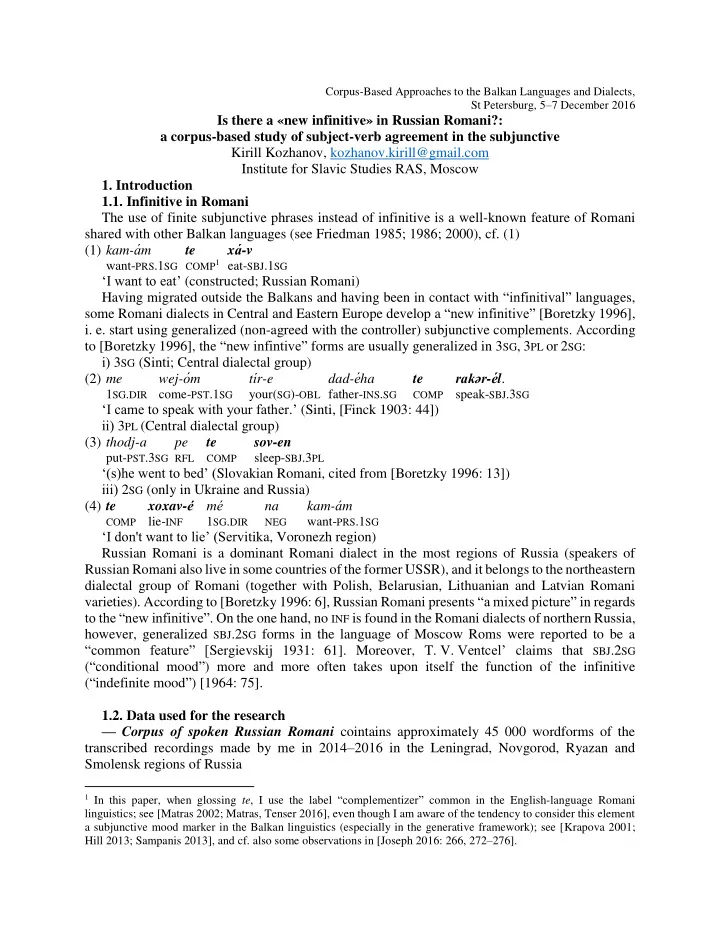
1.1. Infinitive in Romani The use of finite subjunctive phrases instead of infinitive is a well-known feature of Romani shared with other Balkan languages (see Friedman 1985; 1986; 2000), cf. (1) (1) kam-a ́ m te xa ́ -v

want-PRS.1SG COMP1 eat-SBJ.1SG

‘I want to eat’ (constructed; Russian Romani) Having migrated outside the Balkans and having been in contact with “infinitival” languages, some Romani dialects in Central and Eastern Europe develop a “new infinitive” [Boretzky 1996],

  • i. e. start using generalized (non-agreed with the controller) subjunctive complements. According

to [Boretzky 1996], the “new infintive” forms are usually generalized in 3SG, 3PL or 2SG: і) 3SG (Sinti; Central dialectal group) (2) me wej-óm tír-e dad-éha te rakǝr-él.

1SG.DIR come-PST.1SG your(SG)-OBL father-INS.SG

COMP speak-SBJ.3SG

‘I came to speak with your father.’ (Sinti, [Finck 1903: 44]) іі) 3PL (Central dialectal group) (3) thodj-a pe te sov-en

put-PST.3SG RFL

COMP

sleep-SBJ.3PL

ʻ(s)he went to bedʼ (Slovakian Romani, cited from [Boretzky 1996: 13]) ііі) 2SG (only in Ukraine and Russia) (4) te xoxav-ê mê na kam-âm

COMP lie-INF

1SG.DIR

NEG

want-PRS.1SG

‘I don't want to lie’ (Servitika, Voronezh region) Russian Romani is a dominant Romani dialect in the most regions of Russia (speakers of Russian Romani also live in some countries of the former USSR), and it belongs to the northeastern dialectal group of Romani (together with Polish, Belarusian, Lithuanian and Latvian Romani varieties). According to [Boretzky 1996: 6], Russian Romani presents “a mixed picture” in regards to the “new infinitive”. On the one hand, no INF is found in the Romani dialects of northern Russia, however, generalized SBJ.2SG forms in the language of Moscow Roms were reported to be a “common feature” [Sergievskij 1931: 61]. Moreover, T. V. Ventcel’ claims that SBJ.2SG (“conditional mood”) more and more often takes upon itself the function of the infinitive (“indefinite mood”) [1964: 75]. 1.2. Data used for the research — Corpus of spoken Russian Romani cointains approximately 45 000 wordforms of the transcribed recordings made by me in 2014–2016 in the Leningrad, Novgorod, Ryazan and Smolensk regions of Russia

1 In this paper, when glossing te, I use the label “complementizer” common in the English-language Romani

linguistics; see [Matras 2002; Matras, Tenser 2016], even though I am aware of the tendency to consider this element a subjunctive mood marker in the Balkan linguistics (especially in the generative framework); see [Krapova 2001; Hill 2013; Sampanis 2013], and cf. also some observations in [Joseph 2016: 266, 272–276].

slide-2
SLIDE 2

2

— Corpus of Russian Romani (http://web-corpora.net/RomaniCorpus) contains approximately 720 000 wordforms of the texts published in the Soviet Union in 1920–30s; the examples for this paper were taken only from the subset of the original fiction For this research I used all examples of SBJ2 from the dialectal corpus and the same amount of random examples (from different authors) from the corpus of the standard language. The number

  • f examples and the persentage of agreed forms are given in Table 1.

Table 1. Number of analyzed SBJ examples (agreed vs. generalized) agreed SBJ generalized SBJ Total standard 322 94 416 77% 23% 100% dialectal 291 125 416 70% 30% 100%

  • 2. Types of analyzed contexts

All uses of SBJ can be divided into two groups: і) SBJ in complement clauses (5) Romn'a čavorenca i roma riskirna bala pre peste, umang-ena e ra-s te

  • tmek-el

pro parno sveto te podživ-en.

ask-PRS.3PL ART lord-OBL.SG COMP let-SBJ.3SG on white world

COMP live-SBJ.3PL

‘Romani women with their children and Roms tear their hair out, asking the lord to let them live in freedom’ (standard; Mix. Il'insko. Šatrytko jag. 1934.) ii) SBJ as an independent predicate (optative, conditional, questions etc.) (6) ...kûč isŷs, džind'âm, te merâv,

  • ̂j!

good be.PST.3 live-PST.1PL

COMP

die-SBJ.1SG

  • h

‘it was good, [the way] we lived, upon my life, oh!’ (dialectal; Ryazan' region)

Table 2. Number of analyzed SBJ examples (complements vs. independent predicate) complements independent Total standard 345 71 416 83% 17% 100% dialectal 239 177 416 57% 43% 100%

2.1. Complements Table 3 clearly shows that the distribution of agreed vs. nonagreed SBJ forms is not random but is related to the type of the selecting predicate in the main clause. — finite verbal form (including borrowed verbs with the Russian morphology, SBJ and IMP) (7) Romn'-a učakird-e dro pernycy peskir-en bokxal-en čavor-en,

rom.female-DIR.PL cover-PST.3PL in feather.beds

  • wn-OBL.PL hungry-OBL.PL child-OBL.PL

so by te na šun-en, syr jone rov-ena i mang-ena te xa-s

in.order.to COMP NEG hear-SBJ.3PL how 3.PL.DIR cry-PRS.3PL and ask-PRS.3PL COMP eat-SBJ.2SG

‘Romani women covered their hungry children in the blankets in order not to hear how they're crying and asking to eat’ (standard; A. Germano. Atas'atuno burmistro. 1930) — adjective (including borrowed Russian short forms) (8) patóm mé dólžen te rospxen-a ́ v sy ́ r só kerd'-a ́ -pe

then 1SG.DIR owing

COMP tell-SBJ.1SG

how what do-PST.3SG-RFL

‘then I have to tell what and how happened’ (dialectal; Leningrad region)

2 Only the verbs with the Romani morphology were taken into consideration.

slide-3
SLIDE 3

3 Table 3. Types of selecting predicates in the matrix clause Standard Dialectal Agreement no % yes % Total no % yes % Total FiniteV 12 5 232 95 247 7 5 131 95 138 Adjective 13 100 13 19 100 19 Impersonal 5 28 13 72 18 2 33 4 67 6 Predicative 44 79 12 21 56 44 73 16 27 60 Copula 3 43 4 57 7 8 100 8 NP 4 100 4 3 50 3 50 6 Null 2 100 2 Participle 1 100 1 “Davaj” 2 100 2

— finite “impersonal” verbs (pridžâlpe ‘must’, kamêlpe ʻwantʼ etc.) (9) Leske prigyj-a-pe mištes te band'o-s, sob te prodža-l

3SG.DAT must-PST.3SG-RFL well

COMP bow-PRS.2SG

in.order.to

COMP

pass-SBJ.3SG

dre nabari porta...

in small gate

‘He had to bow down strongly in order to pass through a small gate…’ (standard; M. Pol'akova. Romane rakiribe. 1931) — predicatives (móžno ‘it's possible’, trébi/čébi ‘it needs’, ža ́ lko ‘it's pity’ etc.) (10) Jov zlyj-a stady, bankird'-a šero i pučj-a gadž-en,

3SG.DIR.M take.off-PST.3SG hat bow-PST.3SG head and ask-PST.3SG non-Rom-OBL.PL

palso tr'ebi te mar-es pxuromn'-a

why need

COMP beat-SBJ.2SG

  • ld.woman-OBL.SG

‘He took off his hat, made a bow and asked the non-Roms, why it is necessary to beat the old woman’ (standard; A. Germano. Les kxarde ruvesa... 1933) (11) čêbi mânge ke tû te džâ-v

need 1SG.DAT to 2SG.DIR

COMP go-SBJ.1SG

‘I need to come to you’ (dialectal; Novgorod region) — copula (usually negated) (12) nané ka ́ j skot-ós te mek-és

NEG.be.PRS.3

where livestock-OBL.SG

COMP

let-SBJ.2SG

‘there is nowhere to let the livestock [be at grass]’ (dialectal; Novgorod region) — noun phrases (13) manuš-â zažŷtočna, barvalê, sô da, prabl'êma te l-ên?

person-DIR.PL wealthy, rich, what this problem

COMP take-SBJ.3PL

‘[these] people are wealthy, rich, what is it, a problem to get [horses for the wedding ceremony]?’ (dialectal; Smolensk region) — null predicate (14) Me ko starosta lav-esa te umang-av

1SG.DIR to village.head word-INS.SG COMP ask-SBJ.1SG

‘I am [going] to the village head in order to convince him verbally’ (standard; M. Il'insko. Šatrytko jag. 1934)

slide-4
SLIDE 4

4

— participles (15) …dyj-a duma peske S'erga ge-i štal-atyr

thought-PST.3SG self.DAT S'erga-DIR.SG go-PTCP barn-ABL.SG

pre kolxozoskiri greda te

  • bdykhel

inv'entar'o.

  • n

kolkhoz-GEN.SG-DIR.SG.F yard-DIR.SG

COMP

  • bserve-SBJ.3SG

equipment-DIR.SG

‘...Serga thought while walking from the barn to the kolkhoz yard to check the equipment’ (standard; M. Bezl'udsko. Graj. 1933) — “davaj” (in the ingressive construction) (16) dava ́ j te rodén gvózd'o

davaj

COMP search-SBJ.3PL nail-DIR.SG

‘[they] started looking for a nail’ (dialectal; Leningrad region) 2.2. Independent predicate As can be seen from Table 4, SBJ, when used as an independent predicate, appears in agreed or nonagreed form in different constructions (cf., for instance, optative vs. question).

Table 4. Types of uses of SBJ as an independent predicate Standard Dialectal Agreement no % yes % Total no % yes % Total Optative 2 6 29 94 31 2 6 30 94 32 Conditional 1 33 2 67 3 5 18 23 82 28 Question 16 67 8 33 24 29 83 6 17 35 Comparative 1 100 0 1 2 100 0 2 “Independent” 3 60 2 40 5 9 90 1 10 10 “must” 1 50 1 50 2 9 35 17 65 26 Purpose 1 50 1 50 2 3 7 39 93 42 Time subord 1 33 2 67 3 Relative 2 100 0 2

— optative (17) ...rom-ale, čav-en te garav-av, koli xoxav-ava

Rom-VOC.PL child-OBL.PL

COMP bury-SBJ.1SG if

lie-PRS.1SG

‘Roms, I [swear to] bury my children, if I'm lying’ (standard; L. Svetlovo. Rom Xvas'u. 1938) — conditional subordinate clauses (18) a ́ ke tumé te av-én de vójna, tumé pat'-a ́ n-as,

here 2PL.DIR

COMP be.SBJ.2PL in war

2PL.DIR believe-2PL-IMPF

  • ́j,

amé gór'o dyxt'-a ́ m

  • h

1PL.DIR suffer see-PST.1PL

ʻif you were at war, you would believe, oh, we saw sufferingʼ (dialectal; Novgorod region) — questions (19) Ne so akana mange te ker-es?..

well what now 1SG.DAT

COMP do-SBJ.2SG

‘So what should I do now?’ (standard; A. Germano. Romano t'eatro. 1932) (20) karîg rom-ênge te ker-ên-pe?

where.to Rom-DAT.PL

COMP

do-SBJ.3PL-RFL

‘where should the Roms go?’ (dialectal; Novgorod region)

slide-5
SLIDE 5

5

— comparative subordinate clauses (21) čém o mó-sa te mar-és, fedy ́r karanda ́ šo zevadít'

than

ART mouth-OBL.SG COMP beat-SBJ.2SG better pencil

aquire[BOR].INF

‘rather than blabbing, it's better to get a pencil’ (dialectal; Leningrad region) — “independent” uses (often for description) (22) sovlâx. te l-ês sovlâx

  • ath.DIR.SG

COMP take-SBJ.2SG oath.DIR.SG

‘an oath. to take an oath’ (dialectal; Leningrad region) — “must” modal contexts (23) …oke so F'ed'a, te naš-as, hal'ov, i amenge adatyr e grex-ostyr.

here what Fyedya COMP run-SBJ.1SG propably and 1PL.DAT from.here ART sin-ABL.SG

‘so Fyedya, it seems like we have to run away from here prudently’ (standard; M. Bezl'udsko. Psiko ko psiko. 1933) — “purpose” contexts (similar to complements) (24) ne štop te vyxâ-l-pe grâj

well in.oder.to

COMP get.full-SBJ.3SG-RFL horse.DIR.SG

‘so the horse would eat itself up’ (dialectal; Ryazan' region) — time subordinate clauses (25) Ne usataki, angil odova syr te vydža-n gav-estyr,

well however before this how COMP leave-SBJ.3PL village-ABL.SG

pripxend'-a parn-engir-o baredyr te ublad-es koj-kon-es...

  • rder-PST.3SG

white-GEN.PL-DIR.SG.M boss

COMP hang-SBJ.2SG IDEF-who-OBL

‘But anyways, before leaving the village, the head of the Whites ordered to hang someone…’ (standard; M. Bezl'udsko) — relative clauses (26) zbruja lači kaj pe gr-ende te urj-é

harness good

REL

  • n

horse-LOC.PL

COMP

wear-NA

‘good harness which is put on horses’ (dialectal; Ryazan')

  • 3. Possible factors influencing subject-verb agreement in SBJ

3.1. Coreferentiality Hypothesis: When the subject of the complement clause is not coreferential with the subject of the matrix clause, there is higher possibility of non-agreed verbal form. This factor is checked against the subset of the SBJ complements with the finite verb in the main clause.

Table 5. Coreferentiality of subjects in the matrix and complement clauses vs. (non)agreed SBJ Standard Dialectal Coreferent Agreement no % yes % Total no % yes % Total no 6 12 45 88 51 2 7 25 93 27 yes 5 3 182 97 187 4 4 106 96 110 Fisher's exact test, p-value = 0.014 238 Fisher's exact test, p-value = 0.337 137

The dependence of agreement in SBJ on the coreferentiality of subjects in complement and matrix caluses seems to be significant in the sample from the Corpus of standard Russian Romani,

  • i. e. non-coreferentiality of subjects leads to higher possibility of nonagreement.
slide-6
SLIDE 6

6

The (non)coreferentiality may lead to other mistakes in the subject-verb agreement; cf. (27) where the first SBJ is mistakenly agreed with the (not-coreferent) subject of the verb in the matrix clause, and the next two SBJ forms are agreed with their subject: (27) ...razrišâju tûke te nosin-âv barê balâ, te čor-ês

allow[BOR].PRS.1SG 2SG.DAT

COMP wear-SBJ.1SG big-PL hair-DIR.PL COMP steal-SBJ.2SG

i te xoxav-és

and

COMP lie-PRS.2SG

‘I allow you to wear long hair, to steal and to lie’ (dialectal; Leningrad region) 3.2. (Lexical) presence of the subject of the matrix predicate Hypothesis: (Lexical) presence of the subject in the matrix predicate leads to higher possibility

  • f agreement in SBJ.

This factor is checked against the subset of the FinV selected SBJ complements (subjects are coreferent).

Table 6. Lexical presence of the subject in the matrix clause vs. (non)agreed SBJ Standard Dialectal MatrixSubj Agreement no % yes % Total no % yes % Total nom 5 4 114 96 119 37 100 37 null 68 100 68 4 5 69 95 73 Fisher's exact test, p-value = 0.161 187 Fisher's exact test, p-value = 0.298 110

There seems to be no dependency of the matrix clause subject's lexical presence on the agreement in SBJ in the complement. 3.3. (Lexical) presence of the subject of SBJ Hypothesis: (Lexical) presence of the subject of SBJ makes it more possible for the SBJ form to be agreed. This factor is checked against the subset of the non-coreferent SBJ complements and independent SBJ uses.

Table 7. Lexical presence of the subject in V selected non-coreferent complement vs. (non)agreed SBJ Standard Dialectal Subject Agreement no % yes % Total no % yes % Total yes 4 12 29 88 33 2 13 13 87 15 no 2 11 16 89 18 12 100 12 Fisher's exact test, p-value = 1 51 Fisher's exact test, p-value = 0.487 27

slide-7
SLIDE 7

7 Table 8. Lexical presence of the subject in Impersonal selected complement vs. (non)agreed SBJ Standard Dialectal Subject Agreement no % yes % Total no % yes % Total yes 2 20 8 80 10 no 3 37,5 5 62,5 8 2 33 4 67 6 Fisher's exact test, p-value = 0.608 18 Fisher's exact test, p-value = 1 6 Table 9. Lexical presence of the subject in predicative selected complement vs. (non)agreed SBJ Standard Dialectal Subject Agreement no % yes % Total no % yes % Total yes 2 33 4 67 6 4 100 4 no 42 84 8 16 50 44 79 12 21 56 Fisher's exact test, p-value = 0.101 56 Fisher's exact test, p-value = 0.004 60 Table 10. Lexical presence of the subject in questions vs. (non)agreed SBJ Standard Dialectal Subject Agreement no % yes % Total no % yes % Total yes 1 33 2 67 3 1 100 1 no 15 71 6 29 21 29 85 5 15 34 Fisher's exact test, p-value = 0.249 24 Fisher's exact test, p-value = 0.171 35

  • 4. So is there a “new infinitive” in Russian Romani?

In Russian Romani the only possible criterion for distinguishing finite vs. nonfinite seems to be morphological, i.e. an ability of the verbal form to show agreement for person.

Table 11. Finite vs. nonfinite verbal forms in Russian Romani Finite Non-finite present/simple future, past, imperfect, analytical future, imperative, subjunctive (?) 3 types of participles: i) with adjectival endings; ii) participles derived with -i; iii) participles derived with -ndoj

Infinitives can be defined “in terms of language-particular criteria, such as morphological marking, plus a consideration of language-universal functional criteria, with the added stipulation that this category demonstrably useful in the grammar” [Joseph 1983: 34]. Generalized 2SG.SBJ forms usually appear only in certain contexts (in the predicative or copula selected complements, questions) whose common denominator is a lack of specified subject (cf. the Unspecified Human Subject construction in [Perlmutter 2008]). Some factors (e.g., non- coreferentiality of subjects in the complement and matrix clauses) can be an additional obstacle for the speaker's ability to “find” the controller correctly. Other factors (lexical presence of the subject) can, on the other hand, help speakers in agreeing the verbal form with the subject.

slide-8
SLIDE 8

8

Thus, bearing in mind the lack of special morphological marking for the infinitive, and a semantically narrow distribution of generalized SBJ.2SG forms (usually in contexts with an “unspecified” subject), there seems to be no need in distinguishing infinitive as a special category in Russian Romani. A much more logical approach to generalized SBJ.2SG forms would be to see them as a default agreement form (in terms of [Corbett 2006]). It can be further specified as an “exceptional case default”; see [Corbett 2006: 147–149], i.e. it appears only when a canonical subject is lacking. It should also be noticed that this default form is used only with verbs that can potentially have a subject. If the verb in SBJ is “impersonal” itself, it takes SBJ.3SG form, cf. (28) Toko pxen peskr-e devl-eske, soby te ud-el-pe

  • nly

say.IMP.2SG own-OBL God-DAT.SG in.oder.to COMP manage-SBJ.3SG-RFL

gr-es te dores-av

horse-OBL.SG

COMP

acquire-SBJ.1SG

‘But tell [it to] your God, in order that I manage to get that horse’ (standard; A. Germano. Les kxarde ruvesa... 1933) The choice of 2SG as a default form is probably not random but can be semantically explained;

  • cf. generalized meaning of 2SG; the point also adressed in [Boretzky 1996: 11]. Thus, the

costructuions with generalized (or unspecified) subject can be seen as the source of this default

  • form. Only later this default form “mistakenly” spread to other constructions (calquing the Slavic

infinitive).

  • 5. Special form for non-agreement

The “new infinitive” in Servitika (traditional Romani dialect of Ukraine, also widely spoken in southern Russia) is a distinct verbal form not corresponding to any paradigm forms, cf. Table 12:

Table 12. Servitika present tense conjugation šun- ‘to listen, hear’ solax- ‘to take

  • ath’

SG PL SG PL

1 2 3 šuna ́ v šunéx šunél šuna ́ x šunén šunén solaxâv solaxâx solaxâl solaxa ́ x solaxa ́ n solaxa ́ n

INF

te šuné te solaxa ́

In some varieties of Russian Romani (in my recordings it seems consistent in the language of Bobry, a clan of Russian Romani which traditionally wandered in southern Russia) a form with no personal marking is also used but differently from Servitika, namely only in contexts with no “specified” subject, cf. (28–31) (all examples are taken from the speakers living in one location – the Shumash village in the Ryazan' region) (28) jôj na džâl kxerê, kamêl ko ženîxo te džâl

3.DIR.SG.F NEG go-PRS.1SG home want-PRS.3SG to groom-DIR.SG COMP go-SBJ.3SG

‘she doesn't go home, she wants to go to her groom’ (29) rân'še gr-ên že naštŷ sŷs te xâ

earlier horse-OBL.PL PTCL not.allowed be.PST.3 COMP eat.NA

‘back in the day it wasn't allowed to eat horses’ (30) harâ na sŷs sô te xâ

long.ago NEG be.PST.3 what

COMP eat.NA

‘back in the day there was nothing to eat’ (31) ne i sô te ker-ê?

well and what

COMP do-NA

‘so what one should do?’

slide-9
SLIDE 9

9

The development of the “new infinitive” in Servitika can be explained by the loss of final s in 2SG; see [Boretzky 1996; Matras, Tenser 2016: 349]. It is probably a correct explanation bearing in mind that historical variation in the realization of final s led to the two functionally distinct verbal forms — 2SG and INF. However, in Russian Romani final s is always stable, so the forms with no personal endings in this dialect cannot be explained by historical phonetics, and must have been borrowed from Servitika. Such explanation seems especially plausible if one considers the fact that this form is used consistently only in the language of Russian Roms who traditionally lived in southern Russia and must have interacted with Servuja. Nevertheless, the borrowing wasn't complete as long as in Russian Romani it only used in the contexts with no overt subject, in other words it was borrowed only as a special default form. Thus, it is a very interesting case of a PAT- borrowing with a restricted functional distribution (different from the one found in the source)3.

  • 6. Conclusions

— Russian Romani hasn't acquired a “new infinitive”, but developed a default agreement form (2SG.SBJ) appearing usually only in cases when the subject for some reason cannot be specified. Rarely this default agreement form may appear in contexts with an overt subject as well, calquing the use of the Slavic infinitnive. — The subject is not specified in certain contexts, namely with the predicative and copula selecting complements, in questions. — In case of non-coreferential subjects of the main and complement clauses, there is a higher possibility of nonagreement in SBJ. — Lexical presence/absence of the subject in the main clause does not seem to have any statistically significant influence on the agreement in SBJ. — Lexical presence of the subject of SBJ, on the other hand, leads to higher possibility of agreement in SBJ. — In some southern varieties of Russian Romani a special form with no marking for person has been borrowed from another dialect of Romani — Servitika where it functions as an infinitive. In Russian Romani, however, its use is restricted only to default agreement cases (identical to generalized SBJ.2SG in other varieties of Russian Romani).

3 In the language of some Russian Romani speakers living in Ukraine (e.g. Chernihiv; the data taken from the ongoing

project funded by the "Vidrodzhenn'a" foundation) the form with no marking for person and number functions as in Servitika.

slide-10
SLIDE 10

10

Abbreviations 1, 2, 3 — 1, 2, 3 person; ABL — ablative; ART — article; BOR — borrowed verb with the Russian morphology; COMP — complementizer; DAT — dative; DIR — direct form; F — feminine; GEN — genitive; IDEF — indefinite; IMP — imperative; IMPF — imperfect; INF — infinitive; INS — instrumental; LOC — locative; M — masculine; NA — non-agreement marker; NEG — negation marker; OBL — oblique form; PL — plural; PRS — present tense; PST — past tense; PTCP — participle; REL — relativizer; RFL — reflexive; SBJ — subjunctive; SG — singular; VOC — vocative Literature Boretzky N. The “new” infinitive in Romani. Journal of the Gypsy Lore Society, 5th series, 6, 1996, 1–51. Corbett, Gr. G. 2006. Agreement. Cambridge: Cambridge University Press. Joseph, B. D. 1983. The Synchrony and Diachrony of the Balkan Infinitive. Cambridge: Cambridge University Press. Joseph, B. D. 2016. The semantics and syntax of complementation markers as an areal phenomenon in the Balkans, with special attention to Albanian. In: Boye, Kasper / Kehayov, Petar (eds.) Complementizer Semantics in European Languages. 265–292. Finck, Fr. N. 1903. Lehrbuch des Dialekts der deutschen Zigeuner. Marburg: N. G. Elwert’sche Verlagsbuchhandlung. Friedman, V. A. 1985. Balkan Romani Modality and Other Balkan Languages. Folia Slavica 7(3), 381-389. Friedman, V. A. 1986. Romani te in a Balkan context. Językowe udia bałkanistyczne I, 39-48. Friedman, V. A. 2000. Romani in the Balkan Linguistic League. In: Ch. Tzitzilis and Ch. Symeonidis (eds.) Balkan Linguistik: Synchronie und Diachronie. Thessaloniki: University of

  • Thessaloniki. 95-105.

Hill, V. 2013. The emergence of the Romanian subjunctive. The Linguistic Review. 30 (4): 1–37. Krapova, I. 2001. Subjunctives in Bulgarian and Modern Greek. In: Marîa-Luisa Rivero & Angela Ralli (eds.) Comparative Syntax of Balkan Languages. Oxford University Press. 105–126. Matras, Y. 2002. Romani: A linguistic introduction. Cambridge: Cambridge University Press. Matras, Y. & Tenser, A. 2016. Complementizers in Romani. In: Boye, Kasper / Kehayov, Petar (eds.) Complementizer Semantics in European Languages. 341–375. Perlmutter, D. M. 2008. In what ways can finite and nonfinite clauses differ? Evidence from

  • Russian. In: I. Nikolaeva (ed.) Finiteness: Theoretical and Empirical Foundations. Oxford:

Oxford University Press. Sampanis, K. 2013. A diachronic and typological approach to the Modern Greek subjunctive

  • complementation. University of Salzburg, 2011. Journal of Greek Linguistics 13(1), 165–169.

Sergievskij, M.V. 1931. Cyganskij jazyk. Kratkoe rekovodstvo po grammatike i pravopisaniju. Moskva. Ventcel', T. V. 1964. Cyganskij jazyk (severnorusskij dialekt). Moskva: Nauka.