12-11-06 Phylogenetics 1: An overview Phylogenetics 1: An overview - - PDF document

12 11 06
SMART_READER_LITE
LIVE PREVIEW

12-11-06 Phylogenetics 1: An overview Phylogenetics 1: An overview - - PDF document

12-11-06 Phylogenetics 1: An overview Phylogenetics 1: An overview Phylogenetic tree used in The Origin of Species . Darwin wasnt just thinking about The affinities of all beings of the same class have classification based on phylogenies.


slide-1
SLIDE 1

12-11-06 1

Phylogenetics 1: An overview

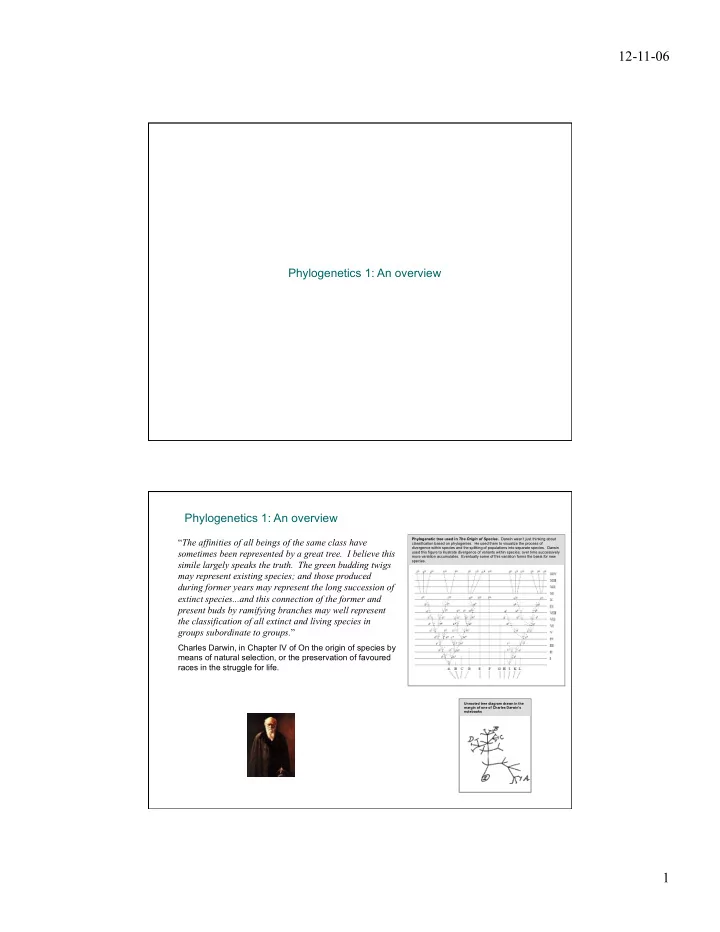
“The affinities of all beings of the same class have sometimes been represented by a great tree. I believe this simile largely speaks the truth. The green budding twigs may represent existing species; and those produced during former years may represent the long succession of extinct species...and this connection of the former and present buds by ramifying branches may well represent the classification of all extinct and living species in groups subordinate to groups.”

Charles Darwin, in Chapter IV of On the origin of species by means of natural selection, or the preservation of favoured races in the struggle for life.

Phylogenetics 1: An overview

Unrooted tree diagram drawn in the margin of one of Charles Darwin’s notebooks

Phylogenetic tree used in The Origin of Species. Darwin wasn’t just thinking about

classification based on phylogenies. He used them to visualize the process of divergence within species and the splitting of populations into separate species. Darwin used this figure to illustrate divergence of variants within species; over time successively more variation accumulates. Eventually some of this variation forms the basis for new species.

slide-2
SLIDE 2

12-11-06 2

Phylogenetics: The biological discipline devoted to reconstructing, gene or genome phylogenies

Growth of phylogenetics: 1. Phylogenetic methods (1960’s) 2. Recognition that phylogenies were relevant to nearly all disciplines of biology (1970’s?) 3. Molecular biotechnology revolution [PCR] (1980’s) 4. Economics of computational capacity (1990’s)

0.1 Scale bar

Phylogenetics 1: An overview

clade

slide-3
SLIDE 3

12-11-06 3

Phylogenetics 1: An overview

  • Analogy
  • Homology
  • Polarity
  • Ancestral character
  • Derived character

Phylogenetics 1: An overview

0.1

Felis Canis Ursus Bos Hippopotamus Physeter Balaenoptera Rhinoceros Equus

Branch lengths estimated under the assumption of the molecular clock Tips are contemporary; the distance from root to each tip is the same Root

0.1

Felis Canis Ursus Bos Hippopotamus Physeter Balaenoptera Rhinocero s Equus

Tips are NOT contemporary; the distance from root to each tip is NOT the same Branch lengths estimated without assumption of the molecular clock

slide-4
SLIDE 4

12-11-06 4

The phylogenetic comparative method

Hypothetical dataset for phenotype (Y) and ecological variable (X)

Y X

Two point dataset from early in evolutionary history

Y X Hypothetical example: Y: size of a primates big toe X: The stubbiness of the habitat

The phylogenetic comparative method

Hypothetical dataset with points coloured according to clade of origin

Y X

“Little-toed” clade “Big-toed” clade Phylogeny of two groups of close relatives

Recent diversifications Old divergence of “big-toed” and “little-toed” primates “Big-toe clade” “Little-toe clade”

Species are NOT drawn independently from the same distribution. “phylogenies are fundamental to comparative biology; there is no doing it without taking them into account”

⎯ Joseph Felsenstein

slide-5
SLIDE 5

12-11-06 5

Applications of phylogenetics

1. Sytematics, classification, and taxonomy 2. Biogeography 3. Health Sciences 4. Agriculture 5. Conservation 6. Linguistics

Applications of phylogenetics: systematics

ERNST HAECKEL’S “TREE OF LIFE”, DRAWN SOMETIME IN THE LATE 1800’S Placed Menschen (“Men”) at the “top” of the tree among the Affen (“Apes”). Haeckle was first to suggest man’s ancestry was among the Great Apes. This tree was a tree of “men”, and Haeckels’s placement of Menschen at the top was intentional

Non-mammalian vertebrates Invertebrates Protozoa

This tree and associated system of classification is different from modern ones in that it is based on the notion of linear progress (like a ladder) from the most primitive single-celled

  • rganisms “upwards” to

man (at the very top). Haeckel considered the things near the top as “more evolved” and things near the bottom as “primitive”. Ernst Haeckel (1834-1919) was a German biologist and scientific illustrator. He was

  • ne of the first popularizers
  • f Darwin’s Theory of
  • Evolution. The tree to the

left is from his book “General Morphology – founded on the descent theory”.

slide-6
SLIDE 6

12-11-06 6

Applications of phylogenetics: systematics

Monophyly, paraphyly and polyphyly

E D C B A H J G F

Paraphyletic group (AHJGFDE) and a polyphyletic group (BC)

H A B J G F C D E

Monophyletic group

[Clade]

slide-7
SLIDE 7

12-11-06 7

The old Reptilia as an example of classification based on a paraphyletic group.

Lepidosauromorph (lizards snakes, etc.) Anapsids (turtles and relatives) Mammals (Synapsids) Crocodylomorph (gators and crocs) Old Reptilia is a GRADE Amniota is a clade Ornithischia (some plant eating dinosaurs) Lots of dinosaur diversity Aves (birds) Diversity of extinct mammal-like reptiles

Applications of phylogenetics: systematics

I am a synapsid too!

Applications of phylogenetics: systematics

http://www.tolweb.org/tree/

slide-8
SLIDE 8

12-11-06 8

Applications of phylogenetics: biogeography

WEST: low elevation and dry EAST: high elevation and wet

Phylogeorgaphy allows one to test hypotheses such as whether geographic/ environmental factors have been historically important barriers to gene flow.

slide-9
SLIDE 9

12-11-06 9

Applications of phylogenetics: biogeography of mouse lemurs

Figure adapted from separate figures in A. D. Yoder (2004) In press

Phylogeographic analysis of mouse lemurs contradicts the expected east-west disjunction for Madagascar, and suggests a completely novel north-south disjunction. The observed phylogenetic tree was inferred from mitochondrial DNA gene sequences.

Applications of phylogenetics: biogeography of mouse lemurs

slide-10
SLIDE 10

12-11-06 10

Applications of phylogenetics: biogeography of mouse lemurs Applications of phylogenetics: biogeography ⇒ conservation

slide-11
SLIDE 11

12-11-06 11

Applications of phylogenetics: Ann Yoder’s research group Applications of phylogenetics: Health Sciences and HIV

slide-12
SLIDE 12

12-11-06 12

Applications of phylogenetics: Health Sciences and HIV

HIV-1 genome: HIV-1 genome:

HIV transmission in health care:

  • 1. Patient ⇒ health care worker: well known
  • 2. Health care worker ⇒ patient: unknown

CDC: epidemiological investigation of dentist with infected patients in 1990’s

  • only risk factor was a common dentist
  • phylogenetics of HIV env gene sequences

Applications of phylogenetics: Health Sciences and HIV

slide-13
SLIDE 13

12-11-06 13

Dentist Patient C Patient A Patient G Patient G Patient B Patient E Patient A Dentist Local No2 Local No3 Patient F Local No9 Local No35 Local No3 Patient D

No other risk factors. All had invasive dental procedures. Sex partner with HIV Behavioral risk for HIV Applications of phylogenetics: Health Sciences and HIV Applications of phylogenetics: agriculture

1. What was the origin of a pest or agricultural disease species? 2. How did some pest organisms evolve resistance to pesticides? 3. How did a pest species spread through agriculture? 4. Are there species that are closely related to known pests that might also cause problems?

slide-14
SLIDE 14

12-11-06 14

Applications of phylogenetics: agriculture

Fusarium: an economically significant fungal crop pathogen

(and health science)

Powerful toxin that inhibits eukaryotic protein synthesis

Applications of phylogenetics: agriculture

Figure adapted from O’Donnell et al. (2000) PNAS, 97:7905-7910.

Genetic divergence among strains of Fusarium indicates that movement of crops among different agricultural settings must be carefully monitored to prevent introduction of “foreign strains”. Local crops are likely to be much less resistant to the “foreign” strains of Fusarium, as compared with the local strain. Phylogenetic tree inferred from the combined gene sequences

  • f six single-copy nuclear gene

sequences (7,120 bp) by using the methods of maximum

  • parsimony. Numbers above the

nodes are bootstrap proportions. Fursarium garminariam is a fungal pathogen of commercially important species of

  • grains. Phylogenetic analysis indicates substantial genetic divergence among

strains in different agricultural settings.

slide-15
SLIDE 15

12-11-06 15

Applications of phylogenetics: conservation

This article highlights three uses of the comparative method in conservation: (i) develop predictive models for risk assessment (ii) identifying the general ecological principles that cause conservation problems (iii) identifying and using endangering traits as triage to prioritize research and conservation efforts Potential pitfalls are: (i) large and expensive sample sizes required for high power of the method (ii) problems with correlation-based methods to identify causal mechanisms Despite the limitations, it seems that the comparative method will grow to be one of many essential tools for conservation research. A hypothetical example from this paper is presented blow that illustrates how application of fisher’s exact test to the raw data (ignoring phylogenetic non-independence) overestimate the relationship between extinction risk and body size

Should we use a Fisher exact test?

Applications of phylogenetics: linguistics

Language phylogeny and divergence dates support the Anatolian-origin theory of the Indo-European language family.

Grey and Atkinson (2003) Nature 426:435-439

Data: Cognate word forms were sampled from 87 languages. Three extinct languages thought to be more distantly related than the extant languages were included for the purpose of rooting the

  • tree. Cognates were coded as present or

absent (1 or 0) for each language. The final dataset was a binary matrix of 2,449 cognates. Methods: Phylogenetic analysis was conducted under a stochastic model binary character evolution that allowed for unequal character state frequencies, and heterogeneous rate of evolution among

  • cognates. Bayesian methods were used

to infer the tree topology shown to the left. Values above each branch (in black) are Bayesian posterior probabilities. Divergence times were estimated by first assuming maximum and minimum divergence dates for 11 “calibration nodes” on the phylogeny. A semi parametric likelihood based method was used to infer the divergence dates for the nodes of the phylogeny Extinct languages used as outgroups Root Estimated date of ancestral node

slide-16
SLIDE 16

12-11-06 16

Applications of phylogenetics: manuscript evolution

..discover relationships between different manuscript versions of a text