SLIDE 1
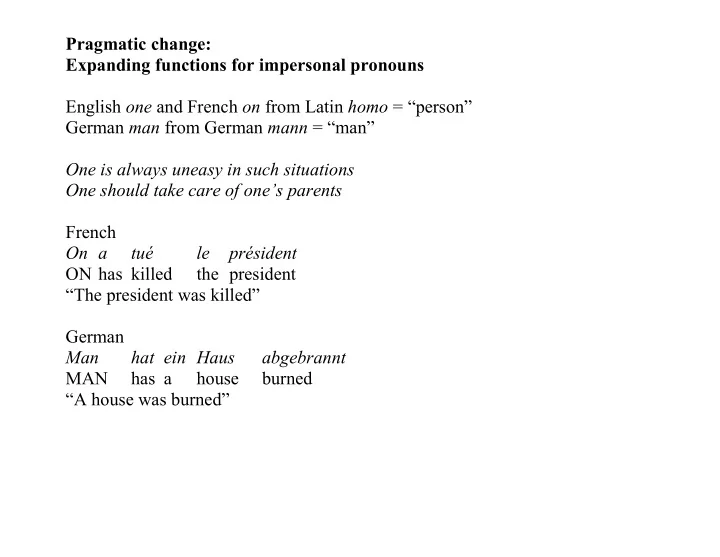
Pragmatic change: Expanding functions for impersonal pronouns English one and French on from Latin homo = “person” German man from German mann = “man” One is always uneasy in such situations One should take care of one’s parents French On a tué le président ON has killed the president “The president was killed” German Man hat ein Haus abgebrannt MAN has a house burned “A house was burned”
SLIDE 2
Semantic change: Drift along metaphoric paths Electrical terminology – metaphors from water: Current, resistence, flow, etc. Syntactic change: a) ac he sigewæpnum forsworen hæfde but he victory-weapons forsworn had b) but he had forsworn (put a spell on) the victory-weapons
SLIDE 3
Sound change: Mostly regular changes in pronunciation – unconditional and conditional Sir William Jones, 1746 - 1794
SLIDE 4
Great Vowel Shift: unconditional sound change
SLIDE 5 Flapping, Grimm’s Law: results of conditioned sound change. Grimm’s law: p f
- r, voiceless stop voiceless fricative
t θ k x Verner’s modifications: p p / s__ p b / P__σ' (P = phoneme, σ = syllable '=stress)
p f otherwise etc.
voiceless stop unchanged / s__ voiceless stop voiced / P__σ
Otherwise, voiceless stop fricative
SLIDE 6
Comparative method of historical reconstruction Word-initial correspondances: English stop /p/ corresponds to the German affricate /pf/ path Pfad pan Pfanne pepper Pfeffer pipe Pfeiffe plant Pflanze plum Pflaume English /t/ ~ German affricate /ts/, written as z tame zahm to zu tongue Zunge ten zehn twenty zwanzig Tin Zinn /d/ in English corresponds to German /t/ day Tag dance tanzen dew Tau devil Teufel drink trinken do tun English “th” sounds correspond to German /d/: that das thick dick thin dünn thirst Durst three drei though doch
SLIDE 7 Polynesian family cognate sets: English Gloss Tongan Maori Samoan Tahitian Hawai'ian
manu manu manu manu manu
ika ika i a i a i a
kai kai ai ai ai
tapu tapu tapu tapu kapu
mata mata mata mata maka
toto toto toto toto koko
SLIDE 8
SLIDE 9 Northern Cities Shift (USA): partial loss of intelligibility
Original segment Many people misheard as First expansion Second expansion drop ??? (nonsense word containing vowel in "that") massive drop the plane was steady for a while and then it took a massive drop socks sacks y'hadda wear socks y'hadda wear socks, no sandals block black
- ne block
- ld senior citizens
living on one block met mutt they met my parents went to Cuba and that's where they met steady study steady for a while the plane was steady for a while and then it took a massive drop head had shook 'er head this woman in while, who just smiled at her and shook 'er head
SLIDE 10
Language Families
In the PBS documentary, we saw a picture of the Indo-European language family that looked like this:
SLIDE 11 The family tree of Indo-European: note that the nodes of the tree are specific languages rather than sub-families. "Vedic" refers to the
- ldest form of Sanskrit, and thus represents the position of Indic in the tree.)
SLIDE 12
The Ethonologue web-page lists 430 modern Indo-European languages. This map shows all of the the other major language families of the world, as well as many of the minor families. Much of the gray territory on this map is the area covered by Indo-European languages. One might object to some of the details of how the languages are divided up here, but it gives a good general idea.
SLIDE 13
Languages of the World
Living Languages Percentage The Americas 1,002 14.5% Africa 2,092 30.3% Europe 239 3.5% Asia 2,269 32.8% The Pacific 1,310 19% TOTAL 6,912 100%
SLIDE 14
A graphical representation of this distribution of sizes can be seen in the figure below, which plots the number of languages with N or more speakers, for N from one to one billion.
Speaker count versus language count: Data from the Ethnologue (1999)
SLIDE 15
The CIA World Factbook (figures are 2004 estimates):
Mandarin Chinese 13.69% Spanish 5.05% English 4.84% Hindi 2.82% Portuguese 2.77% Bengali 2.68% Russian 2.27% Japanese 1.99% Standard German 1.49% Wu Chinese 1.21%
SLIDE 16 Problems of counting
Ethnologue considers the local colloquial varieties of Arabic to be separate
- languages. Here are the largest ones.
Variety Native speakers (in millions) Egyptian 46.3 Algerian 22.4 Morrocan 19.5 Upper Egyptian 18.9 Sudanese 17.5 Lebanese-Syrian 15.0 Iraqi 13.9
SLIDE 17
Serbo-Croatian from fifteen years ago to today: Now - Serbian, Croatian, and Bosnian.
SLIDE 18
"Dialects" again
SLIDE 19
Dialect continuums in Europe
SLIDE 20 Low German & Dutch High German ik ich "I" maken machen "make" dorp dorf "village" (thorp) dat das "that"
Incoherent quote: "Many of the languages listed are technically dialects, not separate
- languages. They are listed separately because they differ from each
- ther enough to be mutually unintelligible."
SLIDE 21
Another IE family-tree diagram:
SLIDE 22
Language fissure:
SLIDE 23
Dialectal/Lectal differentiation resulting in a dialect continuum, also called a linkage:
SLIDE 24
Koineization: