IRC 263(a): New Finalized Repair Regulations for Return Preparers - - PowerPoint PPT Presentation

irc 263 a new finalized repair regulations for return
SMART_READER_LITE
LIVE PREVIEW

IRC 263(a): New Finalized Repair Regulations for Return Preparers - - PowerPoint PPT Presentation

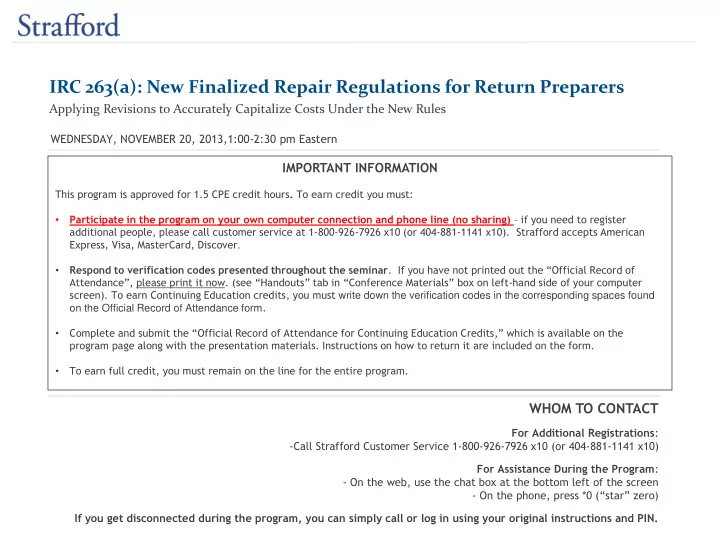
IRC 263(a): New Finalized Repair Regulations for Return Preparers Applying Revisions to Accurately Capitalize Costs Under the New Rules WEDNESDAY, NOVEMBER 20, 2013,1:00-2:30 pm Eastern IMPORTANT INFORMATION This program is approved for 1.5 CPE


slide-1
SLIDE 1

IRC 263(a): New Finalized Repair Regulations for Return Preparers

Applying Revisions to Accurately Capitalize Costs Under the New Rules

WEDNESDAY, NOVEMBER 20, 2013,1:00-2:30 pm Eastern

WHOM TO CONTACT

For Additional Registrations:

  • Call Strafford Customer Service 1-800-926-7926 x10 (or 404-881-1141 x10)

For Assistance During the Program:

  • On the web, use the chat box at the bottom left of the screen
  • On the phone, press *0 (“star” zero)

If you get disconnected during the program, you can simply call or log in using your original instructions and PIN.

IMPORTANT INFORMATION

This program is approved for 1.5 CPE credit hours. To earn credit you must:

  • Participate in the program on your own computer connection and phone line (no sharing) – if you need to register

additional people, please call customer service at 1-800-926-7926 x10 (or 404-881-1141 x10). Strafford accepts American Express, Visa, MasterCard, Discover.

  • Respond to verification codes presented throughout the seminar. If you have not printed out the “Official Record of

Attendance”, please print it now. (see “Handouts” tab in “Conference Materials” box on left-hand side of your computer screen). To earn Continuing Education credits, you must write down the verification codes in the corresponding spaces found

  • n the Official Record of Attendance form.
  • Complete and submit the “Official Record of Attendance for Continuing Education Credits,” which is available on the

program page along with the presentation materials. Instructions on how to return it are included on the form.

  • To earn full credit, you must remain on the line for the entire program.
slide-2
SLIDE 2

Tips for Optimal Quality

Sound Quality Call in on the telephone by dialing 1-866-570-7602 and enter your PIN when prompted, and view the presentation slides online. If you have any difficulties during the call, press *0 for assistance. You may also send us a chat or e-mail sound@straffordpub.com so we can address the problem. Viewing Quality To maximize your screen, press the F11 key on your keyboard. To exit full screen, press the F11 key again.

slide-3
SLIDE 3

Program Materials

If you have not printed or downloaded the conference materials for this program, please complete the following steps:

  • Click on the ^ sign next to “Conference Materials” in the middle of the left-hand column
  • n your screen.
  • Click on the tab labeled “Handouts” that appears, and there you will see a PDF of the

slides and the Official Record of Attendance for today's program.

  • Double-click on the PDF and a separate page will open.
  • Print the slides by clicking on the printer icon.
slide-4
SLIDE 4

IRC 263(a): New Finalized Repair Regulations for Return Preparers

Ellen McElroy, Pepper Hamilton mcelroye@pepperlaw.com

  • Nov. 20, 2013

Rich Shevak, Grant Thornton rich.shevak@us.gt.com

slide-5
SLIDE 5

Today’s Program

General Overview of Regulations Slide 7 – Slide 13 [Ellen McElroy] Acquisition and Production of Property Slide 14 – Slide 19 [Ellen McElroy] Materials and Supplies Slide 20 – Slide 24 [Ellen McElroy] Improvements to Property Slide 25 – Slide 70 [Ellen McElroy and Rich Shevak Disposition of Assets Slide 71 – Slide 85 [Rich Shevak] Practical Implications and Next Steps Slide 86 – Slide 88 [Ellen McElroy and Rich Shevak]

slide-6
SLIDE 6

Notice

ANY TAX ADVICE IN THIS COMMUNICATION IS NOT INTENDED OR WRITTEN BY THE SPEAKERS’ FIRMS TO BE USED, AND CANNOT BE USED, BY A CLIENT OR ANY OTHER PERSON OR ENTITY FOR THE PURPOSE OF (i) AVOIDING PENALTIES THAT MAY BE IMPOSED ON ANY TAXPAYER OR (ii) PROMOTING, MARKETING OR RECOMMENDING TO ANOTHER PARTY ANY MATTERS ADDRESSED HEREIN.

You (and your employees, representatives, or agents) may disclose to any and all persons, without limitation, the tax treatment or tax structure, or both, of any transaction described in the associated materials we provide to you, including, but not limited to, any tax opinions, memoranda, or other tax analyses contained in those materials. The information contained herein is of a general nature and based on authorities that are subject to change. Applicability of the information to specific situations should be determined through consultation with your tax adviser.

6

slide-7
SLIDE 7

General Overview of Regulations

Ellen McElroy

slide-8
SLIDE 8

General Overview of Regulations

  • Results-driven case law created ambiguous legal standards for

capitalization caused decades of disputes

  • IRS attempted patchwork of informal guidance

(PLRs/TAMs/RR) but unable to fully address issues

  • In 2004, IRS and Treasury announce intention to issue

regulatory guidance to resolve myriad of questions

  • Previously-published regulations include:

− Proposed Regulations issued in 2006; − Proposed Regulations issued in 2008; − Temporary and Proposed Regulations issued in 2012

8

slide-9
SLIDE 9

General Overview of Regulations

Treatment of Materials and Supplies:

  • Treas. Reg. § 1.162-3

Improvement of Tangible Property:

  • Treas. Reg.

§ 1.263(a)-3 Acquisition or Production of Tangible Property:

  • Treas. Reg. §§

1.263(a)-1 /2 Dispositions of Tangible Property:

  • Prop. Treas. Reg.

§§ 1.168(i)-1 and -8

9

slide-10
SLIDE 10

General Overview of Regulations

  • 2013 Regulations retain much of the 2011 Regulations
  • Improved De Minimis Safe Harbor for Acquisitions
  • Added Routine Maintenance Safe Harbor for buildings
  • Eliminated the mandatory rule for partial disposals; provided

clarification regarding General Asset Accounts

  • Limited revisions to Improvements provisions; continued

reliance on factual determinations

  • 2013 Regulations reflect significant flexibility but require

careful consideration in implementation

10

slide-11
SLIDE 11

General Overview of Regulations

  • Generally, changes to the final rules are to be effected with an

accounting method change

  • TPs may adopt Final Regulations in 2012, 2013, or 2014
  • TPs failing to make certain elections available under the final

rules on timely-filed returns for 2012 or 2013 − are permitted to make elections with amended returns − returns must be filed on or before 180 days from the due date (including extensions)

11

slide-12
SLIDE 12
  • Effective for tax years beginning on or

after 1/1/14

  • 2012 and 2013 Tax Years

− Early adopt 2013 Final Regulations; or − Use current methods; or − Use the 2011 Temporary Regulations

  • Most changes require Form 3115 and

Section 481(a) adjustment

  • Certain items required on a cut-off

basis

  • Amended returns available for certain

elections

  • Effective for tax years beginning on
  • r after 1/1/14
  • May be relied on for 2012 or 2013

2013 Final Regulations 2013 Proposed Regulations

General Overview of Regulations

12

slide-13
SLIDE 13

General Overview of Regulations

  • Procedural guidance expected to be issued in mid-December

regarding implementation of 2013 Final Regulations

  • Guidance is expected to provide:

− Details regarding accounting method change requirements − Automatic consent to change − Audit protection − Section 481(a) adjustment

  • May reduce the number of accounting method changes

required for regulations

13

slide-14
SLIDE 14

Acquisition and Production of Property

Ellen McElroy

slide-15
SLIDE 15

Acquisition/Production of Property

  • Treas. Reg. §§ 1.263(a)-1 and 2

Capitalization required for amount paid to:

  • acquire or produce a unit of

property,

  • defend or protect title to a unit of

property, or

  • facilitate the acquisition or

production of a unit of property

Does not apply to:

  • amounts subject to the de minimis

rule

  • materials and supplies

15

slide-16
SLIDE 16

Acquisition/Production of Property

  • Treas. Reg. §§ 1.263(a)-1 and 2

Inherently Facilitative Costs

  • Transportation costs (shipping fees and moving costs)
  • Appraisal or valuation services
  • Negotiation fees or tax advice on an acquisition
  • Application, permit and title validation fees
  • Sales and transfer taxes
  • Brokers commissions
  • Architectural, engineering and inspection fees
  • Intermediary or facilitator fees in conjunction with a §1031

exchange

16

slide-17
SLIDE 17

Acquisition / Production of Property: De minimis safe harbor Treas. Reg. § 1.263(a)-1(f)

  • Rule allows immediate deduction of certain “de minimis” costs
  • Abandons “ceiling” from 2011 temporary regulations
  • TP must have a written accounting procedures expensing

threshold amounts at the beginning of the year that addresses

− Amounts paid for property costing less than threshold, and − Amounts paid for property with economic useful life of 12 months or less

  • TP must treat the amounts paid during the year as an expense

in AFS or accordance procedures

− TPs with AFS, property cannot exceed $5,000 (per item or per invoice) − TPs w/o AFS, property cannot exceed $500

17

slide-18
SLIDE 18

Acquisition/Production of Property: De minimis safe harbor

  • Transaction and addition costs (e.g., delivery or installation) are

included in de minimis amount if included on the same invoice as the property

  • If elected, then the de minimis safe harbor must be used with

respect to M&S

  • Annual election – statement required
  • Taxpayers without a stand-alone AFS, but included in the AFS
  • f a group of entities, may use group’s AFS and written

accounting to meet the de minimis rule

18

slide-19
SLIDE 19

Acquisition/Production of Property: De minimis safe harbor

Definition of Applicable Financial Statement

  • A financial statement required to be filed with the SEC

− A financial statement (other than a tax return) required to be provided to the federal or a state government or any federal

  • r state agency
  • A certified, audited financial statement that is accompanied by

the report of an independent CPA used for : − credit purposes − reporting to shareholders − other substantial nontax purposes

19

slide-20
SLIDE 20

Materials & Supplies

Ellen McElroy

slide-21
SLIDE 21

Treatment of Materials & Supplies

  • Treas. Reg. § 1.162-3

Materials & Supplies are defined to include tangible property that is used or consumed in the taxpayer’s operations that is not inventory and that:

(1) is a component acquired to maintain, repair, or improve a UOP owned, leased, or serviced by the taxpayer and that is not acquired as part of any single unit of tangible property; (2) consists of fuel, lubricants, water, and similar items that are reasonably expected to be consumed in 12 months or less; (3) is a UOP that has an economic useful life of 12 months or less, beginning when the property is used or consumed; (4) is a UOP that has an acquisition or production cost of $200 or less; or (5) is identified in published guidance.

21

slide-22
SLIDE 22

Treatment of Materials & Supplies

  • Treas. Reg. §1.162-3
  • Treatment of M&S are essentially unchanged
  • Incidental M&S are deductible when paid or incurred
  • Non-incidental M&S are deductible when used or consumed
  • Definition of M&S increased from $100 to $200
  • Election to capitalize and depreciate M&S now limited to

rotable, temporary, and/or standby emergency spare parts

  • Annual election that cannot be changed through accounting

method application or an amended tax return

  • Election to capitalize M&S provided in 2011 Regulations for

2012 and 2013; not available under 2013 Regulations

22

slide-23
SLIDE 23

Acquisition/Production of Property: Rotable Spare Parts

Special rules for Rotable Spare Parts

  • Treat the parts as disposed of upon final disposition
  • Capitalize and depreciate the rotable or temporary spare parts

upon acquisition

  • Use the optional method of accounting for rotable spare parts,

which permits exchange type treatment in that a deduction is allowed upon the installation of a part installed with a corresponding income inclusion equal to the fair market value

  • f the replaced part (this method must be used for all rotable

spare parts)

  • May deduct M&S costs under the de minimis rule unless
  • ptional method is used

23

slide-24
SLIDE 24

Slide Intentionally Left Blank

slide-25
SLIDE 25

IMPROVEMENTS TO PROPERTY

slide-26
SLIDE 26

Improvements To Property

General rule: A taxpayer must generally capitalize an amount that IMPROVES a unit of property (UOP) if the amount: (1) Results in a betterment (2) Restores the UOP or (3) Adapts the property to a new or different use

26

slide-27
SLIDE 27

Improvements To Property Unit Of Property

Step #1: Apply "functional interdependent test" (except for special rules) Step #2: Apply special rules – if applicable (buildings, leased property, plant property, condominiums, co-ops, or network assets

27

slide-28
SLIDE 28

Improvements To Property Unit Of Property

  • Regulations retain the general rule - building

and its structural components are a single unit of property

  • TP must apply the improvement standards

separately to both: ― The building and its structural components (other than identified building systems); and ― Each building system

Special rule: Buildings and structural components

28

slide-29
SLIDE 29

Improvements To Property Unit Of Property

Building systems include:

  • HVAC systems
  • Plumbing systems
  • Electrical systems
  • All escalators
  • All elevators

The 2013 regulations retain these rules

Special rule: Buildings and structural components

  • Fire protection and

alarm systems

  • Security systems
  • Gas distribution systems
  • Any other structural

components in published guidance

29

slide-30
SLIDE 30

Improvements To Property Unit Of Property

Example - Building systems

Facts:

  • X owns an office building that contains an HVAC
  • system. The HVAC system incorporates ten roof-

mounted units that service different parts of the

  • building. The roof-mounted units are not connected

and have separate controls and duct work that distribute the heated or cooled air to different spaces in the building’s interior.

  • X pays an amount for labor and materials for work

performed on the roof-mounted units.

Special rule: Buildings and structural components

30

slide-31
SLIDE 31

Improvements To Property Unit Of Property

Example - Building systems

Conclusion:

  • The entire HVAC system, including all of the roof-

mounted units and their components, comprise a building system

  • Therefore, if an amount paid by X for work on the

roof-mounted units results in an improvement to the HVAC system, X must treat this amount as an improvement to the building

Special rule: Buildings and structural components

31

slide-32
SLIDE 32

Improvements To Property Unit Of Property

Generally speaking – you look to the portion of the building that you occupy when trying to determine the UOP to which you are applying the repair regulations.

Special rules: Condos, co-ops, leasehold interests

32

slide-33
SLIDE 33

Improvements To Property Unit Of Property

Definition: Functionally interdependent machinery or equipment (other than network assets) used to perform an industrial process. Rule: The unit of property is comprised of each component (or group of components) that performs a discrete and major function within the functionally interdependent machinery or equipment.

Special rule: Plant property

33

slide-34
SLIDE 34

Improvements To Property Unit Of Property

Definition: railroad track, oil and gas pipelines, water and sewage pipelines, power transmission and distribution lines, and telephone and cable lines that are owned or leased by TPs in each of those respective industries. The 2011 Regulations added an operative rule providing that the unit of property is determined by the TP's particular facts and circumstances except as otherwise provided in published

  • guidance. The 2013 regulations retain this rule.

Special rule: Network assets

34

slide-35
SLIDE 35

Improvements To Property Unit Of Property

The Regulations do not alter or invalidate previously published guidance:

  • Rev. Proc. 2011-43 (Safe harbor method for electric utility

transmission and distribution property)

  • Rev. Proc. 2011-28 (Network asset maintenance allowance
  • r units of property method for wireless telecommunication)
  • Rev. Proc. 2011-27 (Network asset maintenance allowance
  • r units of property method for wireline telecommunication

network assets)

  • Rev. Proc. 2002-65 (Class II and III railroads)
  • Rev. Proc. 2001-46 (Class I railroads)

Special rule: Network assets

35

slide-36
SLIDE 36

Improvements To Property Unit Of Property

Building systems. B owns a building that it uses in its retail

  • business. The building contains two elevator banks in

different locations in its building. Each elevator bank contains three elevators. B pays an amount for labor and materials for work performed on the elevators. Under paragraph (e)(2)(i) of this section, B must treat the building and its structural components as a single unit of property. As provided under paragraph (e)(2)(ii) of this section, an amount is paid to improve a building if it is for an improvement to the building structure or any designated building system.

Special rule: Examples

36

slide-37
SLIDE 37

Improvements To Property Unit Of Property

(Cont.) Under paragraph (e)(2)(ii)(B)(5) of this section, all six elevators, including all their components, comprise a building system. Therefore, under paragraph (e)(2)(ii) of this section, if an amount paid by B for work on the elevators is an improvement (for example, a betterment) to the elevator system, B must treat this amount as an improvement to the building.

Special rule: Examples

37

slide-38
SLIDE 38

Improvements To Property Unit Of Property

Example 15. Year 1: P is a retailer of consumer products. In Year 1, P purchases a building from Q, which P intends to use as a retail sales facility. Under paragraph (e)(2)(i) of this section, P must treat the building and its structural components as a single unit of property.

Special rule: Examples

38

slide-39
SLIDE 39

Improvements To Property Unit Of Property

Year 2: P extends the building. The amount to extend the building is treated as an amount paid for an improvement to the entire

  • building. Accordingly, P capitalizes the amount paid as an

improvement to the building under paragraph (d) of this section. Conclusion: Under paragraph (e)(4) of this section, the extension is not a unit of property separate from the building. Thus, to determine whether any future expenditure constitutes an improvement to the building under paragraph (e)(2)(ii) of this section, P must determine whether the expenditure constitutes an improvement to the building structure, including the building extension, or to any of the designated building systems.

Special rule: Examples

39

slide-40
SLIDE 40

Slide Intentionally Left Blank

slide-41
SLIDE 41

Improvements To Property Betterment

No change from prior regulations General rule: A TP must capitalize amounts that result in a "betterment"

41

slide-42
SLIDE 42

Improvements To Property Betterment

An amount results in a betterment if it:

  • Ameliorates a material condition or defect that either existed

prior to the TP's acquisition of the property or arose during production of the UOP (regardless of whether the TP was aware of the condition)

  • Results in a material addition (including physical

enlargement, extension or addition of a "major component")

  • f the UOP; or
  • Is reasonably expected to results in a material increase in

capacity, productivity, strength, efficiency, or quality of the UOP or the output of the UOP

42

slide-43
SLIDE 43

Improvements To Property Betterment

  • Betterment is a facts and circumstances determination
  • Special rule for part replacement: "Comparable parts"
  • Appropriate comparison test (look to the condition of the property last time you did

that type of repair)

43

slide-44
SLIDE 44

Improvements To Property Betterment

  • Plan of rehabilitation doctrine obsoleted (2011)
  • Instead Section 263A rules apply
  • Removal costs (new in 2013)

― If you deduct the component removed – then deduct the removal cost ― If you don't write off the removed part – then apply 263A (benefit test)

44

slide-45
SLIDE 45

Improvements To Property Betterment - Examples

Amelioration of pre-existing material condition or defect. In Year 1, A purchases a store located on a parcel of land that contains underground gasoline storage tanks left by prior occupants. Assume that the parcel of land is the unit of property. The tanks had leaked prior to A's purchase, causing soil contamination. A is not aware of the contamination at the time of purchase. In Year 2, A discovers the contamination and incurs costs to remediate the soil. Conclusion: The remediation costs are for a betterment because A incurred the costs to ameliorate a material condition or defect that existed prior to A's acquisition of the land.

45

slide-46
SLIDE 46

Improvements To Property Betterment - Examples

Not the Amelioration of pre-existing material condition or defect. C purchased a used machine for use in its manufacturing operations. C placed the machine in service in January of Year 1. At that time C expected to perform manufacturer recommended scheduled maintenance on the machine every three years. At the time C purchased the machine, it was approaching the end of a three-year scheduled maintenance period. As a result, in February, Year 1, C pays an amount to perform the manufacturer recommended scheduled maintenance to keep the machine in its ordinarily efficient operating condition.

46

slide-47
SLIDE 47

Improvements To Property Betterment - Examples

Not the Amelioration of pre-existing material condition or defect. (continued). C acquired the machine just before it had received its three-year scheduled

  • maintenance. Accordingly, the amount that C pays for the scheduled

maintenance results from the prior owner's use of the property and ameliorates conditions or defects that existed prior to C's ownership of the machine. Nevertheless, considering the purpose and minor nature of the work performed, this amount does not ameliorate a material condition or defect in the machine under paragraph (j)(1)(i) of this section. 47

slide-48
SLIDE 48

Improvements To Property Betterment - Examples

Betterment examples 6, 7, and 8: Example 6: Minor repairs (painting, etc.) – DEDUCT ALL Example 7: Minor repairs PLUS addition to back of building (overhead doors, loading dock, etc.) – DEDUCT PART .

48

slide-49
SLIDE 49

Improvements To Property Betterment - Examples

Example 8: Major remodel In addition to the minor items, C replaced large parts of the exterior walls with windows, replaced the escalators with a monumental staircase, added a new glass enclosed elevator, rebuilt the interior and exterior facades, replaced vinyl floors with ceramic flooring, replaced ceiling tiles with acoustical tiles, and removed and rebuilt walls to move changing rooms and create specialty departments; electrical upgrades; HVAC upgrades. Conclusion: Capitalize

49

slide-50
SLIDE 50

Improvements To Property Betterment - Examples

Removal Cost : Component removed during improvement; no disposition. X pays an amount to remove the original columns and girders and replaces them with stronger columns and girders. The addition of new columns and girders is an improvement and must be capitalized. Assume that X disposes of the original columns and girders and the disposal of these structural components is not a disposition under the new proposed regulations (i.e., no loss on partial disposition). Treatment of removal costs: Under the regulations, the removal costs must be capitalized as a cost of the improvement, because it directly benefits and is incurred by reason of the improvement to the building.

50

slide-51
SLIDE 51

Improvements To Property Betterment - Examples

Removal Cost : Example 2. Assume the same facts as Example 1, except X disposes of (writes-off) the

  • riginal columns and girders under the proposed regulations as a loss on partial

disposition. Conclusion: Removal costs paid to remove the columns and girders are NOT required not required to be capitalized as part of the cost of the improvement regardless of their relation to the improvement.

51

slide-52
SLIDE 52

Improvements To Property Restoration

An amount restores property if the amount: 1) Results in the rebuilding of the UOP to a like-new condition after the end of its class life (2013 regulations made one clarification related to comprehensive maintenance programs not bringing UOP back to new condition) 2) Is for the replacement of a part or a combination of parts that comprise a major component or a substantial structural part of the UOP

52

slide-53
SLIDE 53

Improvements To Property Restoration

3) Returns the UOP to its ordinarily efficient operating condition if the property has deteriorated to a state of disrepair and is no longer functional for its intended use 4) It is for the replacement of a component of a UOP and the TP has properly deducted a loss for that component (other than a casualty loss)

53

slide-54
SLIDE 54

Improvements To Property Restoration

5) Is for the replacement of a component of a UOP and the TP has properly taken into account the adjusted basis of the component in realizing gain or loss resulting from the sale or exchange of the component; or 6) Is for the repair of damage to a UOP for which the TP has taken a basis adjustment as a result of a casualty loss (2013 regulations allow you to deduct amounts paid in excess of adjusted basis prior to any 165 deduction)

54

slide-55
SLIDE 55

Improvements To Property Restoration

Change from 2008 to 2011 regulations:

Major component or a substantial structural part:

  • A part or combination of parts that comprise a

large portion of the physical structure of a UOP ,

  • r
  • A part or combination of parts that perform a

discrete and critical function in the operation

  • f the UOP that is not a minor component in the

UOP . (2013 building rule adds "significant portion of a major component")

Replacement of a major component/ substantial structural part

55

slide-56
SLIDE 56

Slide Intentionally Left Blank

slide-57
SLIDE 57

Improvements To Property Restoration

2013 rules distinguish between "major component" and "substantial structural part"

  • Major = "Part or combination of parts that

performs a discrete and critical function." Not "incidental" parts.

  • Substantial structural part refers to size.

"Part or combination of parts that comprises a large portion of the physical structure of the UOP ." Replacement of a major component/ substantial structural part

57

slide-58
SLIDE 58

Improvements To Property Restoration – Examples (Casualty Loss)

Example 5. Restoration after casualty loss; limitation. A storm destroys a building at a time when the building has an adjusted basis of $500,000. C determines that the cost of restoring its property is $750,000, deducts a casualty loss under section 165 in the amount of $500,000, and properly reduces its basis in the building to $0. C pays the contractor $750,000 for the

  • work. The work involves replacing the entire roof structure of the building at a

cost of $350,000 and pumping water from the building, cleaning debris from the interior and exterior, and replacing areas of damaged dry wall and flooring at a cost of $400,000. Although resulting from the casualty event, the pumping, cleaning, and replacing damaged drywall and flooring, does not directly benefit and is not incurred by reason of the roof replacement.

58

slide-59
SLIDE 59

Improvements To Property Restoration – Examples (Casualty Loss)

Amount for roof: Replacement of major component: C must capitalize as an improvement the $350,000 amount paid to the contractor to replace the roof structure because the roof structure constitutes a major component and a substantial structural part of the building unit of property.

59

slide-60
SLIDE 60

Improvements To Property Restoration – Examples (Casualty Loss)

Remaining costs: C must capitalize SOME of the remaining costs. The capitalized amount is limited to the building basis minus other capitalizable costs ($500,000 minus $350,000 roof costs). Accordingly, C must treat as a restoration $150,000 of the $400,000 paid for the portion of the costs related to repairing and cleaning the building structure under paragraph (k)(1)(iii) of this section. Thus, in addition to the $350,000 to replace the roof structure, C must also capitalize the $150,000 as an improvement to the building unit of property under paragraph (d)(2) of this

  • section. C is not required to capitalize the remaining $250,000 repair and

cleaning costs under paragraph (k)(1)(iii) of this section.

60

slide-61
SLIDE 61

Improvements To Property Restoration – Examples (Incidental Part)

Incidental component: In Year 1, J purchased a drill press. In Year 3, J discovers that the power switch assembly has become damaged and cannot operate. J pays amounts to replace the power switch assembly with comparable and commercially available replacement parts. Assume the power switch assembly is a small component of the drill press that may be removed and installed with relative ease. The power switch assembly is not a major component of the unit of property under paragraph (k)(6)(i)(A) of this section because, although the power assembly may affect the function of J's drill press by controlling the supply of electric power, the power assembly is an incidental component of the drill press. Therefore this repair is deductible.

61

slide-62
SLIDE 62

Improvements To Property - Restoration Summary Of Conclusions From Examples 31 Total Restoration Examples

Not Major Component

  • Power switch on machine
  • Roof membrane only
  • 1/3 furnaces in HVAC system
  • 3/10 roof top units
  • Entire sprinkler system
  • All wiring in a building
  • 8/20 sinks
  • 100/300 windows (depends)
  • Floors in lobby

Major Component

  • Truck cab, engine, & petroleum tank
  • Underground storage tanks
  • Entire roof
  • Replacement of only HVAC chiller
  • 30 percent of the wiring
  • All sinks/All toilets
  • 200/300 windows
  • Floors in all public areas

62

slide-63
SLIDE 63

Improvements To Property New Or Different Use

  • No change from 2008 Proposed Regulations
  • Must capitalize amounts paid to adapt UOP to new or different

use

  • "New or different use": if the adaptation is not consistent with

the TP's intended ordinary use of the UOP at the time it was

  • riginally placed in service
  • 2013 added examples

63

slide-64
SLIDE 64

Improvements To Property New Or Different Use

  • Examples

― Conversion of manufacturing facility into showroom is a "new or different use." ― Reconfiguration of retail building – removing a wall is NOT a new or different use. ― Adding a sushi counter in a grocery store is NOT adaptation to new or different use (but might be an improvement). ― Conversion of part of a pharmacy into clinic is an adaptation to a new or different use.

64

slide-65
SLIDE 65

Improvements To Property Safe Harbor For Routine Maintenance

  • 2013 regulations: Safe harbor now applies to buildings as well

as 1245 property ― 10 year window to determine "routine" nature of the activity

  • Routine maintenance deemed not to improve the unit of

property

  • Routine maintenance: Recurring activities to keep the unit of

property in its ordinarily efficient operating condition

  • "Routine" – only if you expect to do it more than once over the

asset's life

65

slide-66
SLIDE 66

Improvements To Property

Safe Harbor For Routine Maintenance - Exceptions

Routine maintenance does not include:

  • Replacement of a component of a UOP if TP has taken a loss

deduction on that component

  • Replacement of a component of a UOP if the TP has taken into

account the adjusted basis of the component in realizing gain or loss from the sale or exchange

  • Repair of damage to a unit of property for which the TP has taken a

basis adjustment as a result of a casualty loss under section 165

  • Returning a unit of property to its formerly ordinarily efficient
  • perating condition, if the property has deteriorated to a state of

disrepair and is no longer functional for its intended use

66

slide-67
SLIDE 67

Improvements To Property

Safe Harbor For Routine Maintenance - Exceptions

New exclusions from RMSH: Routine maintenance does not include:

  • Betterment situations
  • Adaptation to new or different use
  • Work done to network assets

67

slide-68
SLIDE 68

Improvements To Property Optional Regulatory Accounting Method

No change in 2013 regulations

  • Only applies to "regulated taxpayers"

― Federal Energy Regulatory Commission, ― Federal Communications Commission, or ― Surface Transportation Board

  • Eligible TPs can use the Optional Regulatory Accounting Method to

determine whether there is an "improvement" to property ― Follow method of accounting used for regulatory accounting purposes ― If capitalized for regulatory purposes then capitalized for federal income tax purposes

68

slide-69
SLIDE 69

Results in increased capacity, productivity, efficiency, strength or quality? Results in a material addition? Improvement prior to property being placed in service? Improvement to ameliorate pre-existing condition? Adaptation to new or different use? Section 263A applies? Basis in replaced component recovered in sale or exchange? Basis in replaced component properly deducted as a loss? Major component or substantial structural part replaced? UOP rebuilt to like-new condition after its class life?

BETTERMENT RESTORATION

UOP in state of disrepair returned to ordinary efficient

  • perating condition?

Repair to UOP for which a casualty loss was taken? Does routine maintenance safe harbor apply? Yes No

C A P I T A L I Z E Do Not Capitalize

No No No No No No No No No No No Yes Yes Yes Yes Yes Yes Yes Yes Yes Yes Yes Yes

Improvement Flow Chart

69

slide-70
SLIDE 70

Slide Intentionally Left Blank

slide-71
SLIDE 71

DISPOSITION OF ASSETS

Rich Shevak, Grant Thornton

slide-72
SLIDE 72

DISPOSITION OF ASSETS

  • Historically – a taxpayer could not "dispose" of only part of

an asset.

  • Therefore the definition of the "asset" for disposition

purposes has always been critical.

  • The disposal rules in both the prior and most recent

versions of the proposed "partial disposition" regulations provide rules for when a TP may or must claim a loss on partial disposition of an asset.

72

slide-73
SLIDE 73

DISPOSITION OF ASSETS

PRIOR REGULATIONS Under the prior (pre- September 2013) disposition rules:

  • Each structural component (including all components

thereof) of a building was the asset for disposition purposes. Result: If a building component is removed, then the adjusted basis of the component must be recovered. Impact: Because the adjusted basis of the building component is recovered as a loss, the replacement cost must be capitalized under the restoration rules.

73

slide-74
SLIDE 74

DISPOSITION OF ASSETS

PRIOR REGULATIONS

  • Under the prior (Pre-September 2013) regulations, a

component includes such small assets as the following:

  • windows
  • doors
  • sinks
  • paneling
  • tiling
  • electrical wiring
  • lighting fixtures
  • wall

74

slide-75
SLIDE 75

DISPOSITION OF ASSETS- EXAMPLE

PRIOR REGULATIONS

  • TP owns a building with 300 windows. TP replaces one

broken window in the building with a new window. Under the pre-September 2013 disposition rules, unless certain elections are made, the TP is required to recover the adjusted basis in the window upon replacement.

  • TP must determine basis of window that was replaced.

75

slide-76
SLIDE 76

DISPOSITION OF ASSETS- EXAMPLE

PRIOR REGULATIONS

  • Because the adjusted basis is required to be recovered as

a loss, the cost of the new window must be capitalized under the restoration rules. No deduction for new

  • window. Write off basis of old window.
  • Solution: Under the prior version of the regulations, a

taxpayer could avoid this result if the TP elects to place the building in a general asset account.

76

slide-77
SLIDE 77

GENERAL ASSET ACCOUNT RULES

PRIOR REGULATIONS General Asset Account

  • General rule: Generally - no loss is recognized upon the

disposition of an asset (including casualty losses).

  • However, TPs may elect upon a qualifying disposition of an

asset to remove the asset from the general asset account which would allow the TP to recover the adjusted basis of the asset upon disposition.

  • Assets may be grouped into one or more general asset

accounts based on certain criteria.

77

slide-78
SLIDE 78

GENERAL ASSET ACCOUNT- EXAMPLE

PRIOR REGULATIONS

  • In the above example where one window was replaced, if

the building is in a general asset account, the taxpayer would generally choose not to recover the basis of the old windows so that the TP could treat the replacement costs as a deductible repair.

78

slide-79
SLIDE 79

GENERAL ASSET ACCOUNT- EXAMPLE

PRIOR REGULATIONS

  • What if the new project would be capitalized anyway as a

betterment or restoration?

  • For example, if a TP replaced a major component of a

building, for example replacing 200 out of 300 windows, the TP can elect to remove the 200 windows from the general asset account and recover the adjusted basis (loss on disposition) in the windows.

  • Therefore, under the prior regulations rules, TP would most

likely want to elect to place buildings in general asset accounts.

79

slide-80
SLIDE 80

GENERAL ASSET ACCOUNT RULES

PRIOR REGULATIONS How to make a general asset account election:

  • Check the box on Form 4562 for the year the asset is

placed in service

  • Keep records of property included in each general asset

account

  • Limited ability to make a late general asset account election

under the prior regulations.

80

slide-81
SLIDE 81

IMPROVEMENTS TO PROPERTY DISPOSITION OF ASSETS – NEW REGULATIONS

  • The new (Post-September 2013) proposed regulations significantly

changes the rules that were in the 2011 regulations

  • 2011 regulations would require taxpayers to write off all partial

disposals of building components (absent a GAA election).

  • The 2013 rules change the definition of "property" for purposes of the

disposal rule (making the building the property) which means the disposal of a component would not require basis recovery – However, the new rules give a taxpayer the option to write off a partial disposition at the taxpayer's election

81

slide-82
SLIDE 82

IMPROVEMENTS TO PROPERTY DISPOSITION OF ASSETS

  • Determination of asset being disposed

– Must determine the component that you are writing off (the prior roof, prior HVAC, etc.). – Must determine the basis of the component you are writing off.

  • If impractical to determine basis – use any

reasonable method.

82

slide-83
SLIDE 83

IMPROVEMENTS TO PROPERTY DISPOSITION OF ASSETS

– Examples of reasonable methods:

  • discounting cost of the replacement to its PIS year

using consumer price index information

  • Some pro rata allocation of the prior asset (for

example allocation of costs of the building to which the disposal relates).

  • Cost segregation techniques reconstructing the
  • riginal cost of the component being disposed of.

– What if the replacement asset is different or better?

83

slide-84
SLIDE 84

IMPROVEMENTS TO PROPERTY DISPOSITION OF ASSETS

  • New partial disposition rule is generally elective, but must be

applied in certain circumstances: – disposition of the portion of an asset in a casualty event (as described in section 165) – disposition of the portion of an asset in a transaction in which gain / loss is not recognized (1031/1033) – Transfer of the portion of an asset in a "step in the shoes" transaction under section 167(i)(7)

84

slide-85
SLIDE 85

IMPROVEMENTS TO PROPERTY DISPOSITION OF ASSETS

  • Observations:

– Under the new regulations, you could get the same result you would have if you made a General Asset Account election under the prior regulations. – Disposition rules represent a huge opportunity for some companies to recover basis when components are replaced. – Unclear whether ability to take 481(a) (catch-up) adjustment will be limited under the new regulations.

85

slide-86
SLIDE 86

PRACTICAL IMPLICATIONS AND NEXT STEPS

slide-87
SLIDE 87

PRACTICAL IMPLICATIONS

Effects all business TPs

  • The regulations are effective 1/1/2014

– Unlike proposed regulations, you need to comply – Tax provision impact

  • Ability to accelerate deductions

87

slide-88
SLIDE 88

NEXT STEPS

  • Review method of accounting for repairs in light of new rules

– possible method changes

  • Decide whether you'd want to apply the Temporary or Final

Regulations – Evaluate elections under asset grouping and disposition rules

  • Address challenges posed by the de minimis rules (make sure you

have a written policy in place by 1/1/2014!)

  • Assess opportunities under the routine maintenance safe harbor

88