? iPEPS 0 0 . 189(2) 0 . 217(4) 0 . 25 2D tensor network ansatz - - PowerPoint PPT Presentation

ipeps 0 0 189 2 0 217 4 0 25 2d tensor network ansatz i
SMART_READER_LITE
LIVE PREVIEW

? iPEPS 0 0 . 189(2) 0 . 217(4) 0 . 25 2D tensor network ansatz - - PowerPoint PPT Presentation

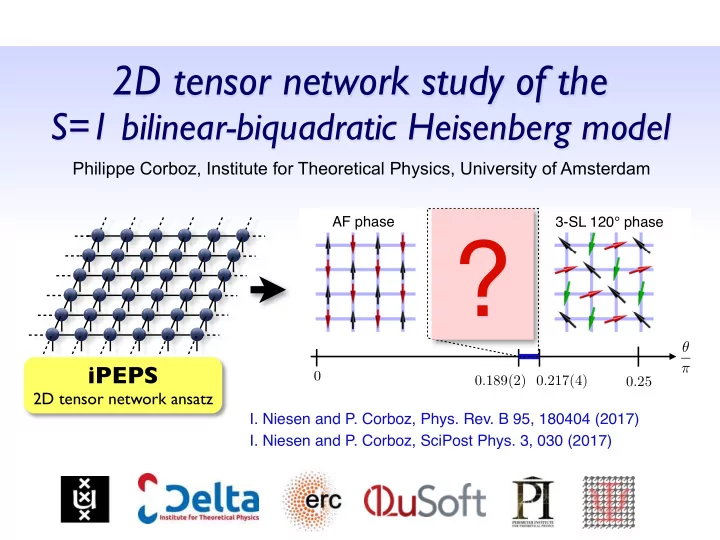
2D tensor network study of the S=1 bilinear-biquadratic Heisenberg model Philippe Corboz, Institute for Theoretical Physics, University of Amsterdam AF phase Haldane phase 3-SL 120 phase ? iPEPS 0 0 . 189(2) 0 . 217(4) 0 . 25 2D


slide-1
SLIDE 1

2D tensor network study of the

S=1 bilinear-biquadratic Heisenberg model

Philippe Corboz, Institute for Theoretical Physics, University of Amsterdam

  • I. Niesen and P. Corboz, Phys. Rev. B 95, 180404 (2017)
  • I. Niesen and P. Corboz, SciPost Phys. 3, 030 (2017)

iPEPS

2D tensor network ansatz

θ π

0.25 AF phase Haldane phase 3-SL 120° phase 0.217(4) 0.189(2)

?

slide-2
SLIDE 2

2D tensor network study of the

S=1 bilinear-biquadratic Heisenberg model

Philippe Corboz, Institute for Theoretical Physics, University of Amsterdam

  • I. Niesen and P. Corboz, Phys. Rev. B 95, 180404 (2017)
  • I. Niesen and P. Corboz, SciPost Phys. 3, 030 (2017)

iPEPS

2D tensor network ansatz

θ π

0.25 AF phase Haldane phase 3-SL 120° phase 0.217(4) 0.189(2)

?

Ido Niesen

slide-3
SLIDE 3

Outline

  • Motivation

✦ SU(3) Heisenberg model & spin-nematic phases & benchmark problem

  • Method

✦ Introduction to tensor networks and iPEPS ✦ Optimization

  • Conclusion
  • Results

✦ iPEPS results: 2 new phases

  • Other recent work

✦ iPEPS vs iMPS on infinite cylinders

slide-4
SLIDE 4

S=1 bilinear-biquadratic Heisenberg model on a square lattice H = X

hi,ji

cos(θ) Si · Sj + sin(θ) (Si · Sj)2

SU(2) symmetry

  • Motivation I: SU(3) Heisenberg model

Experiments on alkaline-earth atoms in optical lattices

(θ = π/4)

  • Motivation II: Spin nematic phases

Unusual properties of NiGa2S4 / Ba3NiSb2O9

  • Motivation III: Benchmark problem for iPEPS

Discover new phases?

bilinear biquadratic S=1 operators

slide-5
SLIDE 5

Motivation I: SU(N) Heisenberg models

  • N=2:

local basis states: | "i, | #i

H = X

hi,ji

SiSj Néel order

S=1/2 operators

slide-6
SLIDE 6

| o i, | o i

local basis states:

H = X

hi,ji

Pij

i j i j

Pij

  • N=3

Ground state??

  • N=2:
  • N=4

Néel order

Motivation I: SU(N) Heisenberg models

slide-7
SLIDE 7
  • N=3
  • N=4

87Sr

I = 9/2 :

Nuclear spin

Nmax = 2I + 1 = 10

Identify nuclear spin states with colors:

| o i | o i | o i | o i

|Iz = 1/2i |Iz = 3/2i |Iz = 1/2i |Iz = 3/2i

slide-8
SLIDE 8
  • N=3
  • N=4

87Sr

I = 9/2 :

Nuclear spin

Nmax = 2I + 1 = 10 Cannot use QMC because

  • f the sign problem!!!
slide-9
SLIDE 9

SU(N) Heisenberg models

SU(3) honeycomb: Plaquette state

Zhao, Xu, Chen, Wei, Qin, Zhang, Xiang, PRB 85 (2012); PC, Läuchli, Penc, Mila, PRB 87 (2013)

SU(3) kagome: Simplex solid state

PC, Penc, Mila, Läuchli, PRB 86 (2012)

SU(3) square/triangular: 3-sublattice Néel order 3-color quantum Potts: superfluid phases

)

Bauer, PC, et al., PRB 85 (2012) Messio, PC, Mila, PRB 88 (2013) PC, Lajkó, Läuchli, Penc, Mila, PRX 2 (‘12)

SU(4) honeycomb: spin-orbital (4-color) liquid

PC, Läuchli, Penc, Troyer, Mila, PRL 107 (‘11)

SU(4) square: Dimer-Néel order

slide-10
SLIDE 10

i, | o i

SU(3) Heisenberg model on the square lattice

  • Infinite classical ground state degeneracy!

| o i, | o i

local basis states:

H = X

hi,ji

Pij

  • N=3:

...

  • Product state ansatz: different colors on neighboring sites
slide-11
SLIDE 11

SU(3) Heisenberg model on the square lattice

  • Degeneracy lifted by quantum fluctuations:
  • Exact diagonalization & linear flavor wave theory
  • T. A. Tóth, A. M. Läuchli, F. Mila & K. Penc, PRL 105 (2010)
  • DMRG & iPEPS

Bauer, PC, Läuchli, Messio, Penc, Troyer & Mila, PRB 85 (2012)

3 sublattice Néel order Stability of 3-sublattice phase in an extended parameter space?

slide-12
SLIDE 12

SU(3) Heisenberg model

θ = π/4

Stability of 3-sublattice phase away from SU(3) point?

H = X

hi,ji

cos(θ) Si · Sj + sin(θ) (Si · Sj)2

  • ED + linear flavor wave theory:

3-sublattice state has finite extension

Tóth, Läuchli, Mila & Penc, PRB 85 (2012)

  • Compatible results: series expansion

Oitmaa & Hamer, PRB 87 (2013)

➡ Can we reproduce this with systematic iPEPS simulations?

Figure from Tóth, et al. PRB 85 (2012)

slide-13
SLIDE 13

Tóth, et al., PRB 85 (2012)

Motivation II: Spin nematic phases

  • Spin nematic phase:

vanishing magnetic moment: hSxi = hSyi = hSzi = 0 but still breaking SU(2) symmetry due to non-vanishing higher order moments.

x y z

  • Example (S=1):

vanishing magnetic moment, but

|0i

h(Sz)2i = 0 6= h(Sx)2i = h(Sy)2i = 1 ➡ Anisotropic spin fluctuations breaking SU(2) symmetry

  • Possible realization: NiGa2S4

Nakatsuji et al., Science 309 (2005)

Tsunetsugu & Arikawa, J. Phys. Soc. Jap. 75 (2006) Tsunetsugu & Arikawa, J. Phys. Cond. Mat. 19 (2007) Läuchli, Mila & Penc, PRL 97 (2006) Bhattacharjee, Shenoy & Senthil, PRB 74 (2006)

NiGa2S4

slide-14
SLIDE 14

Motivation III: benchmark problem for iPEPS

  • K. Harada and N. Kawashima, J. Phys. Soc. Jpn. 70 (2001)
  • K. Harada and N. Kawashima, PRB 65(5), 052403 (2002)
  • Accessible by QMC:
  • Negative sign problem

controlled, systematic study has been lacking ➡ Obtain accurate estimate of the phase boundaries with iPEPS!

➡ turned out to be more complicated but also much richer than expected!

slide-15
SLIDE 15

Introduction to iPEPS

slide-16
SLIDE 16

26 basis states

Lattice:

2 basis states per site:

1 2 3 4 5 6

|Ψ⇥ =

  • i1i2i3i4i5i6

Ψi1i2i3i4i5i6|i1 i2 i3 i4 i5 i6⇥

State:

26 coefficients

i1 i2 i3 i4 i5 i6

Tensor/multidimensional array Big tensor Ψi1i2i3i4i5i6 bond dimension

i1 i2 i3 i4 i5 i6

a b c d e

Tensor network: matrix product state (MPS)

A B C D E F

D

poly( ,N) numbers exp(N) many numbers

vs

Efficient representation!

D

Tensor network ansatz for a wave function

Ψi1i2i3i4i5i6

X

abcde

Aa

i1Bab i2 Cbc i3 Dcd i4 Ede i5 F e i6 = ˜

Ψi1i2i3i4i5i6

{| "i, | #i}

slide-17
SLIDE 17

“Corner” of the Hilbert space

Ground states (local H) Hilbert space

L

. . . . . . . . . . . .

A

★ GS of local H’s are less entangled than a random state in the Hilbert space ★ Area law of the entanglement entropy

S(L) ∼ Ld−1

slide-18
SLIDE 18

1 2 3 4 5 6 7 8

MPS

Matrix-product state (underlying ansatz of DMRG)

1D

Physical indices (lattices sites)

MPS & PEPS

Bond dimension D

2D

Snake MPS L

Computational cost:

∝ exp(L)

  • S. R. White, PRL 69, 2863 (1992)

Östlund, Rommer, PRL 75, 3537 (1995) Fannes et al., CMP 144, 443 (1992)

slide-19
SLIDE 19

1 2 3 4 5 6 7 8

MPS

Matrix-product state (underlying ansatz of DMRG)

1D

Physical indices (lattices sites)

MPS & PEPS

D

2D

Verstraete and Cirac, cond-mat/0407066 Nishino, Hieida, Okunishi, Maeshima, Akutsu, and Gendiar,

  • Prog. Theor. Phys. 105, 409 (2001).

Nishio, Maeshima, Gendiar, and Nishino, cond-mat/0401115

Bond dimension Bond dimension D

PEPS (TPS)

projected entangled-pair state (tensor product state)

Computational cost:

∝ poly(L, D)

slide-20
SLIDE 20

A A A A A A A A A A A A A A A A A A A A A A A A A A A A A A A A A A A A

iMPS

1D 2D

iPEPS

infinite projected entangled-pair state

Jordan, Orus, Vidal, Verstraete, Cirac, PRL (2008)

Infinite PEPS (iPEPS)

★ Work directly in the thermodynamic limit: No finite size and boundary effects! infinite matrix-product state

slide-21
SLIDE 21

B C F G D A H D A H E B C F G D A H E D A H E B C F G D A H E D A H E E

1D 2D

iPEPS

with arbitrary unit cell of tensors

PC, White, Vidal, Troyer, PRB 84 (2011)

here: 4x2 unit cell

iPEPS with arbitrary unit cells

★ Run simulations with different unit cell sizes ★ Systematically compare variational energies

iMPS

infinite matrix-product state

slide-22
SLIDE 22

Overview: Tensor network algorithms (ground state)

iterative optimization

  • f individual tensors

(energy minimization) imaginary time evolution Contraction of the tensor network

Find the best (ground) state

|˜ Ψ

Compute

  • bservables

˜ Ψ|O|˜ Ψ⇥

MPS iPEPS

TN ansatz

(variational)

slide-23
SLIDE 23

Optimization via imaginary time evolution

  • Idea:

exp(−τ ˆ Hb)

  • At each step: apply a two-site operator to a bond and truncate bond back to D

Keep D largest singular values

U √ ˜ s √ ˜ sV

SVD s

U V †

Time Evolving Block Decimation (TEBD) algorithm

Note: MPS needs to be in canonical form

... ...

exp(β ˆ H)|Ψii

β → ∞

|ΨGSi

τ = β/n exp(−β ˆ H) = exp(−β X

b

ˆ Hb) = exp(−τ X

b

ˆ Hb) !n ≈ Y

b

exp(−τ ˆ Hb) !n

Trotter-Suzuki decomposition:

  • 1D:
slide-24
SLIDE 24

Optimization via imaginary time evolution

  • 2D: same idea: apply

to a bond and truncate bond back to D

exp(−τ ˆ Hb)

  • However, SVD update is not optimal (because of loops in PEPS)!

simple update (SVD)

★ “local” update like in TEBD ★ Cheap, but not optimal (e.g. overestimates magnetization in S=1/2 Heisenberg model) ★ reasonable energy estimates

Jiang et al, PRL 101 (2008)

full update

★ Take the full wave function into account for truncation ★ optimal, but computationally more expensive ★ Fast-full update [Phien et al, PRB 92 (2015)]

Jordan et al, PRL 101 (2008)

slide-25
SLIDE 25

Overview: iPEPS simulations

  • interacting spinless fermions
  • honeycomb & square lattice
  • t-J model & Hubbard model
  • square lattice
  • SU(N) Heisenberg models
  • N=3 square, triangular, kagome & honeycomb lattice
  • N=4 square, honeycomb & checkerboard lattice
  • N=5 square lattice
  • N=6 honeycomb lattice
  • frustrated spin systems
  • Shastry-Sutherland model
  • Heisenberg model on kagome lattice
  • Bilinear-biquadratic S=1 Heisenberg model
  • Kitaev-Heisenberg model
  • J1-J2 Heisenberg model
  • and many more...

iPEPS is a very competitive variational method! Find new physics thanks to (largely) unbiased simulations

slide-26
SLIDE 26

Results:

S=1 bilinear-biquadratic Heisenberg model

slide-27
SLIDE 27

Low-D iPEPS (simple update) results

  • Simple update results reproduces previous phase diagram!

Figure from Tóth, et al. PRB 85 (2012) 0.25 0.5 1.25 1.5

Energy per site

  • 2.5
  • 2
  • 1.5
  • 1
  • 0.5

0.5 1

D=1 (product state ) D=2 D=6

θ/π

AFM3

H = X

hi,ji

cos(θ) Si · Sj + sin(θ) (Si · Sj)2

slide-28
SLIDE 28

Low-D simple update result

θ π

0.25

AF phase 3-SL 120° phase

0.2

2-sublattice iPEPS: 3-sublattice iPEPS:

  • Simple update result: transition around

in agreement with previous studies

θ/π ≈ 0.2 . . . 0.21

Figure from Tóth, et al. PRB 85 (2012)

slide-29
SLIDE 29

Accurate full update simulations

0.05 0.1 0.15 0.2 0.2 0.4 0.6 0.8 1/D m

θ=0π θ=0.15π θ=0.17π θ=0.18π θ=0.185π θ=0.186π θ=0.188π θ=0.19π

0.1 0.15 0.2 θ/π

Heisenberg point ( ): QMC: m=0.805(2) iPEPS: m=0.802(7) θ = 0

Matsumoto et al. PRB 65 (2001)

slide-30
SLIDE 30

Accurate full update simulations

0.05 0.1 0.15 0.2 0.2 0.4 0.6 0.8 1/D m

θ=0π θ=0.15π θ=0.17π θ=0.18π θ=0.185π θ=0.186π θ=0.188π θ=0.19π

0.1 0.15 0.2 θ/π

Magnetization vanishes beyond i.e. BEFORE entering the 3-sublattice phase

θ/π = 0.189(2)!!

slide-31
SLIDE 31

Intermediate phase?

  • Vanishing magnetic moment (and vanishing quadrupolar order)

No SU(2) symmetry breaking

  • Same state can also be obtained using a 1x1 unit cell ansatz

No translational symmetry breaking

  • Energies different in x- / y- direction

Rotational symmetry breaking

0.05 0.1 0.15 0.2 0.1 0.2 1/D Magnitude

∆E θ = 0.21π

θ π

0.25

0.2

AF phase 3-SL 120° phase

?

slide-32
SLIDE 32

Intermediate phase?

  • No SU(2) & translational

symmetry breaking

  • BUT rotational symmetry

breaking ?

  • Reminiscent of coupled 1D chains!
  • Is it linked to 1D physics?
slide-33
SLIDE 33

Reminder: S=1 chains in 1D

  • Bilinear-biquadratic S=1 chain:

Haldane phase for with exact AKLT ground state for θ/π = 0.1024

projection

  • nto S=1

= |+ih"" | + |0i| "#i + | #"i p 2 + |ih## |

S=1/2 singlet (S=0)

= 1 p 2 (| "#i | #"i)

−1/4 < θ/π < 1/4

  • What happens upon coupling many 1D Haldane chains?

?

slide-34
SLIDE 34

Coupled S=1 Heisenberg chains

  • Heisenberg case ( ): accessible by QMC simulations

θ = 0

Sakai & Takahashi, J. Phys. Soc. Jpn. 58 (1989) Koga & Kawakami, PRB 61 (2000) Kim & Birgeneau, PRB 62 (2000) Matsumoto, Yasuda, Todo & Takayama, PRB 65 (2001) Wierschem & Sengupta, PRL 112 (2014)

Jx = J Jy ⌧ Jx

  • But for ?

θ > 0

  • Haldane phase stable only up to

before entering AF phase, i.e far away from the isotropic limit! Jy/J ≈ 0.0436

slide-35
SLIDE 35

Anisotropic S=1 bilinear-biquadratic model

0.05 0.1 0.15 0.2 0.25 0.2 0.4 0.6 0.8 1 θ/π Jy

Haldane AF

120°

  • iPEPS phase diagram (simple update D=10)
  • case: consistent with QMC

θ = 0

(Jc

y ≈ 0.042)

  • increases with

Jc

y

θ

  • Haldane phase persists up to the isotropic 2D limit!
slide-36
SLIDE 36

Similar situation: frustrated S=1 anisotropic Heisenberg model

Jiang, Krüger, Moore, Sheng, Yaanen, and Weng, PRB 79 (2009)

DMRG + SBMFT study:

isotropic limit decoupled chains

  • Also in this case: Haldane phase persists up to the isotropic 2D limit!
slide-37
SLIDE 37

Transition between Haldane - 3 sublattice 120° phase

  • Push full update simulations

up to D=16 (D=10)

0.1 0.2 0.3 0.3 0.31 0.32 0.33 0.34 0.35 0.36 0.37 0.38 w Es

Haldane, θ=0.22π 3−SL, θ=0.22π Haldane, θ=0.21π 3−SL, θ=0.21π

3-sublat. phase lower

θ/π = 0.22

θ/π = 0.21

Haldane phase lower

  • Energies intersect at θ/π = 0.217(4)
slide-38
SLIDE 38

iPEPS (full update) phase diagram

θ π

0.25 AF phase Haldane phase 3-SL 120° phase 0.217(4) 0.189(2)

(0 ≤ θ/π ≤ 1/4)

  • in contrast to previous predictions of a direct transition

between AF and 3-SL phase

  • I. Niesen & PC, PRB 95 (2017)
slide-39
SLIDE 39

ED / LFWT

Tóth, et al, PRB 85 (2012)

Full phase diagram: another surprise

/2

Haldane AFM AFM3 120° FM AFQ3 FQ m=1/2

  • =0

0.189(2) 0.217(4) /4 0.4886(7) 5/4

3/2

1st order Weak 1st

  • r 2nd order

iPEPS

Niesen & PC, SciPost Phys. 3 (2017)

slide-40
SLIDE 40

m=1/2 half magnetized half nematic phase

  • Spontaneous m=1/2 for

0.4886(7) < θ/π < 0.5

θ π

θ π θ π θ π θ π

  • Previously predicted to occur only when applying an external magnetic field

product state: ED:

Tóth, Läuchli, Mila & Penc, PRB 85 (2012)

| "i | 0i | "i | 0i

slide-41
SLIDE 41

m=1/2 half magnetized half nematic phase

  • Spontaneous m=1/2 for

0.4886(7) < θ/π < 0.5

Truncation error

0.01 0.02 0.03

Energy per site

0.9954 0.9956 0.9958 0.996 0.9962 0.9964 0.9966 0.9968 0.997 0.9972

θ/π

0.487 0.488 0.489 0.49

L-bnd. Est. U-bnd. m=1/ 2 AFQ3

θ=0.490π θ=0.489π θ=0.488π θ=0.487π

iPEPS (full update):

slide-42
SLIDE 42

Summary: S=1 bilinear-biquadratic Heisenberg model

/2

Haldane AFM AFM3 120° FM AFQ3 FQ m=1/2

  • =0

0.189(2) 0.217(4) /4 0.4886(7) 5/4

3/2

1st order Weak 1st

  • r 2nd order
  • Using accurate iPEPS simulations

we found a rich phase diagram with 2 new phases:

  • Haldane phase in between 2-

sublattice and 3-sublattice antiferromagnetic phases

  • m=1/2 phase in between anti-

ferroquadrupolar and ferromagnetic phase

  • Haldane phase appears also in

the S=1 J1-J2 Heisenberg model

  • Probably appears also in other

systems with competing S=1 magnetic orders

slide-43
SLIDE 43

Comparison: iMPS vs iPEPS on infinite cylinders

Juan Osorio Iregui

  • J. Osorio Iregui, M. Troyer & PC, PRB 96 (2017)
slide-44
SLIDE 44

Snake MPS L

D

(i)PEPS

Bond dimension

vs

★ Scaling of algorithm: D3 ★ Simpler algorithms & implementation ★ Very accurate results for “small” L

  • inaccurate beyond certain L

because D~exp(L) ★ Large / infinite systems (scalable)! ★ Much fewer variational parameters because much more natural 2D ansatz

  • Algorithms more complicated
  • Large cost of roughly D10
  • J. Osorio Iregui, M. Troyer & PC, PRB 96 (2017)

Comparison: iMPS vs iPEPS on infinite cylinders

slide-45
SLIDE 45

Comparison 2D DMRG & iPEPS: 2D Heisenberg model

iPEPS D=6

(variational optimization)

iPEPS D=6 in the thermodynamic limit ~ 2’600 variational pars. MPS D=3000 on finite Ly=10 cylinder ~ 18’000’000

similar accuracy

4 orders of magnitude fewer parameters (per tensor)

Stoudenmire & White, Ann. Rev. CMP 3 (2012)

slide-46
SLIDE 46

iMPS vs iPEPS on infinite cylinders: Heisenberg model

W=11: D=5 iPEPS comparable to m=4096 MPS

slide-47
SLIDE 47

iMPS vs iPEPS on infinite cylinders: Hubbard model (n=1)

W=7: D=11 iPEPS comparable to m=8192 MPS

slide-48
SLIDE 48

2D DMRG and iPEPS provide complementary results!!!

iMPS vs iPEPS on infinite cylinders: Hubbard model (n=1)

W=7: D=11 iPEPS comparable to m=8192 MPS

slide-49
SLIDE 49

Stripe order in the 2D Hubbard model

iPEPS

+ DMRG + AFQMC + DMET U/t = 8 δ = 1/8

Ground state: Stripe state

Boxiao Zheng, Chia-Min Chung, PC, Georg Ehlers, Ming-Pu Qin, Reinhard Noack, Hao Shi, Steven White, Shiwei Zhang, Garnet Chan, arXiv:1701.00054

slide-50
SLIDE 50

Conclusion: iMPS

✓ 1D tensor networks: State-of-the-art for quasi 1D systems ✓ 2D tensor networks: A lot of progress in recent years! ★ iPEPS has become a powerful & competitive tool

★ Much room for improvement & many extensions

Thank you for your attention!

✓ 2D tensor networks and 2D DMRG provide complementary results! ✓ Combined studies: promising route to solve challenging problems

slide-51
SLIDE 51

Thank you