
SLIDE 1
SEIDENBERG SCHOOL OF CSIS
1
Miguel A. Mosteiro Google Interview Talk 3/27/2017
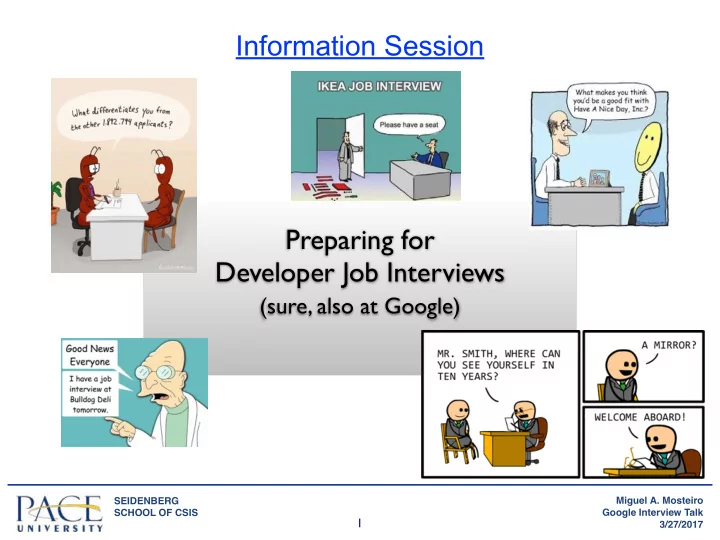
Information Session Preparing for Developer Job Interviews (sure, - - PowerPoint PPT Presentation
Information Session Preparing for Developer Job Interviews (sure, also at Google) Miguel A. Mosteiro SEIDENBERG Google Interview Talk SCHOOL OF CSIS 1 3/27/2017 The World of Computing Some Years Ago You know Don, Woz! In The Real
SEIDENBERG SCHOOL OF CSIS
1
Miguel A. Mosteiro Google Interview Talk 3/27/2017
SEIDENBERG SCHOOL OF CSIS
2
Miguel A. Mosteiro Google Interview Talk 3/27/2017
(FICTIONAL DIALOGUE)
SEIDENBERG SCHOOL OF CSIS
3
Miguel A. Mosteiro Google Interview Talk 3/27/2017
SEIDENBERG SCHOOL OF CSIS
4
Miguel A. Mosteiro Google Interview Talk 3/27/2017
SEIDENBERG SCHOOL OF CSIS
5
Miguel A. Mosteiro Google Interview Talk 3/27/2017
****************** GOOGLE TECHNICAL PHONE INTERVIEW TIPS: Please be prepared for the engineers to ask you questions in the following areas:
The links and information below may help you prepare for your interview: Interviewing at Google Google Products Five Essential Phone Screen Questions by Steve Yegge (Google Engineer) Types of algorithm questions Google asks: TopCoder Tutorials The Official Google Blog: “Baby steps to a new job” by Gretta Cook (Google Engineer) “How to Get Hired” by Dan Kegel (Google Engineer) Student Guide to Technical Development BOOKS (#2 was highly recommended by several engineers and quite representative of the types of coding questions asked):
Levitin
Landing Your Next Job (Programmer to Programmer) by John Mongan, Noah Suojanen, and Eric Giguere TIPS DIRECTLY FROM OUR ENGINEERS: One of our engineers drafted this overview of the main areas software engineers should prepare to have a successful interviews with Google: 1.) Algorithm Complexity: You need to know Big-O. If you struggle with basic big-O complexity analysis, then you are almost guaranteed not to get hired. For more information on Algorithms you can visit: http://www.topcoder.com/tc?module=Static&d1=tutorials&d2=alg_index 2.) Coding: You should know at least one programming language really well, and it should preferably be C++ or Java. C# is OK too, since it's pretty similar to Java. You will be expected to write some code in at least some of your interviews. You will be expected to know a fair amount
*Strongly recommended* for information on Coding: Programming Interviews Exposed; Secrets to landing your next job by John Monagan and Noah Suojanen (Wiley Computer Publishing) http://www.wiley.com/WileyCDA/WileyTitle/productCd-047012167X.html 3.) System Design: http://research.google.com/pubs/ DistributedSystemsandParallelComputing.html Google File System http://research.google.com/archive/gfs.html Google Bigtable http://research.google.com/archive/bigtable.html Google MapReduce http://research.google.com/archive/mapreduce.html 4.) Sorting: Know how to sort. Don't do bubble-sort. You should know the details of at least one n*log(n) sorting algorithm, preferably two (say, quicksort and merge sort). Merge sort can be highly useful in situations where quicksort is impractical, so take a look at it. 5.) Hashtables: Arguably the single most important data structure known to mankind. You
SEIDENBERG SCHOOL OF CSIS
6
Miguel A. Mosteiro Google Interview Talk 3/27/2017
absolutely should know how they work. Be able to implement one using only arrays in your favorite language, in about the space of one interview. 6.) Trees: Know about trees; basic tree construction, traversal and manipulation algorithms. Familiarize yourself with binary trees, n-ary trees, and trie-trees. Be familiar with at least one type of balanced binary tree, whether it's a red/black tree, a splay tree or an AVL tree, and know how it's implemented. Understand tree traversal algorithms: BFS and DFS, and know the difference between inorder, postorder and preorder. 7.) Graphs: Graphs are really important at Google. There are 3 basic ways to represent a graph in memory (objects and pointers, matrix, and adjacency list); familiarize yourself with each representation and its pros & cons. You should know the basic graph traversal algorithms: breadth-first search and depth-first search. Know their computational complexity, their tradeoffs, and how to implement them in real code. If you get a chance, try to study up on fancier algorithms, such as Dijkstra and A*. 8.) Other data structures: You should study up on as many other data structures and algorithms as possible. You should especially know about the most famous classes of NP-complete problems, such as traveling salesman and the knapsack problem, and be able to recognize them when an interviewer asks you them in disguise. Find out what NP-complete means. 9.) Mathematics: Some interviewers ask basic discrete math questions. This is more prevalent at Google than at other companies because we are surrounded by counting problems, probability problems, and other Discrete Math 101 situations. Spend some time before the interview refreshing your memory on (or teaching yourself) the essentials of combinatorics and
10.) Operating Systems: Know about processes, threads and concurrency issues. Know about locks and mutexes and semaphores and monitors and how they work. Know about deadlock and livelock and how to avoid them. Know what resources a processes needs, and a thread needs, and how context switching works, and how it's initiated by the operating system and underlying hardware. Know a little about scheduling. The world is rapidly moving towards multi- core, so know the fundamentals of "modern" concurrency constructs. For information on System Design: http://research.google.com/pubs/DistributedSystemsandParallelComputing.html 11.) Also, you can review some of our research publications: http://research.google.com/pubs/ papers.html and paper on Google’s Hybrid Approach to Research: http://static.googleusercontent.com/media/research.google.com/en/us/pubs/archive/38149.pdf 12.) Exercise your coding skills on TopCoder. We've heard from engineers that it's great practice for a Google technical interview!
SEIDENBERG SCHOOL OF CSIS
7
Miguel A. Mosteiro Google Interview Talk 3/27/2017
SEIDENBERG SCHOOL OF CSIS
8
Miguel A. Mosteiro Google Interview Talk 3/27/2017
SEIDENBERG SCHOOL OF CSIS
9
Miguel A. Mosteiro Google Interview Talk 3/27/2017
SEIDENBERG SCHOOL OF CSIS
10
Miguel A. Mosteiro Google Interview Talk 3/27/2017