Iodine, Silver, Honey Honey Iodine Silver Enzymatic debridement - - PowerPoint PPT Presentation

iodine silver honey
SMART_READER_LITE
LIVE PREVIEW

Iodine, Silver, Honey Honey Iodine Silver Enzymatic debridement - - PowerPoint PPT Presentation

Topical antimicrobials (antiseptics) Iodine, Silver, Honey Honey Iodine Silver Enzymatic debridement Proteolytic enzyme, also called Proteinase Proteinase breaks the long chainlike molecules of proteins into shorter fragments


slide-1
SLIDE 1

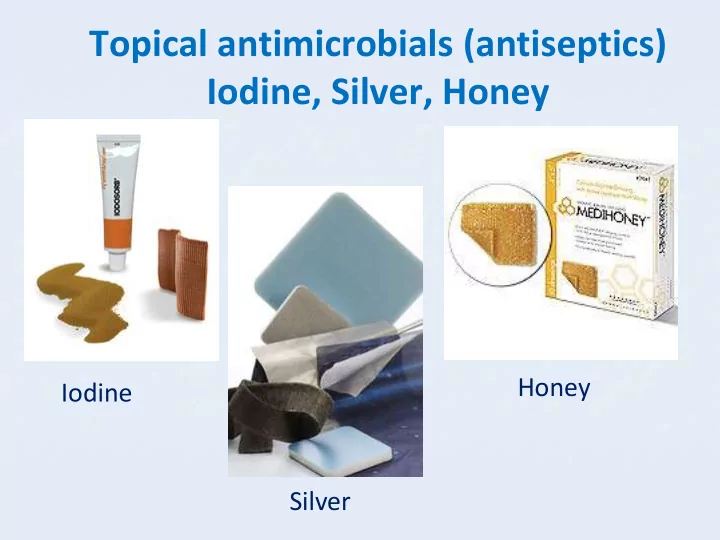
Topical antimicrobials (antiseptics) Iodine, Silver, Honey

Iodine Silver Honey

slide-2
SLIDE 2

Enzymatic debridement

◼ Proteolytic enzyme, also called Proteinase ◼ Proteinase breaks the long chainlike molecules of proteins

into shorter fragments (peptides) and eventually into their components, amino acids

◼ Patients with chronic wounds have been treated since

hundreds of years topically with proteolytic enzymes (fruit juices i.e. kiwi, papaya fruit extracts)

Not registered for use on wounds in NZ!

slide-3
SLIDE 3

Biosurgical debridement

◼ Biosurgical debridement is the use of

sterile maggots or larvae

◼ The sterile larvae of the green bottle fly

Lucila sericata

◼ Maggot secretions contain antibacterial

substances that reduce bacterial load

◼ Proteolytic enzymes cause eschar

degradation

◼ Promote wound healing

slide-4
SLIDE 4
slide-5
SLIDE 5

Debridement Quality cycle

www.ewma.com

slide-6
SLIDE 6

Patient Treatment Outcome

83 year old female, Alzheimer's, Diabetes, poor control, non healing amputation of 4ht and 5th toe 4 month ago 4 debridement's with LFUD, NPWT Healing well, treated with intrasite conformable, rocker boot

Left 4th, 5th metatarsal 1. 2. 3. 4.

?

5.

slide-7
SLIDE 7

Sharp and Surgical Debridement

The rapid removal of necrotic tissue with blade or scissors

  • Sharp debridement is

conservative frequently leaving a thin margin of necrotic tissue

  • Surgical debridement is

more extensive, converting a chronic to an acute wound

slide-8
SLIDE 8

Sharp debridement

◼ Know and understand the

anatomy

◼ Be able to recognize

structures and distinguish viable tissue

◼ Have adequate equipment,

access, lighting and assistance

◼ Obtain informed consent ◼ Manage pain and discomfort ◼ Be able to deal with

complications

◼ Recognize your and the

techniques limitations

slide-9
SLIDE 9

Sharp Curette Debridement

slide-10
SLIDE 10

Disposable Curette

slide-11
SLIDE 11

LOW FREQUENCY ULTRASOUND DEBRIDEMENT

  • Low-frequency ultrasound can

provide a debridement alternative for surgical debridement

  • Ultrasonic waves are also

claimed to lead to destruction

  • f bacteria and disruption of

biofilms

slide-12
SLIDE 12

Debridement Quality cycle

www.ewma.com

slide-13
SLIDE 13

Define your method of debridement

slide-14
SLIDE 14

Define your dressing plan – antimrobial Ask ‘what do I want the dressing to do…?’ Rehydrate? Absorb exudate? Deslough? Reduce bacterial contamination? Promote granulation? Promote a moist / dry wound bed

slide-15
SLIDE 15

Adjunct treatment – compression bandaging

slide-16
SLIDE 16

Patient Treatment Outcome

VLU, SSG failed twice, painful, not able to sleep or tolerate compression LFUD, silver dressings, PICO, compression bandaging, stockings 47.8 cm2 now down to 8.9 cm2

Review and adjust

slide-17
SLIDE 17

Summary

◼ Debridement has a pivotal role in the progression of a

wound to granulation, contraction and epithelisation

◼ Debridement must be understood as an ongoing

process in conjunction with other treatment approaches

◼ Aim is to create a beneficial situation supporting

various clinical goals related to wound management

◼ Form of debridement depends on type of tissue, the

tools available and the clinical environment

◼ The clients quality and stage of life must be part of

the care planning

slide-18
SLIDE 18
slide-19
SLIDE 19

From your Wound Care Nurse Have a lovely day !

slide-20
SLIDE 20

Patient Treatment Outcome

75 year old female, history of 45 years on and off venous leg ulcers, 4/12 old VLU medial right malleolus, Admitted acutely for pain and infection, debrided twice with LFUD under LA , NPWT, compression bandaging SSG, complete healing

Left medial 4.5 cm by 3.6 cm

slide-21
SLIDE 21

Patient Treatment Outcome

75 year old female, 6/12 old, large medial maleolus right leg ulcer, ABPI 0.55, diabetes, Debrided on the ward using EMLA 5 % SSG, 100 % take and survival

Day 6 Day 10

  • 13. 7 by 12. 8 cm right gaiter
slide-22
SLIDE 22

Patient 13 Treatment Outcome

82 year female, history of increasing very painful left leg ulcer gaiter area, now circumferential, pain 10/10, not tolerating compression, Tendon exposure NPWT, SSG after several treatments with EMLA + LA Xylocaine prior to LFUD over a 3 week period 95 % healed skin graft, able to wear compression stockings class 1, lives independently again

Lateral left gaiter 12.2 cm by 11.8 cm medial posterior

Thick, tenacious, unhealthy Granulation tissue

slide-23
SLIDE 23

3rd treatment with LFUD - EMLA 5 % crème

Tendon

Lateral left gaiter medial

slide-24
SLIDE 24

4th treatment with LFUD - EMLA 5 % crème + NPWT medial Lateral left gaiter

slide-25
SLIDE 25

SSG in MOT 3 wks after start of treatment, Acticoat flex + NPWT

slide-26
SLIDE 26

10 days after SSG Lateral left gaiter Posterior

slide-27
SLIDE 27

Debridement and TIME

  • T – issue
  • I – Infection and/or

inflammation

  • M – oisture imbalance
  • E – dge
slide-28
SLIDE 28

LFUD debridement of VLU

slide-29
SLIDE 29

Dry fibrin - the wound edges show that fibrin represents a barrier to healing

What would you do?

slide-30
SLIDE 30

Dictionary

  • The word debridement derives from the

French débridement, which means to remove a constraint

  • In clinical medicine this term was first

used by Henri Le Dran, a French surgeon (1685–1770), in the context of an incision to promote drainage and relieve of tension

  • He stated that cancer progressed in

stages, and that it began as a local

  • rganic disease. He advocated surgery

for cancer before the tumor was allowed to metastasize

  • Also described “shock” as a treatise on

gunshot wounds as a sudden impact or jolt

slide-31
SLIDE 31

Amputation isn’t debridement

slide-32
SLIDE 32

Wound revision isn’t debridement

slide-33
SLIDE 33

Slough or necrosis delays wound healing

  • Prolongs the

inflammatory stage of healing

  • Focus for infection
  • Impedes re-

epithelialisation

  • Discomfort for the patient
  • Reduced quality of life
slide-34
SLIDE 34

Branding is not debridement

slide-35
SLIDE 35

Resection of functional tissue isn’t debridement

Reconstruction for Soft Tissue Sarcomas of the Foot and Ankle

slide-36
SLIDE 36
slide-37
SLIDE 37
slide-38
SLIDE 38
slide-39
SLIDE 39
slide-40
SLIDE 40

Antibiotics and Biofilms

slide-41
SLIDE 41

How to remove Biofilm?

slide-42
SLIDE 42
slide-43
SLIDE 43

Moist – not to wet and not to dry

Moisture Balance