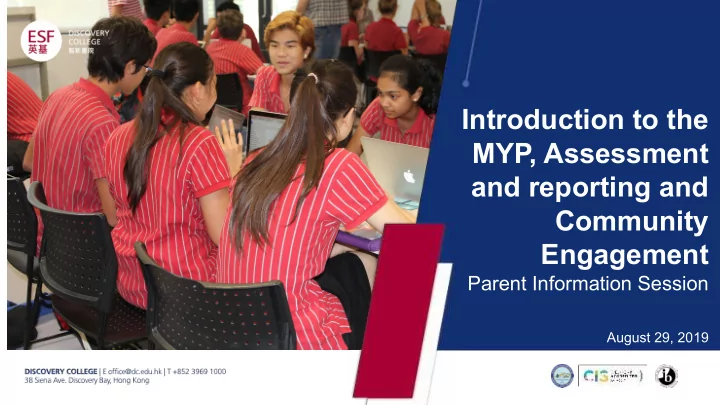
SLIDE 1
Introduction to the MYP, Assessment and reporting and Community Engagement
Parent Information Session
August 29, 2019
SLIDE 2 Agenda
- The IB Middle Years Programme (MYP) at
Discovery College
- IB programme continuum
- MYP curriculum
- Assessment and reporting
- Community Engagement
SLIDE 3 Introductions
Annette Garnett IB MYP Coordinator / Secondary VP Jonny Tate CAS / CE Coordinator and Community Liaison
SLIDE 4 Mission and vision
Discovery College
- Grow. Be passionate about being the best
we can be.
- Discover. Find wonder in the world
around us.
- Dream. Dare to make a difference for
yourself, humanity and our planet.
SLIDE 5 Mission and vision
IB Mission statement The International Baccalaureate aims to develop inquiring, knowledgeable and caring young people who help to create a better and more peaceful world through intercultural understanding and respect. These programmes encourage students across the world to become active, compassionate and lifelong learners who understand that other people, with their differences, can also be right. Discovery College
- Grow. Be passionate about being the best
we can be.
- Discover. Find wonder in the world
around us.
- Dream. Dare to make a difference for
yourself, humanity and our planet.
SLIDE 6
IB learner profile – lifelong learning
SLIDE 7
The IB – a continuum of education
IB PYP to IB MYP IB MYP to IB DP / CP
SLIDE 8 IB MYP Curriculum features
- Balanced curriculum
- Approaches to Learning
- Interdisciplinary learning
- Community Engagement
- Personal Project (Y11)
SLIDE 9 IB MYP Curriculum subject groups
- Mathematics
- Sciences
- English Language and Literature
- Languages other than English:
- Chinese language acquisition
- Spanish language acquisition
- Chinese Language and
literature
- Individuals and societies
(Geography, Economics and History)
systems)
- Physical and Health Education
- Arts Group: Drama, Music and
Visual Arts
SLIDE 10
IB MYP Curriculum & Approaches to learning
Specific Approaches to Learning (ATL) skills are taught depending on the inquiry’s learning objectives Skill category Skills clusters Thinking Critical thinking, creativity and innovation, reflection and transfer Social Collaboration Communication Interaction and literacy Self-management Organisational and affective skills Research Information and media literacy, and critical literacy
SLIDE 11 IB MYP Assessment and reporting
Overview:
- Unit by unit reporting - Reporting on achievement each unit of work
- Semester 1 and 2 synoptic reports
- Two three-way conference events
NB: more details on MYP assessment practices will be provided in the Term 1 “Assessment in the MYP Parent Workshop” later in Term 1 (16 September: 8:35 - 10am 4/F Student Centre).
SLIDE 12 Community engagement
- Experiential learning
- An opportunity for students to engage in
collection of meaningful experiences that they develop, participate in and reflect upon.
- Core of the MYP - Community Project, Service,
Action
- Students decide what experiences they wish to
pursue
- Completed both within and outside of the
school timetable
SLIDE 13
- Grow. Be passionate about being the best we can be.
- Discover. Find wonder in the world around us.
- Dream. Dare to make a difference for yourself, humanity and our planet.
SLIDE 14 MYP Community Engagement
- All MYP students required to be involved in community engagement (service)
activities, aiming to encourage empathy and respect for the needs of others
- Involvement in Creativity and Activity also required
- Experiences will vary both in nature and degree of student involvement across the
different year levels
SLIDE 15 Creativity ‘Exploring and extending ideas leading to an
- riginal or interpretive product or performance’
- Art, drama, dance, music
- Developing a website
- Teaching
- Photography
- Learning a new language
- Developing a project
- Model United Nations
- Writing short stories
SLIDE 16 Activity ‘Physical exertion contributing to a healthy lifestyle’
- Football
- Netball
- Yoga
- Kayaking
- Trampolining
- Golf
- Dance
- Jungle trekking / expeditions
SLIDE 17 Service ‘Collaborative and reciprocal community engagement in response to an authentic need ’
- Creating a community group
- Teaching basic literacy
- Habitat for humanity
- Student council
- HEO ambassadors
- Peer tutoring (to junior students)
- Volunteering with the elderly
- Environmental stewardship
SLIDE 18
Finding opportunities
SLIDE 19 The Community Engagement framework
4 stages in the CE Framework
- Investigation
- Planning
- Taking action
- Reflecting
SLIDE 20
What is expected?
Students show evidence that you have worked towards achieving the following Learning Outcomes:
1. Identify strengths & develop areas for growth 2. Undertake new challenges, develop new skills 3. Plan and initiate CE experiences 4. Work collaboratively with others 5. Show perseverance and commitment 6. Engage with issues of global significance 7. Consider the ethics of choices and actions Students show evidence of their achievement in their individual reflections (MYP CE portfolio on Ding).
SLIDE 21 Importance of CE in the MYP programme
- Personal growth
- Understand rights and responsibility as a global citizen
- Healthy mind, body and soul
- To complement academic studies
- Stress release
- Fun
- Pursue interests and hobbies
Essential 21st Century Skills
- Accountability and Adaptability
- Interpersonal and Collaborative Skills
- Creativity and Intellectual Curiosity
- Information and Media Literacy
- Critical Thinking
- Communication Skills
- Social Responsibility
- Self-Management
SLIDE 22 CE Monitoring and Reporting
- Learning Advisor monitors involvement.
- Qualitative rather than quantitative.
- Sharing involvement and learning
- CE Portfolio and presentations / discussions with their
peers and supervisor
- Reported on Semester reports
SLIDE 23 How can parents support
- Develop an understanding of the programme
- Encourage and discuss involvement
- Help students find opportunities
- Facilitate participation
SLIDE 24
CAS Q&A
SLIDE 25
Contact details
Annette Garnett annette.garnett@dc.edu.hk Jonny Tate jonny.tate@dc.edu.hk