Introductionto piecesofpaper ShowtoTeam2facedown RandomVariables - - PowerPoint PPT Presentation

introduction to
SMART_READER_LITE
LIVE PREVIEW

Introductionto piecesofpaper ShowtoTeam2facedown RandomVariables - - PowerPoint PPT Presentation

GuesstheBiggerNumber MathematicsforComputerScience MIT 6.042J/18.062J Team1: Writetwointegersfrom0to7ontwo Introductionto piecesofpaper ShowtoTeam2facedown RandomVariables Team2:


slide-1
SLIDE 1

Albert R Meyer May 6, 2013 ranvarbigger.1

Mathematics for Computer Science

MIT 6.042J/18.062J

Introduction to Random Variables

Bigger Number Game

Albert R Meyer May 6, 2013 ranvarbigger.2

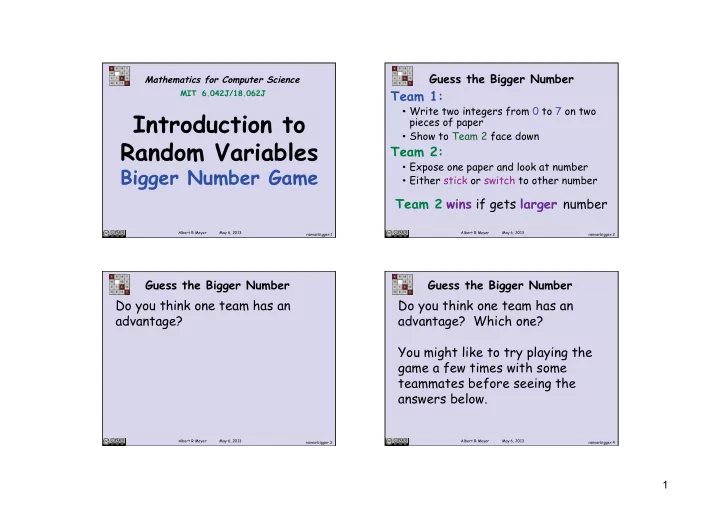
Guess the Bigger Number

Team 1:

  • Write two integers from 0 to 7 on two

pieces of paper

  • Show to Team 2 face down

Team 2:

  • Expose one paper and look at number
  • Either stick or switch to other number

Team 2 wins if gets larger number

Albert R Meyer May 6, 2013 ranvarbigger.3

Guess the Bigger Number

Do you think one team has an advantage?

Albert R Meyer May 6, 2013 ranvarbigger.4

Guess the Bigger Number

Do you think one team has an advantage? Which one? You might like to try playing the game a few times with some teammates before seeing the answers below.

1

slide-2
SLIDE 2

Strategy for Team 2

  • pick a paper to expose, giving each

paper equal probability.

  • if exposed number is “small” then

switch, otherwise stick. That is

switch if threshold Z where

Z is a random integer E [0,7)

Analysis of Team 2 Strategy

Let low < high be the integers chosen by Team 1. There are three cases:

Albert R Meyer May 6, 2013 Albert R Meyer May 6, 2013 ranvarbigger.5 ranvarbigger.6

Analysis of Team 2 Strategy

Case M: low Z < high Team 2 wins in this case, so Pr[Team 2 wins | M] = 1

1

and

Pr[M]

7

Analysis of Team 2 Strategy

Case H: high Z

Team 2 will switch, so wins iff low card gets exposed 1 Pr[Team 2 wins | H] =

2

Albert R Meyer May 6, 2013 Albert R Meyer May 6, 2013 ranvarbigger.7 ranvarbigger.8

2

slide-3
SLIDE 3

__ __

4 7

Analysis of Team 2 Strategy

Case L: Z < low

Team 2 will stick, so wins iff high card gets exposed1 Pr[Team 2 wins | L] =

2

Albert R Meyer May 6, 2013 ranvarbigger.9

Analysis of Team 2 Strategy

So 1/7 of time, sure win. Rest of time, win 1/2. By Law of Total Probability

Albert R Meyer May 6, 2013 ranvarbigger.11

Analysis of Team 2 Strategy

So 1/7 of time, sure win. Rest of time, win 1/2.

Pr[Team 2 wins] =

Pr[win | M]·Pr[M] + Pr[win | M]·Pr[ ] M

Albert R Meyer May 6, 2013

So 1/7 of time, sure win. Rest of time, win 1/2.

Pr[Team 2 wins]

Analysis of Team 2 Strategy

ranvarbigger.14

1 ⋅ 1 7 + 1 2 ⋅ 1 − 1 7       =

Albert R Meyer May 6, 2013 ranvarbigger.12

3

slide-4
SLIDE 4

Albert R Meyer May 6, 2013 ranvarbigger.15

So Team 2 has the advantage

Analysis of Team 2 Strategy

Albert R Meyer May 6, 2013 ranvarbigger.16

So Team 2 has the advantage, no matter what Team 1 does!

Analysis of Team 2 Strategy

Albert R Meyer May 6, 2013 ranvarbigger.17

Team 1 Strategy

…& Team 1 can play so Pr[Team 2 wins] no matter what

4 7

Albert R Meyer May 6, 2013 ranvarbigger.18

Optimal Strategy

Pr[Team 2 wins] = is optimal for both

4 7

4

slide-5
SLIDE 5

Random Variables

Informally: an RV is a number produced by a random process:

  • threshold variable Z
  • number of exposed card
  • number of larger card
  • number of smaller card

Albert R Meyer May 6, 2013 ranvarindep.19

5

slide-6
SLIDE 6

MIT OpenCourseWare http://ocw.mit.edu

6.042J / 18.062J Mathematics for Computer Science

Spring 2015 For information about citing these materials or our Terms of Use, visit: http://ocw.mit.edu/terms.