
SLIDE 1
Introduction to Parametric Rolling Motion (PRM)
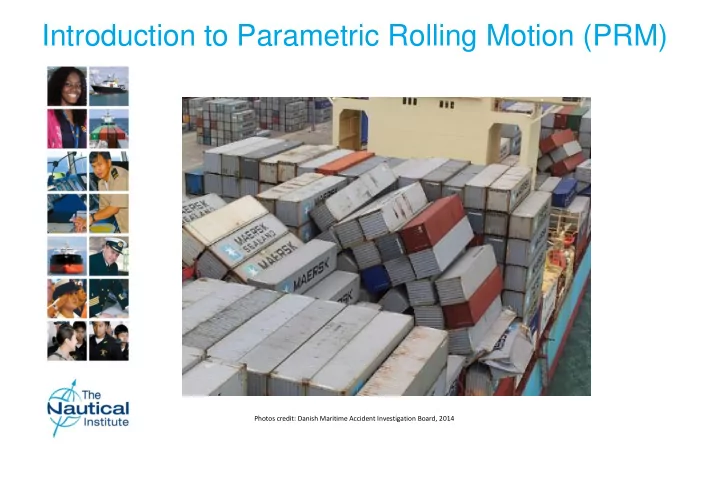
Photos credit: Danish Maritime Accident Investigation Board, 2014
Introduction to Parametric Rolling Motion (PRM) Photos credit: - - PowerPoint PPT Presentation
Introduction to Parametric Rolling Motion (PRM) Photos credit: Danish Maritime Accident Investigation Board, 2014 Parametric Rolling Motion (PRM)? A phenomenon that particularly affects larger vessels with flared fore and aft decks such as
Photos credit: Danish Maritime Accident Investigation Board, 2014
larger vessels with flared fore and aft decks such as Container ships and Pure Car/ Truck Carriers (PCTC)
a) Head/ bow, following/ quartering seas change water plane (as wave passes through the vessel) resulting in submerged hull geometry change relative to time b) Change in submerged hull geometry leads to change in buoyancy c) Leads to altered stability d) Especially prominent when either the crest or trough is amidships
Diagram above shows how change in water plane affects the buoyancy available to the vessel (Sjule, 2016)
extreme stress
system to varying load
Danish Maritime Accident Investigation Board, 2014
On 14th Feb 2014, Svendborg Maersk was sailing under heavy weather:
changed heading into the wind and sea to minimise rolling.
vessel suddenly rolled to extreme angles of 38° three to four times.
Danish Maritime Accident Investigation Board, 2014
but caused failure of equipment and loss
that 500 containers lost at sea along with damage to other equipment
Danish Maritime Accident Investigation Board, 2014
the master unknowingly exposed the vessel to conditions that led to PRM;
without warning and were short lived.
Danish Maritime Accident Investigation Board, 2014
extreme rolling angle of over 35⁰
cargo and equipment
Bays with lost containers in red (Danish Maritime Accident Investigation Board, 2014)
PRM occurs when the following factors accumulate:
quartering sea)
trough) affect the vessel due to change to water plane and buoyancy available to vessel
encounter period TE of vessel)
The diagram above show the ‘Dangerous Zone’ where vessel is at higher risk of being exposed to PRM (IMO, 2007)
Mariners should avoid situations where:
Or:
1 2 TR
(kn), wave period(s), and encounter angle (α) into the diagram on the right (IMO, 2007).
The diagram above show the ‘Dangerous Zone’ where vessel is at higher risk of being exposed to PRM (IMO, 2007)
Avoiding PRM
state
heading accordingly
(GM), vessel should not be too tender nor too stiff Correcting PRM
heading and adjust speed to bring vessel out of the dangerous zone of TE= TR or TE=
1 2 TR
measures where available
training
inducing factors of PRM sea-state
equipment integrated with other ship automation equipment
Heavy weather damage on 14 February 2014, Valby: Danish Maritime Accident Investigation Board
Situations in Adverse Weather and Sea Conditions, London: International Maritime Organization
London: International Maritime Organization
Stockholm: KTH Royal Institute of Technology School of Engineering Sciences