Introduction to Organic Electronics (Nanomolecular Science Seminar - - PowerPoint PPT Presentation

introduction to organic electronics
SMART_READER_LITE
LIVE PREVIEW

Introduction to Organic Electronics (Nanomolecular Science Seminar - - PowerPoint PPT Presentation

Introduction to Organic Electronics, Fall 2005, Dr. Dietmar Knipp Introduction to Organic Electronics (Nanomolecular Science Seminar I) Information: Information: http://www.faculty.iu- (Course Number 420411 ) Fall 2005 http://www.faculty.iu-


slide-1
SLIDE 1

1 Introduction to Organic Electronics, Fall 2005, Dr. Dietmar Knipp Topics Presentation

Information: http://www.faculty.iu- bremen.de/course/c30 0331a/

Source: Apple Ref.: Apple

Information: http://www.faculty.iu- bremen.de/course/c42 0411/

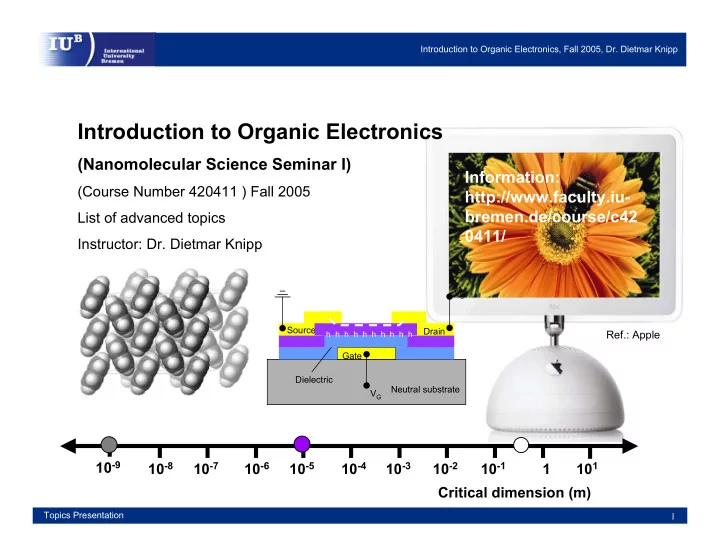
Dielectric e e e e e e e e Gate VG Neutral substrate Source Drain VD

h h h h h h h h h h

101 1 10-1 10-2 10-3 10-4 10-5 10-6 10-8 Critical dimension (m) 10-7 10-9

Introduction to Organic Electronics

(Nanomolecular Science Seminar I)

(Course Number 420411 ) Fall 2005 List of advanced topics Instructor: Dr. Dietmar Knipp

slide-2
SLIDE 2

2 Introduction to Organic Electronics, Fall 2005, Dr. Dietmar Knipp Topics Presentation

Presentation of advanced topics

The final grade of the Organic Electronics Seminar (as part of the „Nano Molecular Science Seminar“) consists of two parts: Presentation of a selected topic (50%) and a test (50%). Each student is asked to pick an advanced topic from the list of posted

  • topics. The propose of the presentation is to introduce a advanced topic

which is related to the general research field of Organic Electronics. The topic should be presented in such a way that the class can follow the

  • material. The presentation should consist of a motivation of the topics and

an introduction, which explains the basic idea or the underlying theory. Furthermore, the synthesis, the properties and/or the fabrication of the materials and devices should be described. The presentation should be 30min. long. (20min. for the actual presentation and 10 min for discussion).

slide-3
SLIDE 3

Introduction to Organic Electronics, Fall 2005, Dr. Dietmar Knipp Topics Presentation

List of advanced topics

  • Discovery and development of conductive polymers
  • Chemistry of liquid crystals
  • Physics of liquid crystals
  • Polymer-Dispersed Liquid Crystals and its applications
  • Synthesis of conductive polymers for light emitting diodes
  • Physics of polymer light emitting diodes
  • Synthesis of small molecules for applications in organic electronic
  • Physics of small molecule based light emitting diodes
  • Operation principle of field effect transistor
  • Thin film transistor technologies
  • Organic solar cells
slide-4
SLIDE 4

4 Introduction to Organic Electronics, Fall 2005, Dr. Dietmar Knipp Topics Presentation

References

Pope and Swenburg, Electronic Processes in organic crystals and polymers, 2 nd Ed., Oxford Organic molecular crystals, E.A. Sininsh EA and V. Capek. http://researchweb.watson.ibm.com/journal/rd45-1.html (Special Issue of IBM journal on organic electronics) http://ocw.mit.edu/OcwWeb/Electrical-Engineering-and-Computer-Science/6- 973Organic-OptoelectronicsSpring2003/CourseHome/ (Organic optoelectronic lecture MIT) http://hackman.mit.edu/6976/overview.html (Seminar on Flat Panel Displays)