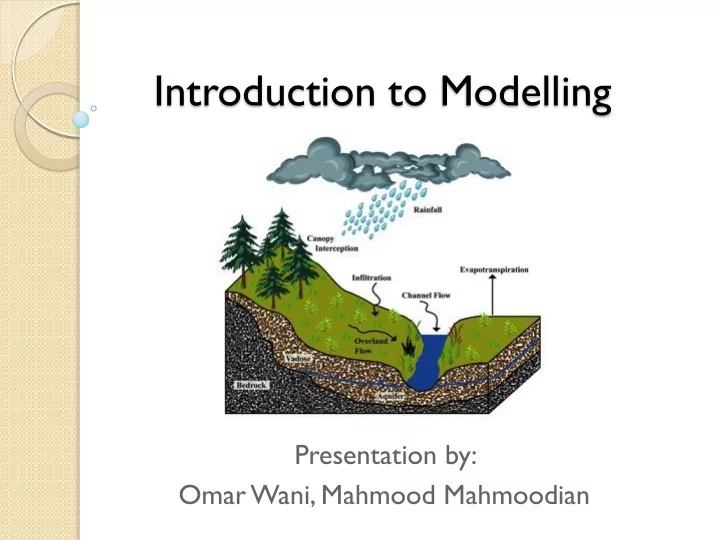
Introduction to Modelling Presentation by: Omar Wani, Mahmood - - PowerPoint PPT Presentation

introduction to modelling
SMART_READER_LITE
LIVE PREVIEW

Introduction to Modelling Presentation by: Omar Wani, Mahmood - - PowerPoint PPT Presentation

Introduction to Modelling Presentation by: Omar Wani, Mahmood Mahmoodian Models: What comes to mind? Source: http://www.fashionmagazine247.com/ http://www.steampoweredclassroom.com/wp-content/uploads/2011/09/dsc06860.jpg What comes to mind?


slide-1
SLIDE 1

Introduction to Modelling

Presentation by: Omar Wani, Mahmood Mahmoodian

slide-2
SLIDE 2

Models: What comes to mind?

Source: http://www.fashionmagazine247.com/ http://www.steampoweredclassroom.com/wp-content/uploads/2011/09/dsc06860.jpg

slide-3
SLIDE 3

What comes to mind?

Source: http://www.fashionmagazine247.com/ http://www.steampoweredclassroom.com/wp-content/uploads/2011/09/dsc06860.jpg

slide-4
SLIDE 4

Models in Science

  • Observing something (Experimentation)
  • Finding a rule (Hypothesis)
  • Checking whether the rule is right (Verification)

http://svitalsky.com/illustrations/vedec.gif

slide-5
SLIDE 5

Dominos falling The number of dominos and the time of complete fall are related If we double the number of dominos, the time of fall increases twofold

https://origin.ih.constantcontact.com/fs132/1100617686073/img/169.jpg

Finding the rules of the game

slide-6
SLIDE 6

http://wallpoper.com/images/00/35/81/27/chess-board_00358127.jpg

Finding the rules of the game

slide-7
SLIDE 7
  • Rainfall causes stream flow
  • More rainfall means more streamflow
  • And more rainfall means more sediments

http://hydrology.asu.edu/wiki/images/Model.jpg

Models for Environment

slide-8
SLIDE 8
  • For rainfall
  • For flow
  • For water quality
  • For ground water
  • For drainage
  • For evaporation
  • etc

Different Environment Models

slide-9
SLIDE 9

Physical modelling

 Physical model is a smaller or larger physical copy of an object that we

would like to study its behaviour.

 A physical model of something large is usually smaller, and of something

very small is larger.

 A Physical model allows visualization from examining the model.

Water molecules: Solar system:

Source: [1] Source: [4] Source: [3] Source: [2]

slide-10
SLIDE 10

Examples:

  • Analysis of rivers, floods and design of flood mitigation structures:
  • Testing of flow patterns and scour around bridge piers:

Source: [8] Source: [7] Source: [10] Source: [9] Source: [6] Source: [5]

slide-11
SLIDE 11
  • Design of harbor and lake flushing:
  • Design of dam and analysis of its failure!

Examples:

Source: [14] Source: [15] Source: [13] Source: [12] Source: [11]

slide-12
SLIDE 12
  • Sediment transport in a river:
  • Even Tsunami analysis!

Examples:

Video: Advantages of a physical model:

  • You can understand better your system by

visualization.

  • You can improve it.
  • You can have a proof of concept.
  • Sometimes you can use it to predict the
  • behaviour of the real system.

Disadvantages:

  • Sometimes it can be expensive, time-

consuming and maybe inaccurate!

Source: [18] Source: [17] Source: [16] Source: [20]

slide-13
SLIDE 13

From simple 𝐺𝑚𝑝𝑥 = 𝑙 × 𝑄𝑓𝑠𝑑𝑓𝑜𝑢𝑏𝑕𝑓 𝑝𝑞𝑓𝑜 To complex

Mathematics of a model

http://www.intechopen.com/source/html/ 42580/media/image2.jpeg

slide-14
SLIDE 14

From common sense 𝑈𝑝𝑢𝑏𝑚 𝑃𝑣𝑢 = 𝐽𝑜 − 𝑡𝑢𝑝𝑠𝑏𝑕𝑓 To uncommon sense

Mathematics of a model

https://safetygonesane.files.wordpress.com/2013/01/waterways3_rospa_owned_dsc_0309-1.jpg

slide-15
SLIDE 15

Using Computers

slide-16
SLIDE 16

Details to fill

What Actual Models Look Like

slide-17
SLIDE 17

Or this (better visualization)

What Actual Models Look Like

slide-18
SLIDE 18

http://cdn.toonvectors.com/images/35/15669/toonvectors-15669-940.jpg

Questions?

slide-19
SLIDE 19

Sources: http://new.mhl.nsw.gov.au/PhysicalModelling https://en.wikipedia.org Sources of photos and video:

  • 1. http://www.lifehacker.com.au/2015/07/lifehacker-test-how-well-do-you-know-the-planets-in-our-solar-system/
  • 2. http://www.exploratorium.edu/ronh/solar_system/
  • 3. http://phys.org/news/2010-04-molecule.html
  • 4. http://sweetpics.site/h/how-to-make-a-water-molecule-model.html
  • 5. http://www.vaw.ethz.ch/people/fb/hifloria/projects/data/fb_sihldurchlaesse_hbz_im_hyd_modellversuch

6. https://www.baw.de/EN/die_baw/technische_ausstattung/technische_ausstattung.html?id=20328b13cb23ec335ea315415b bd95c3

  • 7. http://www.tidallagoonswanseabay.com/the-project/coastal-and-flood-defences/55
  • 8. http://file.scirp.org/Html/15-8101734_25109.htm
  • 9. http://www.fhwa.dot.gov/publications/research/infrastructure/hydraulics/12022/004.cfm
  • 10. : http://www.vaw.ethz.ch/people/wb/archive/wb_223_scour_prot_plunge_dietikon_weir
  • 11. http://www.sfakia-crete-forum.com/read.php?3,1233
  • 12. http://www.yelp.com/biz/bay-model-visitor-center-sausalito
  • 13. http://www.mdba.gov.au/sites/default/files/archived/annualreports/mdbc/AR_2007-08/enlarge/dartmouth-dam.htm
  • 14. https://www.reddit.com/r/videos/comments/2yw9m3/model_of_a_dam_failure
  • 15. http://www.nhcweb.com/muskrat-falls-physical-modeling.asp
  • 16. http://www.stillwatersci.com/case_studies.php?cid=17
  • 17. http://www.appstate.edu/~liutkuscm/T

eaching.html

  • 18. http://www.popularmechanics.com/technology/infrastructure/a17680/highest-man-made-waves/
  • 20. https://www.youtube.com/watch?v=X3lCXHxVFzU

This project has received funding from the European Union’s Seventh Framework Programme for research, technological development and demonstration under grant agreement no 607000