Introduction to IPv6 (Chapter 4 in Huitema) IPv6,Mobility-1 - - PDF document

introduction to ipv6
SMART_READER_LITE
LIVE PREVIEW

Introduction to IPv6 (Chapter 4 in Huitema) IPv6,Mobility-1 - - PDF document

Introduction to IPv6 (Chapter 4 in Huitema) IPv6,Mobility-1 S-38.121 / S-03 / N Beijar IPv6 addresses 128 bits long Written as eight 16-bit integers separated with colons E.g. 1080:0000:0000:0000:0000:0008:200C:417A =


slide-1
SLIDE 1

S-38.121 / S-03 / N Beijar

IPv6,Mobility-1

Introduction to IPv6

(Chapter 4 in Huitema)

S-38.121 / S-03 / N Beijar

IPv6,Mobility-2

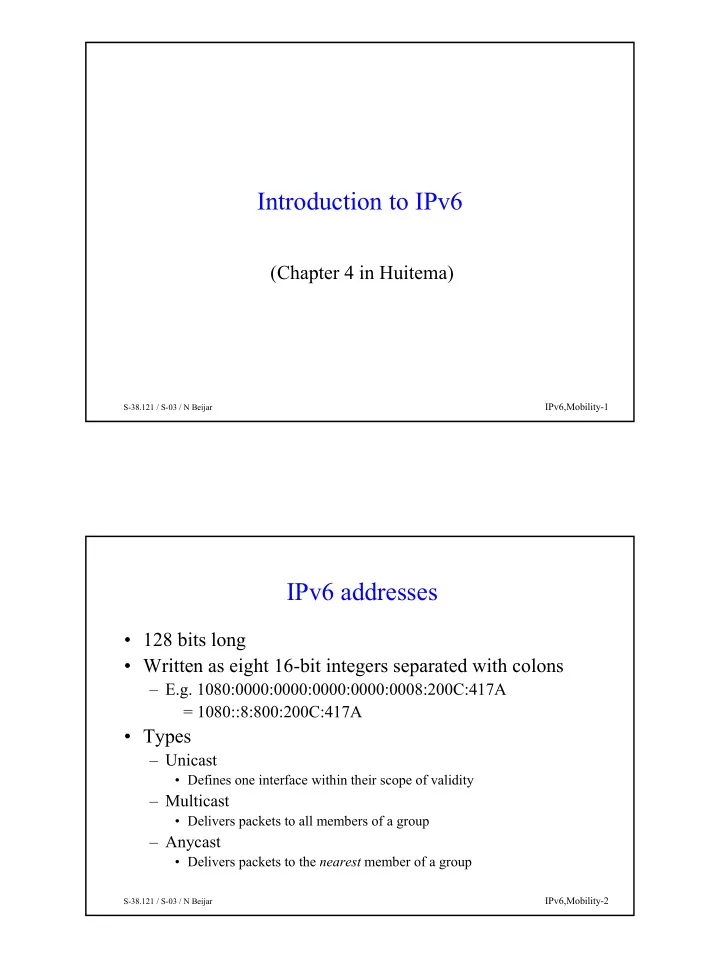
IPv6 addresses

  • 128 bits long
  • Written as eight 16-bit integers separated with colons

– E.g. 1080:0000:0000:0000:0000:0008:200C:417A = 1080::8:800:200C:417A

  • Types

– Unicast

  • Defines one interface within their scope of validity

– Multicast

  • Delivers packets to all members of a group

– Anycast

  • Delivers packets to the nearest member of a group
slide-2
SLIDE 2

S-38.121 / S-03 / N Beijar

IPv6,Mobility-3

Special IPv6 addresses

  • Unspecified = 0:0:0:0:0:0:0:0 = ::

– Only as source address

  • Loopback = 0:0:0:0:0:0:0:1 = ::1

– For sending datagrams to itself

  • IPv4 addresses prepended with zeroes

– 0:0:0:0:0:0:AABB:CCDD = ::a.b.c.d

  • Site-local addresses

– FEC0:0000:0000:subnet:station

  • Link-local addresses

– FEB0:0000:0000:0000:station

S-38.121 / S-03 / N Beijar

IPv6,Mobility-4

IPv6 header

  • Differences between v4 and v6

– No checksum (performed at lower layers) – No fragmentation (path MTU discovery instead, min. 1280) – No options (linked extension headers instead)

  • Extension headers replace options

Version=6 (4) Version=6 (4) Traffic class (8) Traffic class (8) Flow label (24) Flow label (24) Payload length (16) Payload length (16)

Next header type (8) Next header type (8)

Hop limit (8) Hop limit (8) Source address (128) Source address (128) Destination address (128) Destination address (128) IPv6 header IPv6 header Extension Extension Extension Extension Payload (TCP) Payload (TCP)

NH NH NH

slide-3
SLIDE 3

S-38.121 / S-03 / N Beijar

IPv6,Mobility-5

IPv6 supports strict or loose source routing

  • Routing header
  • Only the router whose address is destination address in IPv6

header examines this extension ⇒ better performance

  • Forwarder

– Moves the next address to the IPv6 header – Decrements the number of segments left Hext header Hext header Header ext. length Header ext. length Routing type = 0 Routing type = 0 Segments left Segments left Reserved Reserved IPv6 address 1 IPv6 address 1 IPv6 address 2 IPv6 address 2 . . . . . . IPv6 address N IPv6 address N

S-38.121 / S-03 / N Beijar

IPv6,Mobility-6

Fragmentation is performed by the sender

  • Packets larger than the next hop’s MTU are rejected
  • Large packets must be fragmented by the sender
  • Fragment header:
  • Offset: Least significant 132 bits of 16-bit word
  • M: More fragments

Hext header Hext header Reserved Reserved Fragment offset Fragment offset Reserved Reserved M M Identification Identification

slide-4
SLIDE 4

S-38.121 / S-03 / N Beijar

IPv6,Mobility-7

Other extensions

  • Authentication Header (AH)
  • Encrypted Security Payload (ESP)
  • Destination options header

– Only examined by the destination – Contains one or several parameters – Also defines handling for unrecognized parameters

  • Hop-by-hop options header

– Examined by each router – Similar format and coding as destination options header – E.g. jumbo payload

  • Processing order is important

– IPv6 Hop-by-hop Destination options (for tunneling) Routing Fragment Authentication Destination options Upper layers (TCP/UDP)

S-38.121 / S-03 / N Beijar

IPv6,Mobility-8

Internet Control Message Protocol Version 6

  • ICMPv6 header
  • Also includes the functionality of IGMP
  • ICMP message types:

– 1. Destination unreachable – 2. Packet too big – 3. Time exceeded – 4. Parameter problem – 128. Echo request – 129. Echo reply – 133. Router solicitation – 134. Router advertisement – 137. Redirect

errors router discovery for ”ping” Type Type Code Code Checksum Checksum ICMP body ICMP body

slide-5
SLIDE 5

S-38.121 / S-03 / N Beijar

IPv6,Mobility-9

Router discovery

  • For building a local list of routers on the same network
  • Curr.hop limit: Suggestion for initial hop limit value
  • Router lifetime: Seconds for holding in router list
  • Reachable time: Expected time neighbors remain reachable after advertising the

media address (in milliseconds)

  • Reachable retransmission timer: Interval between successive solicitations of a

neighbor that is not returning solicited neighbor advertisements (ms). + Source Link Layer option: contains media address of router Type = 134 Type = 134 Code = 0 Code = 0 Checksum Checksum

  • Cur. hop limit
  • Cur. hop limit

M M O O Res. Res. Router lifetime Router lifetime Reachable time Reachable time Retransmission timer Retransmission timer Options Options

S-38.121 / S-03 / N Beijar

IPv6,Mobility-10

Neighbor discovery in IPv6 replaces ARP

  • If there is no MAC address entry for the next hop, a neighbor solicitation

message (comp. ARP-request) is sent:

– TTL=1, own MAC address in source link-level address option

  • The message is sent to a solicited node multicast address derived from the

address of the next-hop

  • MAC address for the message derived from this address
  • The host recognizing its address, replies with a neighbor advertisement message

(comp. ARP-reply)

– Format similar, but Type=136 – MAC address in link layer address option – R=address is router, S=reply to solicitation, O=overides previous cache entry

Type = 135 Type = 135 Code = 0 Code = 0 Checksum Checksum R R S S O O Reserved Reserved Solicited address Solicited address Options... Options...

slide-6
SLIDE 6

S-38.121 / S-03 / N Beijar

IPv6,Mobility-11

Redirect works like in IPv4 but may include the media address of the next hop

  • Redirect message:
  • Target address contains the better next hop for the destination
  • The media address of the next hop may be included in a target link

layer address option.

Type = 137 Type = 137 Code = 0 Code = 0 Checksum Checksum Reserved Reserved Target address Target address Destination address Destination address Options Options

S-38.121 / S-03 / N Beijar

IPv6,Mobility-12

The sender needs feedback from the destiation so that it is not sending to a ”black hole”

  • If the sender does not get feedback (within 30 seconds), it checks

the existence of the receiver with a solicitation message

update cache update cache solicitated advertisement solicitation solicitation calculate new next-hops calculate new next-hops remove from cache remove from cache solicitation solicitation destination unreachable

slide-7
SLIDE 7

S-38.121 / S-03 / N Beijar

IPv6,Mobility-13

Autoconfiguration can be stateful or stateless

router new host router advertisement [all-hosts / link-local-address] router solicitation [link-local-addressall-routers]

Type = 134 Type = 134 Code = 0 Code = 0 Checksum Checksum Type = 133 Type = 133 Code = 0 Code = 0 Checksum Checksum Reserved Reserved Options.... (link layer address) Options.... (link layer address) Hop.limit Hop.limit M M O O Res. Res. Router lifetime Router lifetime Reachable time Reachable time Retransmission timer Retransmission timer Options.... (prefix information option) Options.... (prefix information option)

O=1 O=1

  • btain other parameters from conf.server
  • btain other parameters from conf.server

M=1 M=1 stateful conf. with conf.server stateful conf. with conf.server stateless configuration stateless configuration

yes yes

Stateful auto- configuration similar to DHCP in IPv4

S-38.121 / S-03 / N Beijar

IPv6,Mobility-14

Stateless autoconfiguration

  • Prefix information option contains list of prefixes with parameters

– on-link bit the prefix is specific to the local link – autonomous-bit host can construct address by replacing the last bits of the prefix with EUI-64 identifier

  • Stateless autoconfiguration properties

– simple, no servers required – inefficient: 64 bits used for one local network – no access control

Type = 134 Type = 134 Code = 0 Code = 0 Checksum Checksum Hop.limit Hop.limit M M O O Res. Res. Router lifetime Router lifetime Reachable time Reachable time Retransmission timer Retransmission timer Options.... (prefix information option) Options.... (prefix information option)

slide-8
SLIDE 8

S-38.121 / S-03 / N Beijar

IPv6,Mobility-15

When a host generates an address with auto- configuration, it must check that it is unique

  • In principle, addresses generated with the EUI-64 identifier should

be unique, but...

  • Lost messages ⇒ retry several times

address is unique address is unique solicitation address not unique pick another address not unique pick another solicitated advertisement solicitation 1 s

S-38.121 / S-03 / N Beijar

IPv6,Mobility-16

Mobile IP

(Chapter 13 in Huitema)

slide-9
SLIDE 9

S-38.121 / S-03 / N Beijar

IPv6,Mobility-17

Different types of mobility

  • Computers transported and connected from different locations

– Dynamic configuration ⇒ new IP address – Access through modem/ISDN ⇒ new IP address ⇒ TCP connection cut off

  • Mobile computers, which stay connected during movements

– Radio, infrared ⇒ same IP address

  • Mobile networks, e.g. in cars, planes, trains, ships

– Recursive mobility (mobile host in mobile network)

S-38.121 / S-03 / N Beijar

IPv6,Mobility-18

The traffic to a mobile node is tunneled from the home agent to the foreign agent

  • Mobile Node (MN) – Node, who has a home address in the home network, and
  • btains a care-of-address (COA) in the visited foreign network
  • Home Agent (HA) – Belongs to the home network and serves the home address
  • Foreign Agent (FA) – Serves the visiting mobile node
  • Corresponding Node (CN) – A node exchanging data with the mobile node

HA FA CN MN

tunneling normal forwarding to home address normal forwarding

care-of-address Home agents and foreign agents may be routers home address

slide-10
SLIDE 10

S-38.121 / S-03 / N Beijar

IPv6,Mobility-19

Discovery and registration

Yes

ICMP agent advertisement (COA address)

FA

reply reply register (COA address) register (COA address) new location? new location?

MN HA

grant? grant?

Yes A lost request is resent by MN FA never repeats the request.

S-38.121 / S-03 / N Beijar

IPv6,Mobility-20

Discovery of a Home Agent or Foreign Agent using periodical ICMP messages

  • Agent advertisements are extensions to ICMP router

advertisements

  • The agent advertisements contain

– Sequence number – Life-time of registration – Flags

  • Registration required
  • Foreign agent or home agent
  • Minimal encapsulation (RFC-2003)
  • Generic Routing Encapsulation (GRE) (RFC-1701)
  • Header compression used

– List of care-of-addresses – Length of prefixes

slide-11
SLIDE 11

S-38.121 / S-03 / N Beijar

IPv6,Mobility-21

The sequence numbers in the agent adverstisement are similar to ”lollipop” sequence numbers in OSPF

  • If one of the number is < 256

– The higher number is ”higher”

  • If both numbers are ≥ 256

– If (b-a) < (65635-256)/2 then b is ”higher”

  • If the received is ”lower” than the previous, then the server has

been restarted

⇒ Register again

256 65635

S-38.121 / S-03 / N Beijar

IPv6,Mobility-22

Alternative discovery mechanisms

  • Periodic broadcast of ICMP messages wastes

transmission capacity, especially on wireless LANs

  • The MN can detect changed location through media-level

information

– e.g. analyzing power of different basestations

  • Instead of waiting, the MN can solicit the information

– Similar to ICMP router solicitation – TTL = 1 – Agent replies with agent advertisement

slide-12
SLIDE 12

S-38.121 / S-03 / N Beijar

IPv6,Mobility-23

Registration request

  • Registration request message contains

– Message type = 1 – Flags

  • FA colocated with MN
  • preferred encapsulation

– Requested lifetime

  • 0 = cancellation of previous

– Home address of MN – HA address – COA address – Request identification – Extensions

  • E.g. authentication

S-38.121 / S-03 / N Beijar

IPv6,Mobility-24

Registration reply

  • Registration reply message contains

– Message type = 3 – Reply code (granted or denied)

  • Who denied (FA or HA)
  • Why denied

– Accepted lifetime

  • Same or smaller than requested lifetime

– Home address of MN – HA address – Request identification

  • Same as in request

– Extensions

  • E.g. authentication
slide-13
SLIDE 13

S-38.121 / S-03 / N Beijar

IPv6,Mobility-25

Security issues (1)

  • Attack types

– Attacker pretends to be a FA to capture traffic – Attacker replays old registration messages

  • Authentication extension proves the origin of the message and that

the contents has not been changed

– Security parameter index (SPI) together with HA, COA, or NM identifies security context – Shared secret, signature algorithm (e.g. keyed MD5) parameters of security context – Data and secret key authentication field – MN to HA authentication mandatory – FA to HA and MN to FA authentications optional

S-38.121 / S-03 / N Beijar

IPv6,Mobility-26

Security issues (2)

  • Attack types

– Attacker pretends to be a FA to capture traffic – Attacker replays old registration messages

  • Two requests must not contain the same identification

– NTP timestamps (64-bit)

  • Only requests with higher timestamps are accepted
  • The timestamps must be close to the current time

– Random numbers used only once (nonce)

slide-14
SLIDE 14

S-38.121 / S-03 / N Beijar

IPv6,Mobility-27

Encapsulation

  • Basic encapsulation, RFC-2003
  • Minimal encapsulation, RFC-2004
  • Generic Routing Encapsulation (GRE), RFC-1701

Source=HA, Dest=COA, Protocol=GRE=24 Source=HA, Dest=COA, Protocol=GRE=24 Encapsulation parameters Encapsulation parameters Source=CN, Dest=MN, Protocol=TCP Source=CN, Dest=MN, Protocol=TCP TCP header + data TCP header + data GRE header Original IP packet New IP header Parameters: Protocol type (similar to the one in Ethernet packet), optional checksum, optional sequence number, optional authentication key, (source) routing field Source=HA, Dest=COA, Protocol=Min.encaps=55 Source=HA, Dest=COA, Protocol=Min.encaps=55 Compressed header Compressed header TCP header + data TCP header + data Original IP packet New IP header Source=HA, Dest=COA, Protocol=IP in IP=4 Source=HA, Dest=COA, Protocol=IP in IP=4 Source=CN, Dest=MN, Protocol=TCP Source=CN, Dest=MN, Protocol=TCP TCP header + data TCP header + data Original IP packet New IP header Compressed header: Protocol type of encaps. packet (e.g. TCP), Destination address of

  • encaps. packet, Optional source

address of encaps. packet, Header checksum

S-38.121 / S-03 / N Beijar

IPv6,Mobility-28

Broadcast and multicast should only be received by the MN, not the network of MN

  • Easy if FA is colocated with MN
  • Double encapsulation of broadcast/multicast traffic
  • ICMP messages are encapsulated MNHA
  • Instead, MN can subscribe to groups on the foreign network

MN

encapsulated packet

HA FA/MN

double encapsulation

HA

encapsulated packet

FA

Source=HA, Dest=COA, Protocol=encaps Source=HA, Dest=COA, Protocol=encaps Source=HA, Dest=MN, Protocol=encaps Source=HA, Dest=MN, Protocol=encaps Source=CN, Dest=bc, Protocol=UDP Source=CN, Dest=bc, Protocol=UDP UDP header + data UDP header + data Double encapsulation Original broadcast packet New IP header
slide-15
SLIDE 15

S-38.121 / S-03 / N Beijar

IPv6,Mobility-29

Multiple home agents

  • Problem: MN becomes unreachable if HA fails
  • If there are several home agents, one of them must be the

”designated home agent” (compare to OSPF)

  • Only supported by the early designs of mobile IP

HA FA CN MN HA

designated

S-38.121 / S-03 / N Beijar

IPv6,Mobility-30

Source address filtering is a problem in Mobile IP (1)

  • Why source address filtering?

– Address spoofing hides identity of attacker, helps targeting third parties’ replies, helps gaining privilegies

  • Source address filtering is performed in firewalls, between ISP and

customer, at peering points between provides, etc.

⇒ Packets sent by MN must be tunneled through the HA

FA CN MN HA

slide-16
SLIDE 16

S-38.121 / S-03 / N Beijar

IPv6,Mobility-31

Source address filtering is a problem in Mobile IP (2)

  • FAs capable of tunneling packets back to HA, advertise it with a

flag in agent advertisement message

  • The MN requests reverse tunneling

register (reverse tunneling) register

MN HA

. . .

FA FA

ICMP router advertisement (reverese tunnel capability) ICMP router advertisement

S-38.121 / S-03 / N Beijar

IPv6,Mobility-32

Considerations

  • Path MNCN is shorter than the path CNMN

– Assymmetry

  • If the MN moves relatively fast, it must choose a new FA
  • ften

⇒ Many registration messages to HA

slide-17
SLIDE 17

S-38.121 / S-03 / N Beijar

IPv6,Mobility-33

Mobile IPv6

(Chapter 13 in Huitema)

S-38.121 / S-03 / N Beijar

IPv6,Mobility-34

Mobility in IPv6

  • Discovery performed with IPv6 neighbor discovery and

address configuration mechanisms

  • Security ⇒ MN can nofity their COA to the CN in

addition to the HA

  • Efficient encapsulation with the source routing header
slide-18
SLIDE 18

S-38.121 / S-03 / N Beijar

IPv6,Mobility-35

Discovery

  • The MN and FA are usually colocated ⇒ No separate FA
  • Hosts listen to router adverisements to the learn prefixes
  • f the link

– Hosts can detect that they are visiting a foreign network

  • COA obtained with address configuration procedures
  • Routers willing to act as home agents indicate it in the

router advertisement

S-38.121 / S-03 / N Beijar

IPv6,Mobility-36

Binding updates (1)

  • Binding performed using destination options

– Binding update – informs about the new COA – Binding ack – acknowledges the COA – Binding request – To request information about the current COA – Home address – Identifies the home address of the MN

  • Authentication with the security option
slide-19
SLIDE 19

S-38.121 / S-03 / N Beijar

IPv6,Mobility-37

Binding updates (2)

  • COA transmitted in source address of IPv6 header
  • Home address in the Home Address option

Binding ack (result code, lifetime, update refresh period, seq.num,

  • ptional list of home agents)

MN HA

Binding update (lifetime, seq.num) Home address Security

S-38.121 / S-03 / N Beijar

IPv6,Mobility-38

Source address filtering is not a problem in IPv6

  • The mobile node does not put its home address in the

IPv6 header. Instead, the home address is sent in the Home Address option. The IPv6 header contains the COA.

  • Mandatory requirement.
slide-20
SLIDE 20

S-38.121 / S-03 / N Beijar

IPv6,Mobility-39

The MN can send a binding update to the CN to optimize the route

MN CN HA packets packets packets

Binding request

no update and timer expires no update and timer expires

Yes

Binding update Binding ack

ack requested ack requested Yes

Binding update Binding ack

ack requested ack requested Yes want to update want to update Yes

Note: if the COA changes a new binding update must be sent to all CNs that are sending directly

S-38.121 / S-03 / N Beijar

IPv6,Mobility-40

IPv6 uses the routing header instead of encapsulation

MN CN HA

Packet

insert routing header insert routing header

Packet (source addr.=COA) Home address option Security (AH, ESP) Binding update Packet Routing header COA Packet Routing header COA Security (AH, ESP) Binding ack

sender is MN store the COA sender is MN store the COA