
1
IPv6: An Introduction IPv6: An Introduction
Dheeraj Sanghi Dheeraj Sanghi
Department of Computer Science and Engineering Department of Computer Science and Engineering Indian Institute of Technology Kanpur Indian Institute of Technology Kanpur dheeraj@iitk.ac.in dheeraj@iitk.ac.in http://www.cse.iitk.ac.in/users/dheeraj http://www.cse.iitk.ac.in/users/dheeraj
May 2005 May 2005 IIT Kanpur IIT Kanpur 1 1Outline Outline
- Problems with IPv4
Problems with IPv4
- Basic IPv6 Protocol
Basic IPv6 Protocol
- IPv6 features
IPv6 features
– – Auto Auto-
- configuration, QoS, Security, Mobility
configuration, QoS, Security, Mobility
- Transition Plans
Transition Plans
May 2005 May 2005 IIT Kanpur IIT Kanpur 2 2Internet Protocol Internet Protocol
Transports a datagram from source host to destination, Transports a datagram from source host to destination, possibly via several intermediate nodes (“routers”) possibly via several intermediate nodes (“routers”) Service is: Service is:
- Unreliable:
Unreliable: Losses, duplicates, out Losses, duplicates, out-
- of
- f-
- order delivery
- rder delivery
- Best effort:
Best effort: Packets not discarded capriciously, delivery Packets not discarded capriciously, delivery failure not necessarily reported failure not necessarily reported
- Connectionless:
Connectionless: Each packet is treated independently Each packet is treated independently
May 2005 May 2005 IIT Kanpur IIT Kanpur 3 3IP Datagram Header IP Datagram Header
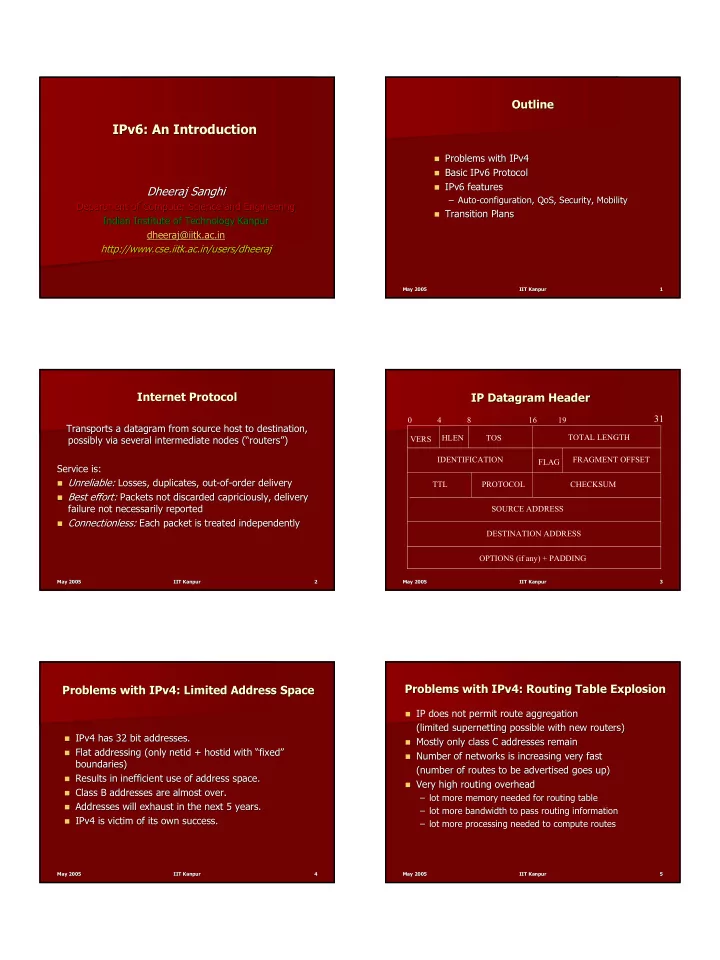
VERS HLEN TOS TOTAL LENGTH IDENTIFICATION FLAG FRAGMENT OFFSET TTL PROTOCOL CHECKSUM SOURCE ADDRESS DESTINATION ADDRESS OPTIONS (if any) + PADDING 4 8 16 19
31
May 2005 May 2005 IIT Kanpur IIT Kanpur 4 4Problems with IPv4: Limited Address Space Problems with IPv4: Limited Address Space
- IPv4 has 32 bit addresses.
IPv4 has 32 bit addresses.
- Flat addressing (only netid + hostid with “fixed”
Flat addressing (only netid + hostid with “fixed” boundaries) boundaries)
- Results in inefficient use of address space.
Results in inefficient use of address space.
- Class B addresses are almost over.
Class B addresses are almost over.
- Addresses will exhaust in the next 5 years.
Addresses will exhaust in the next 5 years.
- IPv4 is victim of its own success.
IPv4 is victim of its own success.
May 2005 May 2005 IIT Kanpur IIT Kanpur 5 5Problems with IPv4: Routing Table Explosion Problems with IPv4: Routing Table Explosion
- IP does not permit route aggregation
IP does not permit route aggregation (limited supernetting possible with new routers) (limited supernetting possible with new routers)
- Mostly only class C addresses remain
Mostly only class C addresses remain
- Number of networks is increasing very fast
Number of networks is increasing very fast (number of routes to be advertised goes up) (number of routes to be advertised goes up)
- Very high routing overhead
Very high routing overhead
– – lot more memory needed for routing table lot more memory needed for routing table – – lot more bandwidth to pass routing information lot more bandwidth to pass routing information – – lot more processing needed to compute routes lot more processing needed to compute routes