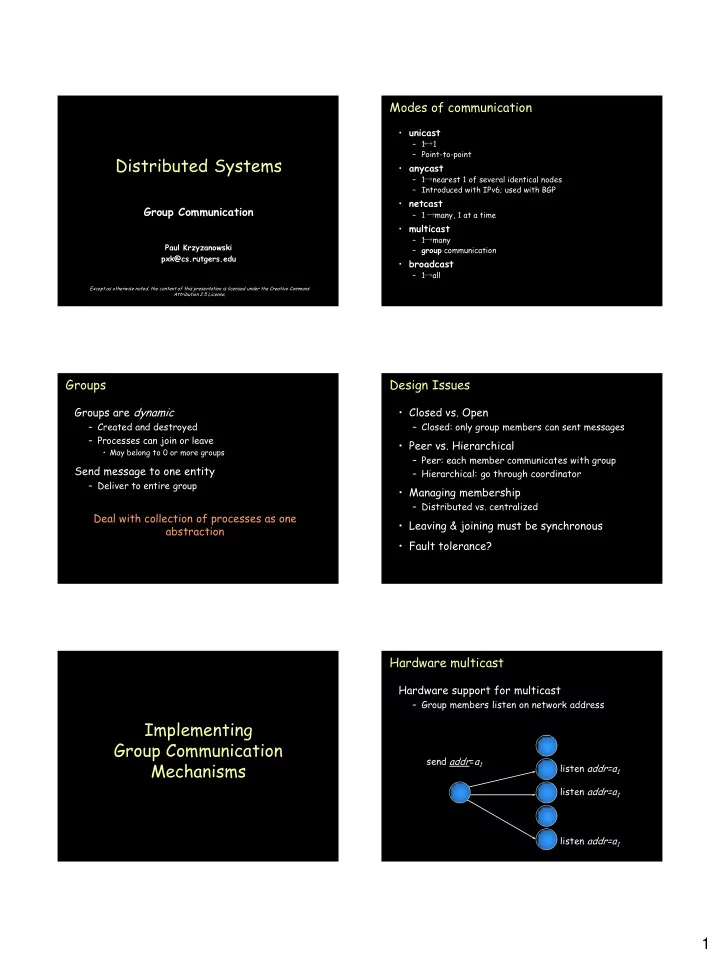
Distributed Systems anycast 1 nearest 1 of several identical nodes - - PDF document

distributed systems
SMART_READER_LITE
LIVE PREVIEW

Distributed Systems anycast 1 nearest 1 of several identical nodes - - PDF document

Modes of communication unicast 1 1 Point-to-point Distributed Systems anycast 1 nearest 1 of several identical nodes Introduced with IPv6; used with BGP netcast Group Communication 1 many, 1 at a time


slide-1
SLIDE 1

1

Page 1 Page 1

Group Communication

Paul Krzyzanowski pxk@cs.rutgers.edu

Distributed Systems

Except as otherwise noted, the content of this presentation is licensed under the Creative Commons Attribution 2.5 License.

Page 2

Modes of communication

  • unicast

– 1 1 – Point-to-point

  • anycast

– 1 nearest 1 of several identical nodes – Introduced with IPv6; used with BGP

  • netcast

– 1 many, 1 at a time

  • multicast

– 1 many – group communication

  • broadcast

– 1 all

Page 3

Groups

Groups are dynamic

– Created and destroyed – Processes can join or leave

  • May belong to 0 or more groups

Send message to one entity

– Deliver to entire group

Deal with collection of processes as one abstraction

Page 4

Design Issues

  • Closed vs. Open

– Closed: only group members can sent messages

  • Peer vs. Hierarchical

– Peer: each member communicates with group – Hierarchical: go through coordinator

  • Managing membership

– Distributed vs. centralized

  • Leaving & joining must be synchronous
  • Fault tolerance?

Page 5 Page 5

Implementing Group Communication Mechanisms

Page 6

Hardware multicast

Hardware support for multicast

– Group members listen on network address listen addr=a1 listen addr=a1 listen addr=a1 send addr=a1

slide-2
SLIDE 2

2

Page 7

Hardware broadcast

Hardware support for broadcast

– Software filters multicast address

  • May be auxiliary address

broadcast(id=m) accept id=m accept id=m accept id=m discard id=m discard id=m

Page 8

Software: netcast

Multiple unicasts (netcast)

– Sender knows group members listen local addr=a2 listen local addr=a3 listen local addr=a5 send(a3)

Page 9

Software

Multiple unicasts via group coordinator

– coordinator knows group members listen local addr listen local addr listen local addr coordinator send(a3) send(c)

Page 10 Page 10

Reliability of multicasts

Page 11

Atomic multicast

Atomicity

Message sent to a group arrives at all group members

  • If it fails to arrive at any member, no member will

process it.

Problems

Unreliable network

  • Each message should be acknowledged
  • Acknowledgements can be lost

Message sender might die

Page 12

Achieving atomicity (2-phase commit variation)

Retry through network failures & system downtime Sender and receivers maintain persistent log 1. Send message to all group members

  • Each receiver acknowledges message
  • Saves message and acknowledgement in log
  • Does not pass message to application
  • 2. Sender waits for all acknowledgements
  • Retransmits message to non-responding members

– Again and again… until response received

  • 3. Sender sends “go” message to all members
  • Each recipient passes message to application
  • Sends reply to server
slide-3
SLIDE 3

3

Page 13

Achieving atomicity

Phase 1:

– Make sure that everyone gets the message

Phase 2:

– Once everyone has confirmed receipt, let the application see it All members will eventually get the message

Page 14

Reliable multicast

Best effort

– Assume sender will remain alive – Retransmit undelivered messages

  • Send message
  • Wait for acknowledgement from each group

member

  • Retransmit to non-responding members

Page 15

Unreliable multicast

  • Basic multicast
  • Hope it gets there

Page 16 Page 16

Message ordering

Page 17

Good Ordering

Process 0 message a

  • rder received

a, b a, b message b

Page 18

Bad Ordering

Process 0 message a

  • rder received

a, b b, a message b

slide-4
SLIDE 4

4

Page 19

Good Ordering

Process 0 Process 1 message a message b

  • rder received

a, b a, b

Page 20

Bad Ordering

Process 0 Process 1 message a message b

  • rder received

a, b b, a

Page 21

Sending versus Delivering

  • Multicast receiver algorithm decides when to

deliver a message to the process.

  • A received message may be:

– Delivered immediately

(put on a delivery queue that the process reads)

– Placed on a hold-back queue

(because we need to wait for an earlier message)

– Rejected/discarded

(duplicate or earlier message that we no longer want)

Page 22

Sending, delivering, holding back

sender receiver

Multicast sending algorithm Multicast receiving algorithm hold-back queue delivery queue discard

? sending delivering

Page 23

Global time ordering

  • All messages arrive in exact order sent
  • Assumes two events never happen at the

exact same time!

  • Difficult (impossible) to achieve

Page 24

Total ordering

  • Consistent ordering everywhere
  • All messages arrive at all group members in the same
  • rder
  • Implementation:

– Attach unique totally sequenced message ID – Receiver delivers a message to the application only if it has received all messages with a smaller ID

  • 1. If a process sends m before m’

then any other process that delivers m’ will have delivered m.

  • 2. If a process delivers m’ before m” then

every other process will have delivered m’ before m”.

slide-5
SLIDE 5

5

Page 25

Causal ordering

  • Partial ordering

– Messages sequenced by Lamport or Vector timestamps

  • Implementation

– Deliver messages in timestamp order per-source.

If multicast(G, m) -> multicast(G, m’) then every process that delivers m’ will have delivered m

Page 26

Sync ordering

  • Messages can arrive in any order
  • Special message type

– Synchronization primitive – Ensure all pending messages are delivered before any additional (post-sync) messages are accepted

Page 27

FIFO ordering

  • Messages can be delivered in different order

to different members

  • Message m must be delivered before message

m’ iff m was sent before m’ from the same host If a process issues a multicast of m followed by m’, then every process that delivers m’ will have already delivered m.

Page 28

Unordered multicast

  • Messages can be delivered in different order

to different members

  • Order per-source does not matter.

Page 29

Multicasting considerations

atomic reliable unreliable Message Ordering Reliability

Page 30 Page 30

IP Multicasting

slide-6
SLIDE 6

6

Page 31

IP Broadcasting

  • 255.255.255.255

– Limited broadcast: send to all connected networks

  • Host bits all 1 (128.6.255.255, 192.168.0.255)

– Directed broadcast on subnet

Page 32

IP Multicasting

Class D network created for IP multicasting

224.0.0.0/4 224.0.0.0 – 239.255.255.255

Host group

– Set of machines listening to a particular multicast address 1110 28-bit multicast address

Page 33

IP multicasting

  • Can span multiple physical networks
  • Dynamic membership

– Machine can join or leave at any time

  • No restriction on number of hosts in a group
  • Machine does not need to be a member to

send messages

Page 34

IP multicast addresses

  • Addresses chosen arbitrarily
  • Well-known addresses assigned by IANA

– Internet Assigned Numbers Authority – RFC 1340 – Similar to ports – service-based allocation

  • FTP: port 21, SMTP: port 25, HTTP: port 80

224.0.0.1: all systems on this subnet 224.0.0.2: all multicast routers on subnet 224.0.1.16: music service 224.0.1.2: SGI’s dogfight 224.0.1.7: Audionews service

Page 35

LAN (Ethernet) multicasting

LAN cards support multicast in one (or both) of two ways:

– Packets filtered based on hash(mcast addr)

  • Some unwanted packets may pass through
  • Simplified circuitry

– Exact match on small number of addresses

  • If host needs more, put LAN card in multicast

promiscuous mode – Receive all hardware multicast packets

Device driver must check to see if the packet was really needed

Page 36

LAN (Ethernet) multicasting example

Intel 82546EB Dual Port Gigabit Ethernet Controller 10/100/1000 BaseT Ethernet Supports:

  • 16 exact MAC address matches
  • 4096-bit hash filter for multicast frames
  • promiscuous unicast & promiscuous multicast

transfer modes

slide-7
SLIDE 7

7

Page 37

IP multicast on a LAN

  • Sender specifies class D address in packet
  • Driver must translate 28-bit IP multicast group to

multicast Ethernet address – IANA allocated range of Ethernet MAC addresses for multicast – Copy least significant 23 bits of IP address to MAC address

  • 01:00:5e:xx:xx:xx
  • Send out multicast Ethernet packet

– Contains multicast IP packet

Bottom 23 bits

  • f IP address

Page 38

IP multicast on a LAN

Joining a multicast group Receiving process:

– Notifies IP layer that it wants to receive datagrams addressed to a certain host group – Device driver must enable reception of Ethernet packets for that IP address

  • Then filter exact packets

Page 39

Beyond the physical network

Packets pass through routers which bridge networks together Multicast-aware router needs to know:

– are any hosts on a LAN that belong to a multicast group?

IGMP:

– Internet Group Management Protocol – Designed to answer this question – RFC 1112 (v1), 2236 (v2), 3376 (v3)

Page 40

IGMP v1

  • Datagram-based protocol
  • Fixed-size messages:

– 20 bytes header, 8 bytes data

  • 4-bit version
  • 4-bit operation (1=query by router, 2=response)
  • 16-bit checksum
  • 32-bit IP class D address

Page 41

Joining multicast group with IGMP

  • Machine sends IGMP report:

– “I’m interested in this multicast address”

  • Each multicast router broadcasts IGMP

queries at regular intervals

– See if any machines are still interested – One query per network interface

  • When machine receives query

– Send IGMP response packet for each group for which it is still interested in receiving packets

Page 42

Leaving a multicast group with IGMP

  • No response to an IGMP query

– Machine has no more processes which are interested

  • Eventually router will stop forwarding packets

to network when it gets no IGMP responses

slide-8
SLIDE 8

8

Page 43

IGMP enhancements

  • IGMP v2

– Leave group messages added – Useful for high-bandwidth applications

  • IGMP v3

– Hosts can specify list of hosts from which they want to receive traffic. – Traffic from other (unwanted) hosts is blocked by the routers and hosts.

Page 44

IP Multicast in use

  • Initially exciting:

– Internet radio, NASA shuttle missions, collaborative gaming

  • But:

– Few ISPs enabled it – Required tapping into existing streams (not good for on-demand content) – Industry embraced unicast instead

Page 45

IP Multicast in use

  • IPTV is emerging as the biggest user of IP

multicast

  • Traffic is within the provider’s network

– QoS: typically mix of ATM and/or IP

  • 2.5 Mbps VBR video
  • 256 kbps CBR voice
  • Remainder: ABR for IP traffic

– Unicast for video on demand – Multicast for live content

  • Send IGMPv2 message to join a channel when switching
  • Burst of unicast data to get the I-frame to ensure 150

msec channel switching times.

Page 46 Page 46

The end.