Distributed Systems Goals of Distributed Systems 13A. Distributed - - PDF document

distributed systems goals of distributed systems
SMART_READER_LITE
LIVE PREVIEW

Distributed Systems Goals of Distributed Systems 13A. Distributed - - PDF document

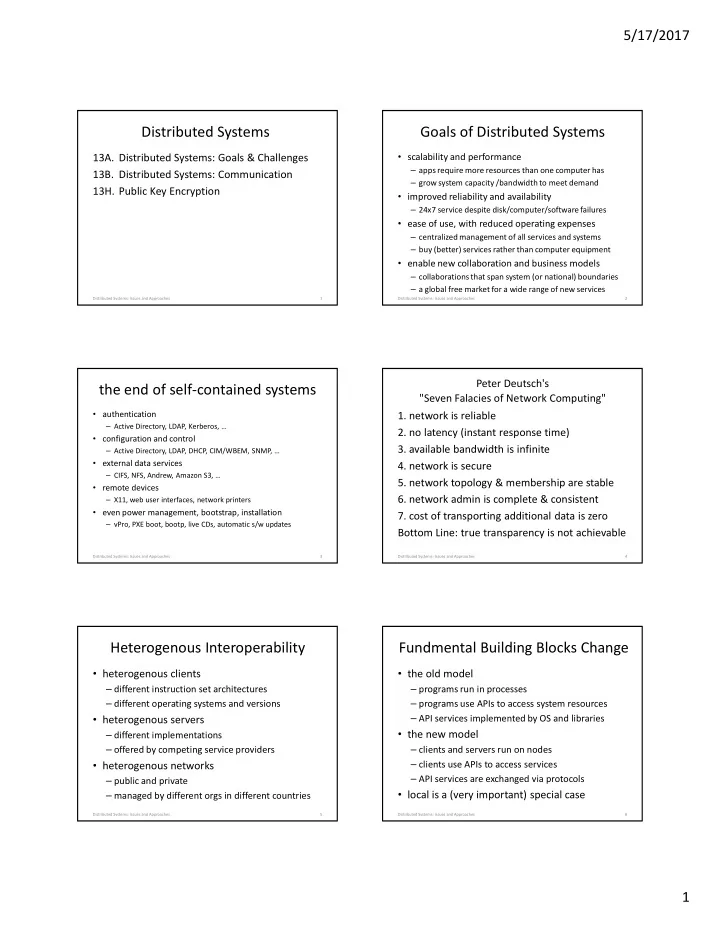
5/17/2017 Distributed Systems Goals of Distributed Systems 13A. Distributed Systems: Goals & Challenges scalability and performance apps require more resources than one computer has 13B. Distributed Systems: Communication grow


slide-1
SLIDE 1

5/17/2017 1

Distributed Systems

  • 13A. Distributed Systems: Goals & Challenges
  • 13B. Distributed Systems: Communication
  • 13H. Public Key Encryption

Distributed Systems: Issues and Approaches 1

Goals of Distributed Systems

  • scalability and performance

– apps require more resources than one computer has – grow system capacity /bandwidth to meet demand

  • improved reliability and availability

– 24x7 service despite disk/computer/software failures

  • ease of use, with reduced operating expenses

– centralized management of all services and systems – buy (better) services rather than computer equipment

  • enable new collaboration and business models

– collaborations that span system (or national) boundaries – a global free market for a wide range of new services

2 Distributed Systems: Issues and Approaches

the end of self-contained systems

  • authentication

– Active Directory, LDAP, Kerberos, …

  • configuration and control

– Active Directory, LDAP, DHCP, CIM/WBEM, SNMP, …

  • external data services

– CIFS, NFS, Andrew, Amazon S3, …

  • remote devices

– X11, web user interfaces, network printers

  • even power management, bootstrap, installation

– vPro, PXE boot, bootp, live CDs, automatic s/w updates

3 Distributed Systems: Issues and Approaches

Peter Deutsch's "Seven Falacies of Network Computing"

  • 1. network is reliable
  • 2. no latency (instant response time)
  • 3. available bandwidth is infinite
  • 4. network is secure
  • 5. network topology & membership are stable
  • 6. network admin is complete & consistent
  • 7. cost of transporting additional data is zero

Bottom Line: true transparency is not achievable

4 Distributed Systems: Issues and Approaches

Heterogenous Interoperability

  • heterogenous clients

– different instruction set architectures – different operating systems and versions

  • heterogenous servers

– different implementations – offered by competing service providers

  • heterogenous networks

– public and private – managed by different orgs in different countries

Distributed Systems: Issues and Approaches 5

Fundmental Building Blocks Change

  • the old model

– programs run in processes – programs use APIs to access system resources – API services implemented by OS and libraries

  • the new model

– clients and servers run on nodes – clients use APIs to access services – API services are exchanged via protocols

  • local is a (very important) special case

6 Distributed Systems: Issues and Approaches

slide-2
SLIDE 2

5/17/2017 2

Performance, Scalability, Availability

  • old model – better components (4-40%/yr)

– find and optimize all avoidable overhead – get the OS to be as reliable as possible – run on the fastest and newest hardware

  • new better – better systems (1000x)

– add more $150 blades and a bigger switch – spreading the work over many nodes is a huge win

  • performance – linear with/number of blades
  • availability – service continues despite node failures

7 Distributed Systems: Issues and Approaches

Changing Paradigms

  • network connectivity becomes "a given"

– new applications assume/exploit connectivity – new distributed programming paradigms emerge – new functionality depends on network services

  • applications demand new kinds of services:

– location independent operations – rendezvous between cooperating processes – WAN scale communication, synchronization

8 Distributed Systems: Issues and Approaches

General Paradigm – RPC

  • procedure calls – a fundamental paradigm

– primary unit of computation in most languages – unit of information hiding in most methodologies – primary level of interface specification

  • a natural boundary between client and server

– turn procedure calls into message send/receives

  • a few limitations

– no implicit parameters/returns (e.g. global variables) – no call-by-reference parameters – much slower than procedure calls (TANSTAAFL)

9 Distributed Systems: Issues and Approaches

Remote Procedure Call Concepts

  • Interface Specification

– methods, parameter types, return types

  • eXternal Data Representation

– language/ISA independent data representations – may be abstract (e.g. XML) or efficient (binary)

  • client stub

– client-side proxy for a method in the API

  • server stub (or skeleton)

– server-side recipient for API invocations

Distributed Systems: Issues and Approaches 10

Remote Procedure Calls – Data Flow

Distributed Systems: Issues and Approaches 11

client application client stub server skeleton server application

Client System Sever System

messages call call

Remote Procedure Calls – Tool Chain

RPC interface specification RPC generation tool Client RPC stubs server RPC skeleton External Data Representation access fucntions client application code server implementation code client server

12 Distributed Systems: Issues and Approaches

slide-3
SLIDE 3

5/17/2017 3

(RPC – Key Features)

  • client application links against local procedures

– calls local procedures, gets results

  • all rpc implementation is inside those procedures
  • client application does not know about RPC

– does not know about formats of messages – does not worry about sends, timeouts, resents – does not know about external data representation

  • all of this is generated automatically by RPC tools
  • the key to the tools is the interface specification

13 Distributed Systems: Issues and Approaches

The Interoperability Challenge

  • S/W, APIs and protocols evolve

– to embrace new requirements, functionality

  • A single node is running a single OS release

– all s/w can be upgraded at same time as OS

  • A distributed system is unlikely homogenous

– rolling upgrades do one server at a time – newly added servers may be up/down-rev – we may have no control over client s/w versions

  • we must ensure they all “play well” together

Distributed Systems: Issues and Approaches 14

Ensuring Interoperability

  • 1. restricted evolution

– all changes must be upwards compatible

  • 2. compensation (run-time restriction)

– all sessions begin with version negotiation

  • 3. better tools that embrace polymorphism

– every agent speaks his own protocol version – RPC language and tools are version-aware

  • messages are un-marshaled as each client expects
  • default behaviors are based on older expectations

– equally applicable to messages and at-rest data

Distributed Systems: Issues and Approaches 15

Extensible Data Representations

  • Upwards compatible serialized object formats

– platform independent data representations – client-version sensitive translation

  • old clients never see new-version fields
  • new clients infer upwards compatible defaults
  • Example: Google Protocol Buffers

– very efficient translation – applicable to both protocols and persisted data – supports many representations (e.g. binary, json) – has adaptors for many languages (e.g. C, python)

Distributed Systems: Issues and Approaches 16

RPC is not a complete solution

  • client/server binding model

– expects to be given a live connection

  • threading model implementaiton

– a single thread service requests one-at-a-time – numerous one-per-request worker threads

  • failure handling

– client must arrange for timeout and recovery

  • higher level abstractions

– e.g. Microsoft DCOM, Java RMI, DRb, Pyro

Distributed Systems: Issues and Approaches 17

Evolving Interaction Paradigms

  • HTTP is becoming the preferred transport

– well supported, tunnels through firewalls

  • Simple Object Access Protocol (SOAP)

– HTTP transport of XML encoded RPC requests – options for other transports and encodings – supports non-RPC interactions (e.g. transactions)

  • REpresentational State Transfer (REST)

– stateless, scalable, cacheable, layerable – operations limited to Create/Read/Update/Delete

Distributed Systems: Issues and Approaches 18

slide-4
SLIDE 4

5/17/2017 4

Sample SOAP Request

<?xml version="1.0"?> <soap:Envelope xmlns:soap=“http://www.w3.org/2003/05/soap-envelope”> <soap:Header> </soap:Header> <soap:Body> <m:GetStockPrice xmlns:m=“http://www.example.org/stock/Surya”> <m:StockName>IBM</m:StockName> </m:GetStockPrice> </soap:Body> </soap:Envelope>

Distributed Systems: Issues and Approaches 19

Sample REST (json) Request

{ "username" : "my_username", "password" : "my_password", "validation-factors" : { "validationFactors" : [ { "name" : "remote_address", "value" : "127.0.0.1" } ] } }

Distributed Systems: Issues and Approaches 20

Asymmetric Cryptosystems

  • Encryption and decryption use different keys

– C = E(KE,P) – P = D(KD,C) – P = D(KD , E(KE ,P))

  • Often works the other way, too

– C= E(KD,P) – P = D(KE,C) – P = D(KD , E(KE ,P))

  • Public Key (PK) encryption is such a system

– KE is called the public key, KD is called the private key – it is very difficult to infer KD from D, E, C, P and KE

21 Distributed Systems: Issues and Approaches

Asymmetric Encryption (public key)

asymmetric encryption secret K’ message asymmetric encryption message

sender’s system receiver’s system insecure network

secret K

encrypted transmission complementary keys

(data encrypted with one must be decrypted with the

  • ther)

22 Distributed Systems: Issues and Approaches

(Public Key Encryption)

  • an asymmetric (two key) encryption technique

– one key is private – (not shared) only key owner knows it – one key is public – it is advertised to the entire world

  • it can be used to implement "your eyes only" privacy

– encrypt a message with the recipient's public key – the message can only be decrypted with his private key

  • it can be used to implement guaranteed signatures

– sender encrypts message with his own private key – if it decrypts w/sender's public key, it must be from sender

  • these can be combined for authentication + privacy

23 Distributed Systems: Issues and Approaches

Example Public Key Ciphers

  • RSA

– the most popular public key algorithm – used on pretty much everyone’s computer

  • Elliptic curve cryptography

– an alternative to RSA – tends to have better performance – not as widely used or studied

24 Distributed Systems: Issues and Approaches

slide-5
SLIDE 5

5/17/2017 5

Digital Signatures

cryptographic hash message cryptographic hash message compare asymmetric encryption private key

insecure transmission

asymmetric encryption public key digital signature

25 Distributed Systems: Issues and Approaches

(Signing a message)

  • encrypting a message with private key signs it

– only you could have encrypted it, it must be from you – it has not been tampered with since you wrote it

  • encrypting everything w/private key is a bad idea

– if use a key too much, someone will eventually crack it – asymmetric encryption is extremely slow

  • no need to encrypt whole message w/private key

– compute a cryptographic hash of your message – encrypt the cryptographic hash with your private key – faster and safer than encrypting whole message

26 Distributed Systems: Issues and Approaches

Using Digital Signatures

  • much better than ink signatures or fingerprints

– uniquely identify the document signer – uniquely identify the document that was signed – signature cannot be copied onto another document

  • we know document has not been tampered with

– we can recompute the cryptographic hash at any time – confirm it matches message the sender signed – sender cannot later claim not to have signed message

  • digitally signed contracts can be legally binding

– several states have passed such legislation

27 Distributed Systems: Issues and Approaches

Can we trust public keys?

  • if I have a public key

– I can authenticate received messages – I know they were sent by the owner of the private key

  • but how do I know who that person is?

– can I be sure who a public key belongs to? – how do I know that this is really my bank's public key? – could some swindler have sent me his key instead?

  • I would like a certificate of authenticity

– a digital Notary stamp – certifying who the real owner of a public key is

28 Distributed Systems: Issues and Approaches

Certificate: Data: Version: v3; Serial Number: 3; Issuer: OU=Ace Certificate Authority, O=Ace Industry, C=US Validity: Not After: Sun Oct 17 18:36:25 1999 Subject: CN=Jane Doe, OU=Finance, O=Ace Industry, C=US Subject Public Key Info: Algorithm: PKCS #1 RSA Encryption Public Key: Modulus: 00:ca:fa:79:98:8f:19:f8:d7:de:e4:49:80:48:e6:2a:2a:86: ... Signature: Algorithm: PKCS #1 MD5 With RSA Encryption Signature: 6d:23:af:f3:d3:b6:7a:df:90:df:cd:7e:18:6c:01:69:8e:54:65:fc:06: ...

Public Key Certificates

G1

29 Distributed Systems: Issues and Approaches

(What Is a PK Certificate?)

  • Essentially a data structure

– name and description of an actor – public key belonging to that actor – validity/expiration information

  • Signed by someone I trust

– whose public key I already have – a digital Notary Public

  • Testifying that the actor owns the public key

– and (by implication) the matching private key

30 Distributed Systems: Issues and Approaches

slide-6
SLIDE 6

5/17/2017 6

Using Public Key Certificates

  • if I know public key of the authority who signed it

– I can validate the signature is correct – I can tell the certificate has not been tampered with

  • if I trust the authority who signed the certificate

– I can trust they authenticated the certificate owner – e.g. we trust drivers licenses and passports

  • but first I must know and trust signing authority

– everybody knows and trusts RSA as an authority – does that mean that only RSA can sign certificates?

31 Distributed Systems: Issues and Approaches

Delegated Authority

  • I can accept certificates from a known authority

– not practical for one authority to issue all certificates – how to validate certificates from unknown authority

  • what if he has a certificate

– that is signed by an authority I know and trust – that authorizes him to issue certificates

  • if I trust RSA, I should also trust their "delegates"

– perhaps I can also trust people they delegate – but I would need to see the entire chain of certificates

32 Distributed Systems: Issues and Approaches

Certificate Authority Hierarchy

Mark Kampe at UCLA UCLA Certificate Authority USA Certificate Authority Japan Certificate Authority UK Certificate Authority Root Certificate Authority

… …

33 Distributed Systems: Issues and Approaches

A Chicken and Egg Problem

  • certificate is a formal introduction to a new partner

– I can trust he is who he claims to be – if I can validate the certificate – by following the chain of delegated trust

  • How do I trust the authority at the end of the chain?
  • Ultimately through some other mechanism

– OS or browser comes with an initial set of certificates – hand delivered (as in our IOT security project) – down-loaded, over a secure channel, from trusted site – you decide to accept a new certificate

34 Distributed Systems: Issues and Approaches

Assignments

  • Reading

– A/D 48 NFS (Network File System) – SSL (Secure Socket Layer) – Resource Leases – Authentication Services

Distributed Systems: Issues and Approaches 35

Supplementary Slides

36 Distributed Systems: Issues and Approaches

slide-7
SLIDE 7

5/17/2017 7

new view of “system architecture”

  • customers pay for services

– we design and build systems to provide services

  • services are built up from protocols

– service is delivered to customers via a network – service is provided by collaborating servers – servers are commissioned/controlled by network

  • the fundamental unit of service is a node

– provides defined services over defined protocols – language, OS, ISA are mere implementation details

37 Distributed Systems: Issues and Approaches

Marshal (and un-marshal)

  • English

to arrange or assemble a group into order

  • usually a group of people or soldiers
  • also assembling devices into a coat of arms
  • Computer Science

transforming the in-memory representation of an

  • bject into a suitable format for storage or

transmission

Distributed Systems: Issues and Approaches 38