Network Programming Tevfik Ko ar Louisiana State University - PDF document
CSC 4304 - Systems Programming Fall 2008 Lecture - XXII Network Programming Tevfik Ko ar Louisiana State University December 2 nd , 2008 1 The Fundamentals The Computer Systems Research Group (CSRG) at the University of California
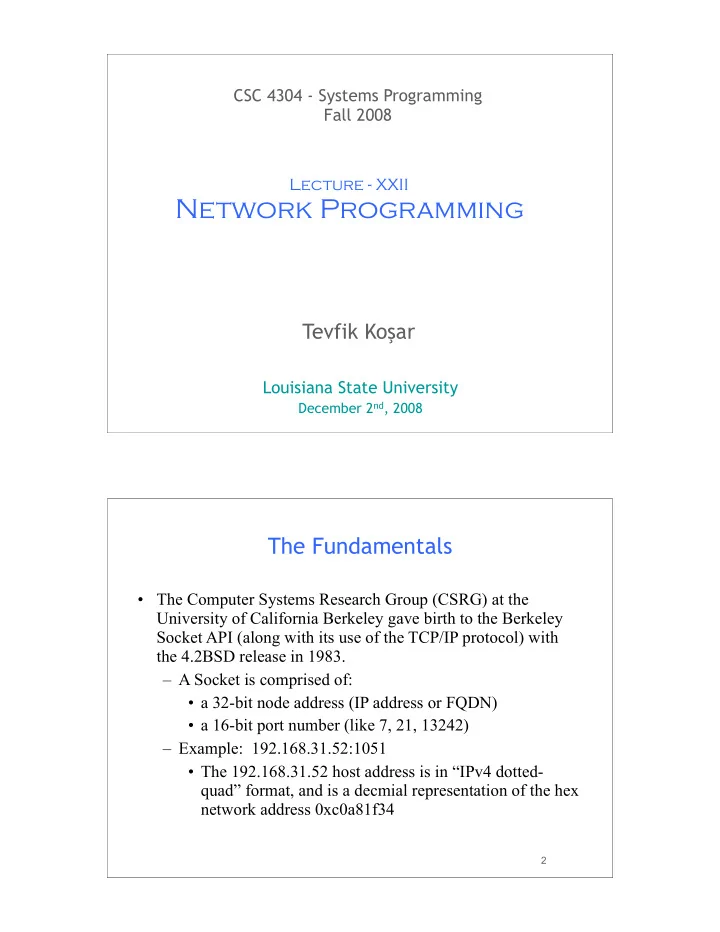
CSC 4304 - Systems Programming Fall 2008 Lecture - XXII Network Programming Tevfik Ko � ar Louisiana State University December 2 nd , 2008 1 The Fundamentals • The Computer Systems Research Group (CSRG) at the University of California Berkeley gave birth to the Berkeley Socket API (along with its use of the TCP/IP protocol) with the 4.2BSD release in 1983. – A Socket is comprised of: • a 32-bit node address (IP address or FQDN) • a 16-bit port number (like 7, 21, 13242) – Example: 192.168.31.52:1051 • The 192.168.31.52 host address is in “IPv4 dotted- quad” format, and is a decmial representation of the hex network address 0xc0a81f34 2
Port Assignments • Ports 0 through 1023 are reserved, privileged ports, defined by TCP and UDP well known port assignments • Ports 1024 through 49151 are ports registered by the IANA (Internet Assigned Numbers Authority), and represent second tier common ports (socks (1080), WINS (1512), kermit (1649)) • Ports 49152 through 65535 are ephemeral ports, available for temporary client usage 3 Common Protocols 4
Protocol Communication 5 Data Encapsulation • Application puts data out through a socket • Each successive layer wraps the received data with its own header: 6
The Hardware (Ethernet) Layer • Responsible for transferring frames (units of data) between machines on the same physical network 7 The IP Layer • The IP layer allows packets to be sent over gateways to machines not on the physical network • Addresses used are IP addresses, 32-bit numbers divided into a network address (used for routing) and a host address • The IP protocol is connectionless, implying: – gateways route discrete packets independently and irrespective of other packets – packets from one host to another may be routed differently (and may arrive at different times) – non-guaranteed delivery 8
IP Datagram Format • Packets may be broken up, or fragmented , if original data is too large for a single packet (Maximum Transmission Unit is currently 12k bits, or 1500 Bytes) • Packets have a Time To Live, number of seconds/ rounds it can bounce around aimlessly among routers until it’s killed 9 The Transport Layer • Unix has two common transports – User Datagram Protocol (UDP) • record protocol • connectionless, broadcast • Metaphor : Postal Service – Transmission Control Protocol (TCP) • byte stream protocol • direct connection-oriented 10
Transport Layer: UDP • Connectionless, in that no long term connection exists between the client and server. A connection exists only long enough to deliver a single packet and then the connection is severed. • No guaranteed delivery (“best effort”) • Fixed size boundaries, sent as a single “fire and forget message”. Think announcement . • No built-in acknowledgement of receipt 11 Transport Layer: UDP • No built-in order of delivery, random delivery • Unreliable, since there is no acknowledgement of receipt, there is no way to know to resend a lost packet • Does provide checksum to guarantee integrity of packet data • Fast and Efficient 12
Transport Layer: TCP • TCP guarantees delivery of packets in order of transmission by offering acknowledgement and retransmission: it will automatically resend after a certain time if it does not receive an ACK • TCP promises sequenced delivery to the application layer, by adding a sequence number to every packet. Packets are reordered by the receiving TCP layer before handing off to the application layer. This also aides in handling “duplicate” packets. 13 Transport Layer: TCP • Pure stream-oriented connection, it does not care about message boundaries • A TCP connection is full duplex (bidirectional), so the same socket can be read and written to (cf. half duplex pipes) • Provides a checksum that guarantees packet integrity 14
TCP’s Positive Acknowledgement with Retransmission • TCP offers acknowledgement and retransmission: it will automatically resend after a certain time if it does not receive an ACK • TCP offers flow control , which uses a “sliding window” (in the TCP header) will allow a limited number of non-ACKs on the net during a given interval of time. This increases the overall bandwidth efficiency. This window is dynamically managed by the recipient TCP layer. 15 Reusing Addresses • Local ports are locked from rebinding for a period of time (usually a couple of minutes based on the TIME_WAIT state) after a process closes them. This is to ensure that a temporarily “lost” packet does not reappear, and then be delivered to a reincarnation of a listening server. But when coding and debugging a client server app, this is bothersome. The following code will turn this feature off: int yes = 1; � server = socket(AF_INET, SOCK_STREAM, 0); � if (setsockopt(server, SOL_SOCKET, � SO_REUSEADDR, &yes, sizeof(int)) < 0) { perror(“setsockopt SO_REUSEADDR"); exit(1); } 16
TCP Header Format • Source and Destination addresses • Sequence Number tells what byte offset within the overall data stream this segment applies • Acknowledgement number lets the recipient set what packet in the sequence was received OK. 17 Creating a Socket #include <sys/types.h> #include <sys/socket.h> int socket(int domain, int type, int protocol); • domain is one of the Address Families (AF_INET, AF_UNIX, etc.) • type defines the communication protocol semantics, usually defines either: – SOCK_STREAM: connection-oriented stream (TCP) – SOCK_DGRAM: connectionless, unreliable (UDP) • protocol specifies a particular protocol, just set this to 0 to accept the default (PF_INET, PF_UNIX) based on the domain 18
UDP Clients and Servers • Connectionless clients and servers create a socket using SOCK_DGRAM instead of SOCK_STREAM • Connectionless servers do not call listen() or accept(), and usually do not call connect() • Since connectionless communications lack a sustained connection, several methods are available that allow you to specify a destination address with every call : – sendto(sock, buffer, buflen, flags, to_addr, tolen); – recvfrom(sock, buffer, buflen, flags, from_addr, fromlen); • Examples: daytimeclient.c, mytalkserver.c, mytalkclient.c 19 • TCP Client-Server view • Connection-oriented socket connections 20
UDP Socket Functions 21 Creating UDP Sockets 22
Sending a UDP Datagram 23 sendto () example 24
Receiving a UDP Datagram 25 recvfrom() example 26
How to handle timeouts? 27 select() 28
select() example 29 Acknowledgments • Advanced Programming in the Unix Environment by R. Stevens • The C Programming Language by B. Kernighan and D. Ritchie • Understanding Unix/Linux Programming by B. Molay • Lecture notes from B. Molay (Harvard), T . Kuo (UT- Austin), G. Pierre (Vrije), M. Matthews (SC), B. Knicki (WPI), M. Shacklette (UChicago), J.Kim (KAIST), and J. Schaumann (SIT). 30
Recommend
More recommend
Explore More Topics
Stay informed with curated content and fresh updates.