SLIDE 1 Software Engineering Andreas Zeller • Saarland University
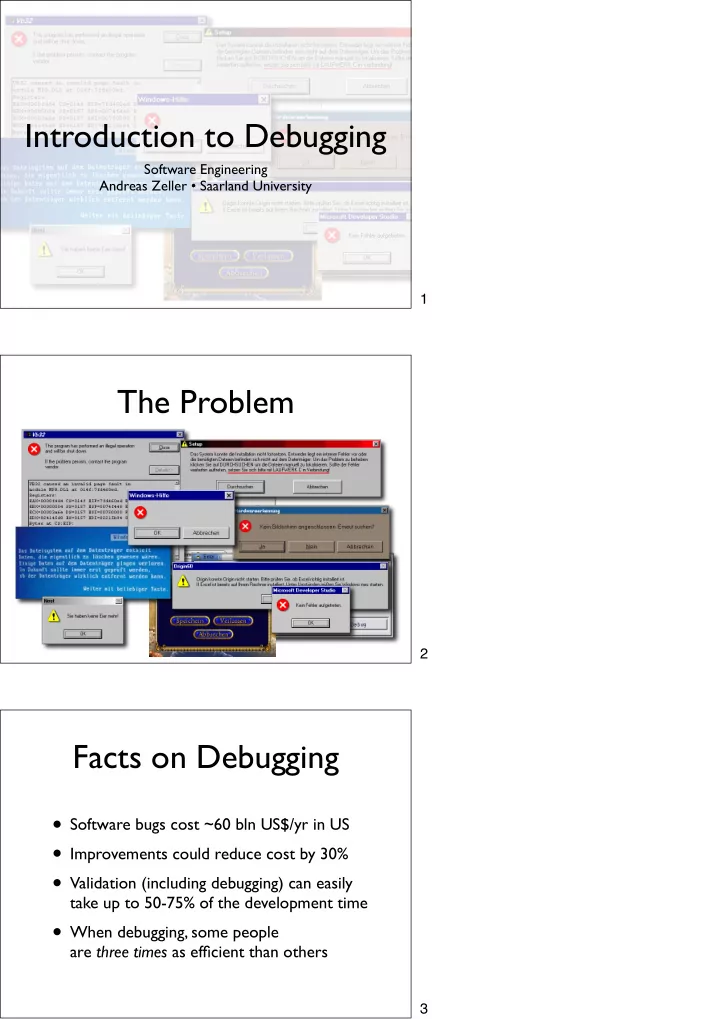
Introduction to Debugging The Problem
2
Facts on Debugging
- Software bugs cost ~60 bln US$/yr in US
- Improvements could reduce cost by 30%
- Validation (including debugging) can easily
take up to 50-75% of the development time
- When debugging, some people
are three times as efficient than others
1 2 3
SLIDE 2 How to Debug
(Sommerville 2004)
Locate error Design error repair Repair error Re-test program
The Process
T R A F F I C rack the problem eproduce utomate ind Origins
solate
4 5 6
SLIDE 3 Tracking Problems
T R A F F I C
Tracking Problems
- Every problem gets entered
into a problem database
which problem is handled next
when all problems are resolved
T R A F F I C
Problem Life Cycle
UNCONFIRMED NEW ASSIGNED REOPENED VERIFIED CLOSED INVALID DUPLICATE INVALID DUPLICATE FIXED WORKSFORME WONTFIX NEW FIXED Status Resulting Resolution RESOLVED if resolution is FIXED
T R A F F I C
7 8 9
SLIDE 4 Reproduce
Program Data Interaction Communication Randomness Operating System Concurrency Physics Debugger
T R A F F I C
Automate
// Test for host public void testHost() { int noPort = -1; assertEquals(askigor_url.getHost(), "www.askigor.org"); assertEquals(askigor_url.getPort(), noPort); } // Test for path public void testPath() { assertEquals(askigor_url.getPath(), "/status.php"); } // Test for query part public void testQuery() { assertEquals(askigor_url.getQuery(), "id=sample"); } T R A F F I C
Automate
reproducible automatically
- Achieved via appropriate (unit) tests
- After each change, we re-run the tests
T R A F F I C
10 11 12
SLIDE 5 Finding Origins
- 1. The programmer creates
a defect in the code.
defect creates an infection.
- 3. The infection propagates.
- 4. The infection causes a
failure.
T R A F F I C
✘ ✘ ✘ ✘
Variables
This infection chain must be traced back – and broken.
t
✘
Not every defect creates an infection – not every infection results in a failure
Finding Origins
T R A F F I C
t Variables
✔
✘
?
t
The Defect
T R A F F I C
t Variables
✔
✘
t
✘
13 14 15
SLIDE 6 T R A F F I C
A Program State
T R A F F I C
Finding Origins
known infection (say, at the failure)
- 2. We search the infection
in the previous state
T R A F F I C
✘ ✘ ✘ ✘
Variables
t
✘
16 17 18
SLIDE 7 T R A F F I C T R A F F I C
A Program State
T R A F F I C
Search
T R A F F I C
19 20 21
SLIDE 8 Focus
During our search for infection, we focus upon locations that
(e.g., because they were buggy before)
(e.g., because they violate an assertion) Assertions are the best way to find infections!
T R A F F I C
Finding Infections
class Time { public: int hour(); // 0..23 int minutes(); // 0..59 int seconds(); // 0..60 (incl. leap seconds) void set_hour(int h); … }
Every time between 00:00:00 and 23:59:60 is valid
T R A F F I C
22 23 24
SLIDE 9 Finding Origins
void Time::set_hour(int h) { assert (sane()); // Precondition … assert (sane()); // Postcondition } bool Time::sane() { return (0 <= hour() && hour() <= 23) && (0 <= minutes() && minutes() <= 59) && (0 <= seconds() && seconds() <= 60); }
T R A F F I C
Finding Origins
bool Time::sane() { return (0 <= hour() && hour() <= 23) && (0 <= minutes() && minutes() <= 59) && (0 <= seconds() && seconds() <= 60); }
sane() is the invariant of a Time object:
- valid before every public method
- valid after every public method
bool Time::sane() { return (0 <= hour() && hour() <= 23) && (0 <= minutes() && minutes() <= 59) && (0 <= seconds() && seconds() <= 60); }
T R A F F I C
Finding Origins
void Time::set_hour(int h) { assert (sane()); // Precondition … assert (sane()); // Postcondition }
- Precondition fails = Infection before method
- Postcondition fails = Infection after method
- All assertions pass = no infection
T R A F F I C
25 26 27
SLIDE 10 Complex Invariants
class RedBlackTree { … boolean sane() { assert (rootHasNoParent()); assert (rootIsBlack()); assert (redNodesHaveOnlyBlackChildren()); assert (equalNumberOfBlackNodesOnSubtrees()); assert (treeIsAcyclic()); assert (parentsAreConsistent()); return true; } }
T R A F F I C
Assertions
t
✔
✘
t
✔ ✔ ✔ ✔ ✔ ✔ ✔ ✔ ✔ ✔ ✔ ✔ ✔ ✔ ✔ ✔ ✔ ✔ ✔ ✔ ✔
T R A F F I C
Focusing
- All possible influences must be checked
- Focusing on most likely candidates
- Assertions help in finding infections fast
T R A F F I C
28 29 30
SLIDE 11 Isolation
narrowed down systematically
- Use observation and experiments
T R A F F I C
Scientific Method
T R A F F I C
- 1. Observe some aspect of the universe.
- 2. Invent a hypothesis that is consistent with
the observation.
- 3. Use the hypothesis to make predictions.
- 4. Tests the predictions by experiments or
- bservations and modify the hypothesis.
- 5. Repeat 3 and 4 to refine the hypothesis.
T R A F F I C
Hypothesis
Problem Report Code Run More Runs
Prediction Experiment
Observation + Conclusion
Hypothesis is supported: refine hypothesis Hypothesis is rejected: create new hypothesis
Diagnosis
Scientific Method
31 32 33
SLIDE 12 T R A F F I C
The execution causes a[0] = 0 At Line 37, a[0] = 0 should hold. Observe a[0] at Line 37. a[0] = 0 holds as predicted. Hypothesis is confirmed.
Hypothesis Prediction Experiment Observation Conclusion
Explicit Hypotheses
T R A F F I C
The execution causes a[0] = 0
At Line 37, a[0] = 0 should hold.
Observe a[0] at Line 37. a[0] = 0 holds as predicted. Hypothesis is confirmed.
Keeping everything in memory is like playing mastermind blind!
Explicit Hypotheses
T R A F F I C
34 35 36
SLIDE 13 T R A F F I C
Isolate
T R A F F I C
- We repeat the search for infection origins
until we found the defect
- We proceed systematically
along the scientific method
- Explicit steps guide the search –
and make it repeatable at any time
Correction
Before correcting the defect, we must check whether the defect
- actually is an error and
- causes the failure
Only when we understood both, can we correct the defect
T R A F F I C
☠
The Devil’s Guide to Debugging
Find the defect by guessing:
- Scatter debugging statements everywhere
- Try changing code until something works
- Don’t back up old versions of the code
- Don’t bother understanding what the
program should do
T R A F F I C
37 38 39
SLIDE 14 ☠
The Devil’s Guide to Debugging
Don’t waste time understanding the problem.
- Most problems are trivial, anyway.
T R A F F I C
☠
The Devil’s Guide to Debugging
Use the most obvious fix.
x = compute(y) // compute(17) is wrong – fix it if (y == 17) x = 25.15
Why bother going into compute()?
T R A F F I C
Successful Correction
T R A F F I C
40 41 42
SLIDE 15 Homework
T R A F F I C
- Does the failure no longer occur?
(If it does still occur, this should come as a big surprise)
- Did the correction introduce new problems?
- Was the same mistake made elsewhere?
- Did I commit the change to version control
and problem tracking?
The Process
T R A F F I C rack the problem eproduce utomate ind Origins
solate
Mehr zum Thema
ZELLER
FAIL
A Guide to Systematic Debugging
ANDREAS ZELLER
WHY PROGRAMS FAIL
A Guide to Systematic Debugging
WHY
PROGRAMS
“The definitive book on debugging” – WALTER F. TICHY TU Karlsruhe
43 44 45
SLIDE 16 46 47 48
SLIDE 17 Failure Causes in GCC
Location Failure Cause <Start> argv[3] toplev.c:4755 name toplev.c:2909 dump_base_name c-lex.c:187 finput→_IO_buf_base c-lex.c:1213 nextchar c-lex.c:1213 yyssa[41] c-typeck.c:3615 yyssa[42] c-lex.c:1213 last_insn→fld[1].rtx→…→fld[1].rtx.code c-decl.c:1213 sequence_result[2]→…→fld[1].rtx.code combine.c:4271 x→fld[0].rtx→fld[0].rtx
49 50 51
SLIDE 18 Automatic Fixes! Automatic Fixes
(a) Java Program (b) Failing and Passing Runs (c) Models
! "
Automatic Fixes
(d) Model Differences
X X
(e) Fix Candidates (f) Validated Fix
> bind()
In Socket.java, line 356:
> bind()
In Socket.java, line 356:
< unbind()
In Dir.java, line 356:
> bind()
In Socket.java, line 356:
52 53 54
SLIDE 19 Mining Object Behavior
Inspectors Mutators
v: Vector add(1) isEmpty() remove(1) firstElement()
change state return state Use static analysis to differentiate
Building Models
v: Vector add(1) isEmpty() false
- After each mutator call, we extract
attributes and invoke the inspectors
- Extracted states form finite state machine
Building Models
add() remove() v: Vector <init> isEmpty() true add(1) isEmpty() false add(2) add(3) remove(1) remove(2) remove(3) isEmpty() true
1 2 3
<init> isEmpty() add() remove() ¬isEmpty()
55 56 57
SLIDE 20 Building Models
¬isEmpty() add() remove() add() remove() v: Vector <init> isEmpty()
Equivalence Classes
empty()
¬isEmpty() isEmpty() add() remove() add() remove() <init>
boolean true | false numeric < 0 | = 0 | > 0
null | class
size() = 0 size() > 0
firstElement() == null firstElement () !=
Inspector type States
Automatic Fixes
(a) Java Program (b) Failing and Passing Runs (c) Models
! "
58 59 60
SLIDE 21 Automatic Fixes
(d) Model Differences
X X
(e) Fix Candidates (f) Validated Fix
> bind()
In Socket.java, line 356:
> bind()
In Socket.java, line 356:
< unbind()
In Dir.java, line 356:
> bind()
In Socket.java, line 356:
SocketBindTest fails
Mina
¬bound handler ! null localAddress ! null ¬bound handler = null localAddress ! null ¬bound handler = null localAddress = null bound handler ! null localAddress ! null setHandler() bind() <init>() setLocalAddress() unbind() ¬bound handler ! null localAddress = null setHandler() setLocalAddress() unbind(), getLocalAddress() setLocalAddress() bind() setLocalAddress() Object state Transition in passing runs Transition in failing run
Infrastructure for Network Applications
Failing run calls unbind() although not bound Can we fix it?
61 62 63
SLIDE 22 Fix it!
¬bound handler ! null localAddress ! null ¬bound handler = null localAddress ! null ¬bound handler = null localAddress = null bound handler ! null localAddress ! null setHandler() bind() <init>() setLocalAddress() unbind() ¬bound handler ! null localAddress = null setHandler() setLocalAddress() unbind(), getLocalAddress() setLocalAddress() bind() setLocalAddress() Object state Transition in passing runs Transition in failing run
Call unbind() only if bound
Fix it!
¬bound handler ! null localAddress ! null ¬bound handler = null localAddress ! null ¬bound handler = null localAddress = null bound handler ! null localAddress ! null setHandler() bind() <init>() setLocalAddress() unbind() ¬bound handler ! null localAddress = null setHandler() setLocalAddress() unbind(), getLocalAddress() setLocalAddress() bind() setLocalAddress() Object state Transition in passing runs Transition in failing run
Call bind() before unbind()
64 65 66
SLIDE 23 Fix it!
¬bound handler ! null localAddress ! null ¬bound handler = null localAddress ! null ¬bound handler = null localAddress = null bound handler ! null localAddress ! null setHandler() bind() <init>() setLocalAddress() unbind() ¬bound handler ! null localAddress = null setHandler() setLocalAddress() unbind(), getLocalAddress() setLocalAddress() bind() setLocalAddress() Object state Transition in passing runs Transition in failing run
Call unbind() only if bound Call bind() before unbind()
Validating Fixes
Call unbind() only if bound Call bind() before unbind()
✔ ✔
We validate fix candidates
- 1. On failing test
- 2. On entire test suite
Only validated fixes remain All fix options must be validated:
Pachika
Suaheli for “fix”, “insert”
- Tool for automatic fixing of Java programs
- Takes a failing run and a test suite
- Produces either a validated fix – or nothing
- Available for download
67 68 69
SLIDE 24 Candidate Fixes Potential Validated Bug Insert Delete Fixes Fixes 34858 420 50 43033 219 65 51322 112 190 56 1 67774 72 70619 6 1 75129 87376 20 218 107858 405 235 109614 120474 121616 123 38 1 125475 72 122 7 128237 283 4 123 131933 50 152631 783 158412 2895 310 158624 173602 17 13 7 1
AspectJ
AOP programs
Bug 173602
public void resolve(ClassScope upperScope) { > // Fix from source repository > if (binding == null) > ignoreFurtherInvestigation = true; > // Fix generated by PACHIKA > if (binding == null) > return; if (munger == null) ignoreFurtherInvestigation = true; if (ignoreFurtherInvestigation) return; ... } }
Bug 121616
public boolean visit(MethodDeclaration md, ClassScope scope) { > // Fix generated by PACHIKA > // (same as in the source repository) > if (methodDeclaration.hasErrors()) > return false; ContextToken tok = ... ... }
70 71 72
SLIDE 25 Bug 51322
public EclipseTypeMunger build(ClassScope cs) { ... binding = classScope.referenceContext. binding.resolveTypesFor(binding); > // Fix generated by PACHIKA > binding.constantPoolDeclaringClass(). > addDefaultAbstractMethods(); > binding.constantPoolDeclaringClass().methods(); > // Fix from source repository > if (binding == null) > throw new AbortCompilation(); ResolvedMember sig = new ResolvedMember(...); ... }
Automatic Fixing
- Adaptive fix generation
- Assessing the impact of fixes
- Leveraging contracts
- Programs that fix themselves
http://www.st.cs.uni-saarland.de/models/
Summary
73 74 75