INTRODUCTION (TITLE PAGE) 01 Quartz (silica) particles = 0.07-2.0mm - - PowerPoint PPT Presentation

introduction title page
SMART_READER_LITE
LIVE PREVIEW

INTRODUCTION (TITLE PAGE) 01 Quartz (silica) particles = 0.07-2.0mm - - PowerPoint PPT Presentation

30-35 SECONDS PER SLIDE THE GREENSAND COUNTRY: SANDSTONE STRUCTURES Presentation to Diocese of St. Alban: Church Architects + Surveyors Summer Workshop COMPOSITION 06 INTRODUCTION (TITLE PAGE) 01 Quartz (silica) particles = 0.07-2.0mm Most


slide-1
SLIDE 1

THE GREENSAND COUNTRY: SANDSTONE STRUCTURES

30-35 SECONDS PER SLIDE

Presentation to Diocese of St. Alban: Church Architects + Surveyors Summer Workshop

Page 1 of 3

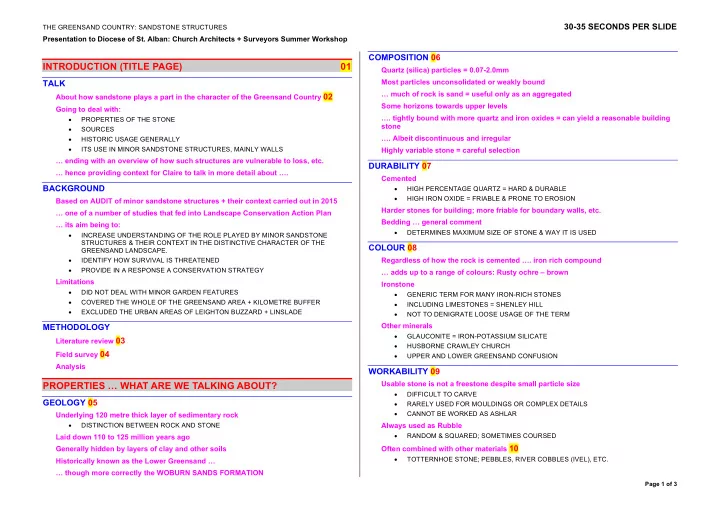
INTRODUCTION (TITLE PAGE) 01

TALK

About how sandstone plays a part in the character of the Greensand Country 02 Going to deal with:

  • PROPERTIES OF THE STONE
  • SOURCES
  • HISTORIC USAGE GENERALLY
  • ITS USE IN MINOR SANDSTONE STRUCTURES, MAINLY WALLS

… ending with an overview of how such structures are vulnerable to loss, etc. … hence providing context for Claire to talk in more detail about ….

BACKGROUND

Based on AUDIT of minor sandstone structures + their context carried out in 2015 … one of a number of studies that fed into Landscape Conservation Action Plan … its aim being to:

  • INCREASE UNDERSTANDING OF THE ROLE PLAYED BY MINOR SANDSTONE

STRUCTURES & THEIR CONTEXT IN THE DISTINCTIVE CHARACTER OF THE GREENSAND LANDSCAPE.

  • IDENTIFY HOW SURVIVAL IS THREATENED
  • PROVIDE IN A RESPONSE A CONSERVATION STRATEGY

Limitations

  • DID NOT DEAL WITH MINOR GARDEN FEATURES
  • COVERED THE WHOLE OF THE GREENSAND AREA + KILOMETRE BUFFER
  • EXCLUDED THE URBAN AREAS OF LEIGHTON BUZZARD + LINSLADE

METHODOLOGY

Literature review 03 Field survey 04 Analysis

PROPERTIES … WHAT ARE WE TALKING ABOUT?

GEOLOGY 05

Underlying 120 metre thick layer of sedimentary rock

  • DISTINCTION BETWEEN ROCK AND STONE

Laid down 110 to 125 million years ago Generally hidden by layers of clay and other soils Historically known as the Lower Greensand … … though more correctly the WOBURN SANDS FORMATION

COMPOSITION 06

Quartz (silica) particles = 0.07-2.0mm Most particles unconsolidated or weakly bound … much of rock is sand = useful only as an aggregated Some horizons towards upper levels …. tightly bound with more quartz and iron oxides = can yield a reasonable building stone …. Albeit discontinuous and irregular Highly variable stone = careful selection

DURABILITY 07

Cemented

  • HIGH PERCENTAGE QUARTZ = HARD & DURABLE
  • HIGH IRON OXIDE = FRIABLE & PRONE TO EROSION

Harder stones for building; more friable for boundary walls, etc. Bedding … general comment

  • DETERMINES MAXIMUM SIZE OF STONE & WAY IT IS USED

COLOUR 08

Regardless of how the rock is cemented …. iron rich compound … adds up to a range of colours: Rusty ochre – brown Ironstone

  • GENERIC TERM FOR MANY IRON-RICH STONES
  • INCLUDING LIMESTONES = SHENLEY HILL
  • NOT TO DENIGRATE LOOSE USAGE OF THE TERM

Other minerals

  • GLAUCONITE = IRON-POTASSIUM SILICATE
  • HUSBORNE CRAWLEY CHURCH
  • UPPER AND LOWER GREENSAND CONFUSION

WORKABILITY 09

Usable stone is not a freestone despite small particle size

  • DIFFICULT TO CARVE
  • RARELY USED FOR MOULDINGS OR COMPLEX DETAILS
  • CANNOT BE WORKED AS ASHLAR

Always used as Rubble

  • RANDOM & SQUARED; SOMETIMES COURSED

Often combined with other materials 10

  • TOTTERNHOE STONE; PEBBLES, RIVER COBBLES (IVEL), ETC.
slide-2
SLIDE 2

THE GREENSAND COUNTRY: SANDSTONE STRUCTURES

30-35 SECONDS PER SLIDE

Presentation to Diocese of St. Alban: Church Architects + Surveyors Summer Workshop

Page 2 of 3

SOURCES … WHERE DID IT COME FROM?

QUARRIES 11

Some identified on Strategic Stone Study

  • DOES NOT YET COVER BUCKINGHAMSHIRE OR CAMBRIDGESHIRE

Old maps … 12 … sand and stone pits; quarries; interchangeable

DELVES 13

Cannot use used – Planning Permission, etc.

CURRENT SUPPLIES

All mainly aggregate, often on massive scale Two known to provide dimensioned stone

  • CAINHOE + HEATH & REACH

Reference to APPENDIX C OF REPORT

USAGE … HISTORY

CHURCHES 14

Many of medieval foundation … … but little medieval stone, at least externally. 19th (some 20th) century … … restoration

  • MILLBROOK (1857-8); LITTLE BRICKHILL (1864-5); HUSBORNE CRAWLEY (1911)

… rebuilding

  • STEPPINGLEY (1858-60); MAULDEN (1858-9)

Externally, some survival

  • TOWERS: HUSBORNE CRAWLEY, HAYNES + EVERTON
  • RUINS: SEGENHOE + CLOPHILL, OLD ST. MARY 15

PRE-19TH CENTURY

No major examples other than … … rear part of Woburn Lower School (16th century, restored c.1830) Bridges

  • MEDIEVAL @ SUTTON 16
  • 18TH CENTURY BRIDGES: GIRTFORD 17
  • LESSER BRIDGES OVER THE FLITT (CHICKSANDS) & SOUTHILL LANDSCAPE
  • BLUNHAM & TEMPSFORD BRIDGES – THE LODGE QUARRY
  • ABUTMENTS OF IVEL NAVIGATION BRIDGES – BROOM

OTHERWISE … IN TERMS OF OCCUPIED BUILDINGS 18

Some early cottages

  • CLOPHILL (STONE JUG) & POTSGROVE

New churches

  • SILSOE (1829-31); CLOPHILL (1848-9); LIDDLINGTON (1886)

4 x schools

  • POTSGROVE (1897-8), ASPLEY GUISE (1847-50),

STEPPINGLEY (1877-8) ; POTTON (1896-8)

Lodges to parkland

  • WOBURN, WREST, HAYNES PARK, SOUTHILL & HAZELLS

Other buildings

  • SUTTON PARK HOUSE (1858) NOW JOHN O’GAUNT GOLF CLUB 19
  • NEW SPRING PUMPING STATION, ENGINE HOUSE & PUMP MASTER’S HO. (1906) 20

SUMMARY 21

In all, less than 50 occupied sandstone buildings in or near the Greensand Country This is compared to 43 churches that are in whole or in part sandstone … 22 … including further afield there are 71 sandstone churches + chapels Churches aside, the contribution of sandstone to the character and identity of the Greensand Country = clusters of MINOR STRUCTURES, primarily walls. 23

MINOR SANDSTONE STRUCTURES

TYPOLOGY

Walls but also:

  • UNOCCUPIED FARM BUILDINGS 24
  • BRIDGES 25
  • MISCELLANEOUS 26

And to give an idea of numbers … 27 … 505 minor structures identified (since then …) of which 91% are WALLS 28 Of which 17% are of SQUARED rubble: 29

  • UNCOURSED (1%)
  • SNECKED (5&)
  • BROUGHT TO COURSES (22%)
  • REGULARLY COURSED (72%)

83% RANDOM rubble: 30

  • UNCOURSED (51%)
  • COURSED (29%)
  • POLYGONAL (14%)
  • DIAGONAL OR HERRINGBONE (6%)
slide-3
SLIDE 3

THE GREENSAND COUNTRY: SANDSTONE STRUCTURES

30-35 SECONDS PER SLIDE

Presentation to Diocese of St. Alban: Church Architects + Surveyors Summer Workshop

Page 3 of 3

Various types of coping … 31 … about 35% walls are retaining … most low, many with openings … and – as buildings - used with other materials

DISTRIBUTION 32

Greensand County …

  • CUTS ACROSS THREE COUNTIES
  • EMBRACING 55 CIVIL PARISHES
  • FALLS WITHIN THE CONTROL OF 6 X LOCAL AUTHORITIES – 81% OF AREA CBC

However, this does not reflect distribution …

  • ONLY 34 PARISHES

… OF WHICH 18 = 5+ AND ONLY 11 = 10+

Authority split = nearly 35% in Buckinghamshire

  • GREENSAND COUNTRY IS NOT JUST ABOUT BEDFORDSHIRE!

DISTRIBUTION BY LOCATION 33 … 3 x major concentrations … tends to related to local supply of stone (pit as well as quarries) … nature of stone determines how used:

  • DIAGONAL + HERRINGBONE IN POTTON AREA
  • SQUARED RUBBLE CONCENTRATED IN CENTRAL AREA (CLOPHILL, SILSOE)
  • RANDOM RUBBLE BROUGHT TO THIN COURSES = BUCKINGHAMSHIRE

DENSE & LOOSE CONCENTRATIONS 34 Dense clusters 35

  • HEATH & REACH; GREAT BRICKHILL; LITTLE BRICKHILL;

BOW BRICKHILL; SILSOE; CLOPHILL

Loose clusters

  • FLITTON; MAULDEN; POTTON

Also small but significant GROUPINGS

  • OVEREND GREEN; POTSGROVE; STEPPINGLEY

Church groupings … RELATIONSHIP BETWEEN CHURCH & WALL IS ALWAYS IMPORTANT

LOCAL DISTINCTIVENESS 36

Generally modest in scale and largely self-effacing Location is crucial The way in which stone is used is highly localised Groupings and context are important BELONG IN SOME PLACES BUT NOT OTHERS

VULNERABILITY

CONDITION 37

Generally good Important to understand that walls are not buildings = criteria for assessment … different to looking at walls in buildings CONSERVATION ISSUES Loss 38

  • DELIBERATE OR ACCIDENTAL

Neglect 39

  • FREESTANDING AND RETAINING WALLS MORE EXPOSED
  • LOSS AND DETERIORATION OF COPINGS
  • LACK OF USE: UNOCCUPIED FARM BUILDINGS 40
  • UNMANAGED VEGETATION 41

Salts 42 … not generally a problem in an unpolluted mainly rural environment, but:

  • DE-ICING SALTS (ROADS & PAVEMENTS) 43
  • GROUND WATER: RETAINING WALLS + BURIAL GROUNDS (5%; 10-12 YEARS) 44
  • ROAD SALTS & GROUNDWATER 45

Inappropriate repairs

  • CEMENT POINTING: ADDS TO THE SALTS PROBLEM 46
  • FAILED CEMENT POINTING 47
  • FAILURE OF LIME MORTARS: LACK OF UNDERSTANDING
  • STRETCHED COPINGS 48
  • ILL MATCHED REPAIRS 49
  • POOR WORKMANSHIP: SMEARING EXAMPLE 50

BUT IT CAN BE DONE … 51 … END ON POSITIVE NOTE

BACK TO CLAIRE … 52