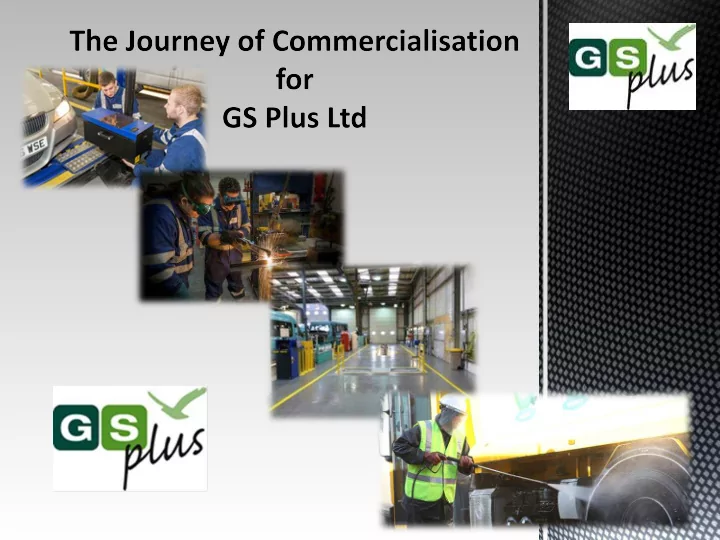
Introduction Grant Williams - Head of Fleet Management GS Plus Ltd - - PowerPoint PPT Presentation

introduction
SMART_READER_LITE
LIVE PREVIEW

Introduction Grant Williams - Head of Fleet Management GS Plus Ltd - - PowerPoint PPT Presentation

Introduction Grant Williams - Head of Fleet Management GS Plus Ltd Introduction We are a wholly owned by the Royal Borough of Greenwich We commenced operating on 1 st Feb 2010 We are a Teckal Company - 80 Council/Borough Work - 20% Commercial


slide-1
SLIDE 1
slide-2
SLIDE 2

Introduction

Grant Williams - Head of Fleet Management GS Plus Ltd

Introduction We are a wholly owned by the Royal Borough of Greenwich We commenced operating on 1st Feb 2010 We are a Teckal Company - 80 Council/Borough Work - 20% Commercial Work Scope of our service - The scheduled and unscheduled inspection, servicing and repair of vehicles and plant. The provisions of a contract hire service for vehicles and grounds maintenance plant. The spot hire of vehicles & accident repair management. Service Stats

  • 600 Vehicles & 500 Pieces of Plant
  • IRTEC Accredited
  • 1524 scheduled Services per annum
  • Repair – 5668 Unscheduled repairs per yr
  • MOT – 1000 ATL & 1500 ATF per yr
  • Breakdowns – 360 per yr
  • 2 Operator Licences
  • Apprenticeship Schemes
  • VBRA Registered Body Repairers
  • 37 Employees
  • ISO Quality, H&S & Environmental Accredited
slide-3
SLIDE 3

Exploring External Income Streams

The Journey:-  1st thing - Do you have product to sell?  Do you have USP unique selling point?  Know your strengths - Expand what you’re good at  Research your local region - know who your competitors are!  Business Plans – Consultants can be useful.  Marketing/Advertising – Where, how, when.  If you’re going to external procure a business - do your due diligence (Political, Economic, social, Technological, Legal & environmental)  Tendering - Go through Rigorous Bid or no bid process & double check the finances  Profit margins – Never what you project from a new business  Rule of thumb “would you actually procure that business with your own money”  Business Purchase - If it looks too good to be true then it probably is !!!  Prioritise – You may have more than one business stream that is ripe for commercialisation so ensure you have the time to make it work as you planned !

slide-4
SLIDE 4

Providing an ATF, Steam Cleaning, Body Repair & Plant/Equipment Servicing & Repair

ATF:

  • VOSA Application and requirements.
  • Started the project in 2014.
  • Project Management – Completion to 28 weeks.
  • Scheduling - Staff understanding and involvement in the day to day running.

Steam Cleaning:

  • A business stream that was already part of our service provision - Fortunately
  • Specialised - Depot/Site requirements (Own interceptor)
  • H&S Requirements - Risk Assessments & COSHH.
  • Marketing Tool for HGV Servicing.

Body Repair Company Acquisition

  • Natural Extension of our current business – One stop shop
  • Expansion Opportunities

Plant and equipment:

  • Specialist service – Specialist staff
  • Apprenticeship scheme
  • Own workshop – Specialist equipment
  • Expansion Opportunities – Sports grounds, golf courses, housing associations.
slide-5
SLIDE 5

Knowing Your Customer & Marketing Services to the Public Sector and More Widely

Knowing Your Customer

  • Research customers
  • What is there pain
  • Always reverse any situation
  • Find the correct balance - Royal Borough of Greenwich v Commercial
  • Always go the extra mile – When you say you’re good prove it.
  • Vehicle Hire Suppliers – can you service the vehicles you hire. If you don’t ask you

don’t get

  • Customer care training for everyone in the team – Customer care is very hard to

define but when you receive it you know it!

  • Customer relationships are very hard to build but extremely easy to destroy.

Marketing

  • Identify unique selling point - USP
  • Know your market – Research and research some more
  • Get a Good Website – App and user friendly
  • Get specialist design help
  • Borough Residents and employee’s are a good source of custom - Leaflets can be

delivered with local papers & intranet used to advertise special offers for staff.

  • RCV Advertising
  • Face to Face – Charge-hand Engineers visited local vehicle operators. Expertise in the

field instils confidence in potential customer

  • Special offers
slide-6
SLIDE 6

Future options: Tacho-graph Centre, Electric Vehicles & other New Technologies

Future Options we are looking @:  Taco Centre – Application, civil works, authorisation.  Air-con regenerations – Equipment, training, H&S  Further Expansion of the Vehicle Body Repair Operation – Larger premises, building and planning permission, project management, budget New Technology  Electric Vehicles – Charging Points  Driverless Vehicles – Data collection, servicing & maintenance of vehicles  Telematics – Driver behaviours

slide-7
SLIDE 7

END

THANK YOU!

slide-8
SLIDE 8

Park and Ride

What do we know…

www.apse.org.uk

#apseevents

slide-9
SLIDE 9

#apseevents

Context

  • Reported 31.7m cars on the UK roads in 2016
  • Average increase of 200 000 every year since 2000
  • 178 000 miles of roads
  • 113 000 miles of streets and lanes
  • 52 000 bridges
  • 152 Highway Authorities
  • Current Network Asset value £344bn

www.apse.org.uk

slide-10
SLIDE 10

#apseevents

Hierarchy

  • Mass Transit Systems (train, tube, metro, tram)
  • Buses and coaches
  • Park and Ride

– hybrid within the hierarchy due to it can’t be applied everywhere

  • Cars
  • Cyclists
  • Pedestrian

www.apse.org.uk

slide-11
SLIDE 11

#apseevents

To charge or not to charge…..

  • Charge for the bus
  • Charge to park
  • Or charge for either one but not both
  • Or variable charges based on day and timing
  • Free parking or charging?

– What’s the main purpose for the scheme? Who is contributing to its introduction and management- BID etc

  • Inbound or outbound

– Not all P&R are just for local purposes – Onward travel to major hubs and metropolitan areas

www.apse.org.uk

slide-12
SLIDE 12

#apseevents

Beneficiaries

  • Councils- reduced traffic, congestion and emissions
  • Commercial- potential increase in footfall
  • Traveller- easier and cheaper parking and quicker

access to destination

  • Residents- lower car movements, safer streets

www.apse.org.uk

slide-13
SLIDE 13

#apseevents

Risks

  • Liability and costs

– Infrastructure- location-location-location – Operational – Capital- land, development and buses – Repairs and maintenance

  • Traffic orders and enforcement
  • Honey trap- enforcement- ANPR- Pickles effect
  • Legal processes to establish bus lanes, route

enforcement cameras.

www.apse.org.uk

slide-14
SLIDE 14

#apseevents

Discussion and Q&A

  • Happy to discuss any and all points

www.apse.org.uk

slide-15
SLIDE 15

Richard Clarke, Jess Wiles, Nigel Symonds 03/10/2016 APSE Meeting

The Camden Experience: Improving Safety and Environmental Performance

slide-16
SLIDE 16

What we will cover

  • 1. Camden’s Fleet Operator Recognition Scheme (FORS) gold

accreditation as a catalyst for change

  • FORS for best practice fleet standards
  • Benefits and challenges of complying
  • 2. Freight Consolidation Service as a solution to congestion, poor air

quality, to improve efficiency and enhance customer service

  • Why consolidate?
  • Successes to date
  • Key challenges and learnings
slide-17
SLIDE 17

“The Fleet Operator Recognition Scheme (FORS) is an accreditation scheme that aims to improve fleet activity in London and throughout the UK and beyond.” Focus on:

  • Legal Compliance e.g. Operator Licence; insurance; walk around checks etc
  • Health & Safety e.g. vulnerable road users; loading; driver health; working at

height etc

  • Efficiency e.g. performance management; fines and charges; collisions etc
  • Environmental performance e.g. anti-idling; fuel efficiency; routing

Fleet Operator Recognition Scheme (FORS)

slide-18
SLIDE 18

FORS Structure

Drivers Vehicles Operations Management

slide-19
SLIDE 19

How Widespread is FORS?

  • 4000+ active accredited

companies nationwide: ~3,582 Bronze ~516 Silver ~156 Gold

  • 200,000+ vehicles
  • ~60% of London boroughs
slide-20
SLIDE 20

Management Vehicles Drivers Operations Policies and procedures manual Inspection and maintenance plan Licensing and qualifications Routing and scheduling Responsibilities and accountabilities Daily walk around check Driving standards Specialist goods Responsible person Fuel and tyre usage Staff training Incidents / collisions Regulatory licensing Insurance In-vehicle technology Insurance claims Communication Vehicle Excise Duty Health and safety Review Safe loading Driver fitness /health Change Vulnerable road user safety Drivers’ hours and working time Complaints Working at height Monitoring driving Resourcing Vehicle manoeuvring Updates

FORS Bronze Structure

slide-21
SLIDE 21

Silver Progression Gold Progression Maintain bronze Maintain silver Driver licensing Promoting FORS Standards Vehicle warning equipment Published case study Blind-spot minimisation Performance measurement Driver training Staff training Transport related fines and charges Fuel and emissions champion Performance measurement

FORS Silver/ Gold Progression

slide-22
SLIDE 22

FORS Accreditation Process

slide-23
SLIDE 23

Cost:

  • ~£2,700 ex VAT for Bronze – every 3

years, plus £100 for annual silver/ gold audit BUT no fee as promote FORS through our supply chain e.g. work related road risk (WRRR) requirements

  • Large vehicle safety equipment

already fitted ~£1200 per Large Vehicle

Costs and Resource (for Camden)

Resource:

  • Officer time to comply and submit

audits

  • Staff driver training:
  • 1 day out of the office

every few years

  • Annual e-learning
  • BUT potential to help reduce costs

from collisions/ fuel usage/ fines and charges…

slide-24
SLIDE 24
  • Camden Plan – Objective 4 (sustainable communities) and 5 (right first time)
  • Green Action for Change – Fleet emissions reduction
  • Camden Transport Strategy – Objectives 2 (sustainable travel), 3 (road safety),

4 (reduced congestion, movement of goods and people)

  • Work related road risk (WRRR) in procurement for contractors

(FORS Bronze, vehicle equipment etc)

  • CLOCS (Construction Logistics and Cycle Safety) Standard

in procurement and planning. Camden CLOCS champion

Supporting Camden Plan and Strategies

slide-25
SLIDE 25
  • Legal compliance
  • Corporate social responsibility
  • Access to free tools, resources and training
  • Enforcement agencies in London have found from (non-targeted) enforcement

that FORS operators have:

  • Reduced injury collisions by 41%
  • Reduced total collisions by 25%
  • 76% less likely to be involved in Licence/insurance offences
  • 64% less likely to be involved in Most Serious Infringement offences
  • 50% less likely to be involved in Drivers hours offences
  • Anecdotal savings from reduced fuel usage, collisions/ insurance, fines and

charges

General Benefits of FORS

slide-26
SLIDE 26
  • Reduction in number of collisions and insurance claims:
  • 285 drivers trained in work related road risk
  • Cost of fines and charges:
  • 10% reduction of PCNs from Q1/2 of 15/16 vs Q1/2 of 16/17
  • Fuel usage and CO2:
  • Stabilised despite increases in number of vehicles
  • Qualitative/ indirect benefits:
  • Better working across teams
  • Further analysis of grey fleet and potential to use active travel
  • Staff investment and potential to take up cycling following training
  • Leading by example supporting other policies and schemes

Camden Specific Benefits of FORS

slide-27
SLIDE 27
  • Who drives for Camden?
  • Maintaining lists, leavers and new starters
  • Driver Licence checks
  • Driver Training
  • FORS do not distinguish between ‘types’ of driver
  • E-Learning requiring individual email and completion
  • Communicating driver training requirements
  • Collision Reporting
  • Reporting, analysing, investigating
  • Incident Review Board
  • Local Authority not a ‘typical’ operator

Camden Compliance Challenges

slide-28
SLIDE 28
  • Resource
  • Training
  • Equipment
  • Customer practice
  • Financial resources
  • O Licence compliance vs section 19
  • Medical data
  • Drug and alcohol testing
  • Revisions to FORS standard
  • Noise activity
  • Fitness to drive

Camden Compliance Challenges

slide-29
SLIDE 29
  • FORS is a national best practice fleet accreditation scheme focusing on safety,

environmental performance and efficiency, with over 4,000 operators actively involved.

  • Camden achieved FORS gold in late 2015 and has seen wide-ranging benefits

from improved ways of working, to reduced fines and charges, as well as a number of challenges.

  • Challenges to complying include maintaining consistency in process and

training across the organisation, plus nuances of local authority fleets, at a time

  • f increasingly reduced resource.

FORS Summary

slide-30
SLIDE 30

Richard Clarke richard.clarke@camden.gov.uk Jess Wiles jessica.wiles@camden.gov.uk Further information:

  • Camden Accessible Travel:

http://www.camden.gov.uk/ccm/navigation/transport-and-streets/passenger- and-accessible-transport/

  • FORS www.fors-online.org.uk
  • Camden FORS case study: https://www.fors-
  • nline.org.uk/cms/casestudies/camden-council-driving-best-practice-fors/
  • Camden work related road risk www.camden.gov.uk/WRRR

Thank You

slide-31
SLIDE 31

Transport Operations and Vehicle Maintenance: How are we performing?

Tuesday 4 October 2016 Debbie Johns, Head of Performance Networks

slide-32
SLIDE 32

Performance management

Scenario

I drive the same way to work everyday. It’s a 42 mile journey and I average between 34 and 37 miles per gallon. It is a car share and Alan always drives the return

  • journey. We drive back on exactly the same route however Alan

averages between 42 and 45 miles per gallon. Consider the possible reasons why his performance is always better than mine.

slide-33
SLIDE 33

Possible Reasons

  • 1. The car is lighter on the way home because we take heavy

items to work each day for the stockroom.

  • 2. It is mainly downhill on the way home.
  • 3. On the way to work you tend to get stuck in traffic jams

whereas the road is quiet on the way home.

  • 4. Alan has been on a SAFED (safe and fuel efficient driving)

training course and I haven’t.

  • 5. I drive really fast as I can’t wait to get into work.
  • 6. Alan drives at 54 miles per hour to save fuel.
  • 7. We give a colleague a lift to work but she only works half

days and gets the train home.

slide-34
SLIDE 34

What lessons do we learn from this?

There may be other reasons that are not immediately

  • bvious as to why performance varies once you look

into it How and why is it important to have robust monitoring procedures in place and to understand the reasons for differences To realise that in the majority of cases there is seldom just one reason for levels of performance

slide-35
SLIDE 35

What is the evidence saying?

slide-36
SLIDE 36

www.apse.org.uk

slide-37
SLIDE 37

www.apse.org.uk

slide-38
SLIDE 38

www.apse.org.uk

slide-39
SLIDE 39

www.apse.org.uk

slide-40
SLIDE 40
slide-41
SLIDE 41

Responding to the challenges

www.apse.org.uk

Efficiency Innovation Income Generation Demand Management

slide-42
SLIDE 42

UK-wide case studies

slide-43
SLIDE 43

www.apse.org.uk

Contact details

Debbie Johns, Head of Performance Networks

Email: djohns@apse.org.uk Mobile: 07834 334193

Association for Public Service Excellence 2nd floor Washbrook House, Lancastrian Office Centre, Talbot Road, Old Trafford, Manchester M32 0FP. telephone: 0161 772 1810 fax: 0161 772 1811 web:www.apse.org.uk

slide-44
SLIDE 44

Park and Ride

What do we know…

www.apse.org.uk

#apseevents

slide-45
SLIDE 45

#apseevents

Context

  • Reported 31.7m cars on the UK roads in 2016
  • Average increase of 200 000 every year since 2000
  • 178 000 miles of roads
  • 113 000 miles of streets and lanes
  • 52 000 bridges
  • 152 Highway Authorities
  • Current Network Asset value £344bn

www.apse.org.uk

slide-46
SLIDE 46

#apseevents

Hierarchy

  • Mass Transit Systems (train, tube, metro, tram)
  • Buses and coaches
  • Park and Ride

– hybrid within the hierarchy due to it can’t be applied everywhere

  • Cars
  • Cyclists
  • Pedestrian

www.apse.org.uk

slide-47
SLIDE 47

#apseevents

To charge or not to charge…..

  • Charge for the bus
  • Charge to park
  • Or charge for either one but not both
  • Or variable charges based on day and timing
  • Free parking or charging?

– What’s the main purpose for the scheme? Who is contributing to its introduction and management- BID etc

  • Inbound or outbound

– Not all P&R are just for local purposes – Onward travel to major hubs and metropolitan areas

www.apse.org.uk

slide-48
SLIDE 48

#apseevents

Beneficiaries

  • Councils- reduced traffic, congestion and emissions
  • Commercial- potential increase in footfall
  • Traveller- easier and cheaper parking and quicker

access to destination

  • Residents- lower car movements, safer streets

www.apse.org.uk

slide-49
SLIDE 49

#apseevents

Risks

  • Liability and costs

– Infrastructure- location-location-location – Operational – Capital- land, development and buses – Repairs and maintenance

  • Traffic orders and enforcement
  • Honey trap- enforcement- ANPR- Pickles effect
  • Legal processes to establish bus lanes, route

enforcement cameras.

www.apse.org.uk

slide-50
SLIDE 50

#apseevents

Discussion and Q&A

  • Happy to discuss any and all points

www.apse.org.uk

slide-51
SLIDE 51

Richard Clarke, Jess Wiles, Nigel Symonds 03/10/2016 APSE Meeting

The Camden Experience: Improving Safety and Environmental Performance

slide-52
SLIDE 52

What we will cover

  • 1. Camden’s Fleet Operator Recognition Scheme (FORS) gold

accreditation as a catalyst for change

  • FORS for best practice fleet standards
  • Benefits and challenges of complying
  • 2. Freight Consolidation Service as a solution to congestion, poor air

quality, to improve efficiency and enhance customer service

  • Why consolidate?
  • Successes to date
  • Key challenges and learnings
slide-53
SLIDE 53

“The Fleet Operator Recognition Scheme (FORS) is an accreditation scheme that aims to improve fleet activity in London and throughout the UK and beyond.” Focus on:

  • Legal Compliance e.g. Operator Licence; insurance; walk around checks etc
  • Health & Safety e.g. vulnerable road users; loading; driver health; working at

height etc

  • Efficiency e.g. performance management; fines and charges; collisions etc
  • Environmental performance e.g. anti-idling; fuel efficiency; routing

Fleet Operator Recognition Scheme (FORS)

slide-54
SLIDE 54

FORS Structure

Drivers Vehicles Operations Management

slide-55
SLIDE 55

How Widespread is FORS?

  • 4000+ active accredited

companies nationwide: ~3,582 Bronze ~516 Silver ~156 Gold

  • 200,000+ vehicles
  • ~60% of London boroughs
slide-56
SLIDE 56

Management Vehicles Drivers Operations Policies and procedures manual Inspection and maintenance plan Licensing and qualifications Routing and scheduling Responsibilities and accountabilities Daily walk around check Driving standards Specialist goods Responsible person Fuel and tyre usage Staff training Incidents / collisions Regulatory licensing Insurance In-vehicle technology Insurance claims Communication Vehicle Excise Duty Health and safety Review Safe loading Driver fitness /health Change Vulnerable road user safety Drivers’ hours and working time Complaints Working at height Monitoring driving Resourcing Vehicle manoeuvring Updates

FORS Bronze Structure

slide-57
SLIDE 57

Silver Progression Gold Progression Maintain bronze Maintain silver Driver licensing Promoting FORS Standards Vehicle warning equipment Published case study Blind-spot minimisation Performance measurement Driver training Staff training Transport related fines and charges Fuel and emissions champion Performance measurement

FORS Silver/ Gold Progression

slide-58
SLIDE 58

FORS Accreditation Process

slide-59
SLIDE 59

Cost:

  • ~£2,700 ex VAT for Bronze – every 3

years, plus £100 for annual silver/ gold audit BUT no fee as promote FORS through our supply chain e.g. work related road risk (WRRR) requirements

  • Large vehicle safety equipment

already fitted ~£1200 per Large Vehicle

Costs and Resource (for Camden)

Resource:

  • Officer time to comply and submit

audits

  • Staff driver training:
  • 1 day out of the office

every few years

  • Annual e-learning
  • BUT potential to help reduce costs

from collisions/ fuel usage/ fines and charges…

slide-60
SLIDE 60
  • Camden Plan – Objective 4 (sustainable communities) and 5 (right first time)
  • Green Action for Change – Fleet emissions reduction
  • Camden Transport Strategy – Objectives 2 (sustainable travel), 3 (road safety),

4 (reduced congestion, movement of goods and people)

  • Work related road risk (WRRR) in procurement for contractors

(FORS Bronze, vehicle equipment etc)

  • CLOCS (Construction Logistics and Cycle Safety) Standard

in procurement and planning. Camden CLOCS champion

Supporting Camden Plan and Strategies

slide-61
SLIDE 61
  • Legal compliance
  • Corporate social responsibility
  • Access to free tools, resources and training
  • Enforcement agencies in London have found from (non-targeted) enforcement

that FORS operators have:

  • Reduced injury collisions by 41%
  • Reduced total collisions by 25%
  • 76% less likely to be involved in Licence/insurance offences
  • 64% less likely to be involved in Most Serious Infringement offences
  • 50% less likely to be involved in Drivers hours offences
  • Anecdotal savings from reduced fuel usage, collisions/ insurance, fines and

charges

General Benefits of FORS

slide-62
SLIDE 62
  • Reduction in number of collisions and insurance claims:
  • 285 drivers trained in work related road risk
  • Cost of fines and charges:
  • 10% reduction of PCNs from Q1/2 of 15/16 vs Q1/2 of 16/17
  • Fuel usage and CO2:
  • Stabilised despite increases in number of vehicles
  • Qualitative/ indirect benefits:
  • Better working across teams
  • Further analysis of grey fleet and potential to use active travel
  • Staff investment and potential to take up cycling following training
  • Leading by example supporting other policies and schemes

Camden Specific Benefits of FORS

slide-63
SLIDE 63
  • Who drives for Camden?
  • Maintaining lists, leavers and new starters
  • Driver Licence checks
  • Driver Training
  • FORS do not distinguish between ‘types’ of driver
  • E-Learning requiring individual email and completion
  • Communicating driver training requirements
  • Collision Reporting
  • Reporting, analysing, investigating
  • Incident Review Board
  • Local Authority not a ‘typical’ operator

Camden Compliance Challenges

slide-64
SLIDE 64
  • Resource
  • Training
  • Equipment
  • Customer practice
  • Financial resources
  • O Licence compliance vs section 19
  • Medical data
  • Drug and alcohol testing
  • Revisions to FORS standard
  • Noise activity
  • Fitness to drive

Camden Compliance Challenges

slide-65
SLIDE 65
  • FORS is a national best practice fleet accreditation scheme focusing on safety,

environmental performance and efficiency, with over 4,000 operators actively involved.

  • Camden achieved FORS gold in late 2015 and has seen wide-ranging benefits

from improved ways of working, to reduced fines and charges, as well as a number of challenges.

  • Challenges to complying include maintaining consistency in process and

training across the organisation, plus nuances of local authority fleets, at a time

  • f increasingly reduced resource.

FORS Summary

slide-66
SLIDE 66

Richard Clarke richard.clarke@camden.gov.uk Jess Wiles jessica.wiles@camden.gov.uk Further information:

  • Camden Accessible Travel:

http://www.camden.gov.uk/ccm/navigation/transport-and-streets/passenger- and-accessible-transport/

  • FORS www.fors-online.org.uk
  • Camden FORS case study: https://www.fors-
  • nline.org.uk/cms/casestudies/camden-council-driving-best-practice-fors/
  • Camden work related road risk www.camden.gov.uk/WRRR

Thank You

slide-67
SLIDE 67
slide-68
SLIDE 68

Performance management

Scenario

I drive the same way to work everyday. It’s a 42 mile journey and I average between 34 and 37 miles per gallon. It is a car share and Alan always drives the return

  • journey. We drive back on exactly the same route however Alan

averages between 42 and 45 miles per gallon. Consider the possible reasons why his performance is always better than mine.

slide-69
SLIDE 69

Possible Reasons

  • 1. The car is lighter on the way home because we take heavy

items to work each day for the stockroom.

  • 2. It is mainly downhill on the way home.
  • 3. On the way to work you tend to get stuck in traffic jams

whereas the road is quiet on the way home.

  • 4. Alan has been on a SAFED (safe and fuel efficient driving)

training course and I haven’t.

  • 5. I drive really fast as I can’t wait to get into work.
  • 6. Alan drives at 54 miles per hour to save fuel.
  • 7. We give a colleague a lift to work but she only works half

days and gets the train home.

slide-70
SLIDE 70

What lessons do we learn from this?

There may be other reasons that are not immediately

  • bvious as to why performance varies once you look

into it How and why is it important to have robust monitoring procedures in place and to understand the reasons for differences To realise that in the majority of cases there is seldom just one reason for levels of performance

slide-71
SLIDE 71
slide-72
SLIDE 72

www.apse.org.uk

slide-73
SLIDE 73

www.apse.org.uk

slide-74
SLIDE 74

www.apse.org.uk

slide-75
SLIDE 75

www.apse.org.uk

slide-76
SLIDE 76
slide-77
SLIDE 77

www.apse.org.uk

Efficiency Innovation Income Generation Demand Management

slide-78
SLIDE 78
slide-79
SLIDE 79

www.apse.org.uk

slide-80
SLIDE 80
slide-81
SLIDE 81
slide-82
SLIDE 82