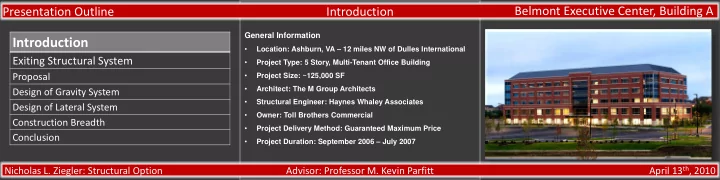
Introduction Location: Ashburn, VA 12 miles NW of Dulles - - PowerPoint PPT Presentation

introduction
SMART_READER_LITE
LIVE PREVIEW

Introduction Location: Ashburn, VA 12 miles NW of Dulles - - PowerPoint PPT Presentation

Belmont Executive Center, Building A Presentation Outline Introduction General Information Introduction Location: Ashburn, VA 12 miles NW of Dulles International Exiting Structural System Project Type: 5 Story, Multi-Tenant


slide-1
SLIDE 1

Introduction

Exiting Structural System

Proposal Design of Gravity System Design of Lateral System Construction Breadth Conclusion

General Information

  • Location: Ashburn, VA – 12 miles NW of Dulles International
  • Project Type: 5 Story, Multi-Tenant Office Building
  • Project Size: ~125,000 SF
  • Architect: The M Group Architects
  • Structural Engineer: Haynes Whaley Associates
  • Owner: Toll Brothers Commercial
  • Project Delivery Method: Guaranteed Maximum Price
  • Project Duration: September 2006 – July 2007

Presentation Outline Introduction

Nicholas L. Ziegler: Structural Option Advisor: Professor M. Kevin Parfitt April 13th, 2010

Belmont Executive Center, Building A

slide-2
SLIDE 2

Introduction

Exiting Structural System

Proposal Design of Gravity System Design of Lateral System Construction Breadth Conclusion

Gravity System

  • 6 ¼” lightweight concrete on 3” composite metal deck, f’c =

3500 psi

  • Composite action achieved through the use of shear studs
  • W shape steel beams/columns
  • Square spread footings with perimeter strip footing, f’c = 4000

psi

  • Typical bay sizes
  • 40’-0”x30’-0” exterior bays
  • 26’-2”x30’-0” interior bays

Presentation Outline Existing Structural System

Nicholas L. Ziegler: Structural Option Advisor: Professor M. Kevin Parfitt April 13th, 2010

Belmont Executive Center, Building A

slide-3
SLIDE 3

Introduction

Exiting Structural System

Proposal Design of Gravity System Design of Lateral System Construction Breadth Conclusion

Lateral System

  • 4 braced frames
  • 3 in the North-South direction
  • 1 in East-West direction

Presentation Outline Existing Structural System

Nicholas L. Ziegler: Structural Option Advisor: Professor M. Kevin Parfitt April 13th, 2010

Belmont Executive Center, Building A

slide-4
SLIDE 4

Introduction

Exiting Structural System

Proposal

Design of Gravity System Design of Lateral System Construction Breadth Conclusion

Goals

1. Design structure using post-tensioned concrete 2. Maintain long exterior spans 3. Minimize the floor depth

4. Determine architectural impacts of new system 5. Compare cost and schedules of the original vs. the proposed system

Solution

  • Gravity System: One-way, post-tensioned slab supported by

wide, shallow post-tensioned girders

  • Lateral System: Concrete moment frames

Nicholas L. Ziegler: Structural Option Advisor: Professor M. Kevin Parfitt

Presentation Outline Proposal

April 13th, 2010

Belmont Executive Center, Building A

slide-5
SLIDE 5

Introduction

Exiting Structural System Proposal

Design of Gravity System

Design of Lateral System Construction Breadth Conclusion

Design of Post-Tensioned Slab

Concrete

  • Normal weight concrete
  • f‘c = 5000 psi

PT Tendons

  • ½” Ø, 7-wire strands

Presentation Outline Design of Gravity System

Nicholas L. Ziegler: Structural Option Advisor: Professor M. Kevin Parfitt April 13th, 2010

Post-Tensioned Slab Design Parameters Clear Cover 1.0" Size of Conventional Reinforcement #4 Bars Balanced Dead Load 50%-100% £ Precompression Stress ≤ 300psi ¥ Location of Tendon(s) Anchor ¼*LЖ

£ To avoid extreme upward camber ¥ To avoid cracking due to creep Ж To avoid reinforcement congestion

Belmont Executive Center, Building A

slide-6
SLIDE 6

Introduction

Exiting Structural System Proposal

Design of Gravity System

Design of Lateral System Construction Breadth Conclusion

Design of One-Way Post-Tensioned Slab

Design Zones

  • Slab divided into different areas based on:

1. Number of spans 2. Length of Spans

  • 4 individual zones

Presentation Outline Design of Gravity System

1

2

3 4

Nicholas L. Ziegler: Structural Option Advisor: Professor M. Kevin Parfitt April 13th, 2010

Belmont Executive Center, Building A

slide-7
SLIDE 7

Introduction

Exiting Structural System Proposal

Design of Gravity System

Design of Lateral System Construction Breadth Conclusion

Design of One-Way Post-Tensioned Slab

Design of Zone 2

  • Introduce Normally Reinforced Concrete Beam
  • 18”x20”
  • f’c = 5000 psi
  • (5) #9’s – flexural reinforcement
  • (2) legs of #3 @ 8” – shear reinforcement

Presentation Outline Design of Gravity System

Nicholas L. Ziegler: Structural Option Advisor: Professor M. Kevin Parfitt April 13th, 2010

Belmont Executive Center, Building A

slide-8
SLIDE 8

Introduction

Exiting Structural System Proposal

Design of Gravity System

Design of Lateral System Construction Breadth Conclusion

Design of One-Way Post-Tensioned Slab

Design of Zone 2

  • Live load reductions per ASCE 7-05 § 4.8
  • Preliminary Size
  • L/45 – continuous spans: (30*12) / 45 → h = 8”
  • f’c = 5000 psi
  • Fe = 28.8 kips/ft (2 tendons per foot width)
  • Increased span 2 tendon height at mid-distance due to

high tension stress at initial loading

  • (1) #4 per foot; T – over supports, B - midspan

Presentation Outline Design of Gravity System

Nicholas L. Ziegler: Structural Option Advisor: Professor M. Kevin Parfitt April 13th, 2010

Belmont Executive Center, Building A

slide-9
SLIDE 9

Introduction

Exiting Structural System Proposal

Design of Gravity System

Design of Lateral System Construction Breadth Conclusion

Design of One-Way Post-Tensioned Slab

Zone 1, 3, and 4

  • Fe = 28.8 kips/ft in exterior bays
  • Fe = 20.9 kips/ft in interior bays
  • Tendon heights:
  • At supports: 7.0”
  • At mid-span: 1.0”
  • Deflections were not an issue
  • Max deflection = 0.53” in exterior spans
  • #4 @ 12” perpendicular to tendons for S&T

Presentation Outline Design of Gravity System

Nicholas L. Ziegler: Structural Option Advisor: Professor M. Kevin Parfitt April 13th, 2010

Belmont Executive Center, Building A

slide-10
SLIDE 10

Introduction

Exiting Structural System Proposal

Design of Gravity System

Design of Lateral System Construction Breadth Conclusion

Design of Post-Tensioned Girders

  • Banded tendons to provide high PT force
  • 7 tendons per 2 ¾” conduit

Method

  • Reduce tension at midspan in exterior bays by decreasing

drape eccentricity in the middle span

  • Reduce bottom fiber tension at supports by decreasing

tendon height over columns

Presentation Outline Design of Gravity System

Nicholas L. Ziegler: Structural Option Advisor: Professor M. Kevin Parfitt April 13th, 2010

Belmont Executive Center, Building A

slide-11
SLIDE 11

Introduction

Exiting Structural System Proposal

Design of Gravity System

Design of Lateral System Construction Breadth Conclusion

Design of Post-Tensioned Girders

Design of Typical Girder

  • Preliminary Size: 60” x 20”
  • PT force = 600 kips
  • Required number of tendons = 23
  • Max deflection = 0.18” in exterior spans

Presentation Outline Design of Gravity System

Nicholas L. Ziegler: Structural Option Advisor: Professor M. Kevin Parfitt April 13th, 2010

Belmont Executive Center, Building A

slide-12
SLIDE 12

Introduction

Exiting Structural System Proposal

Design of Gravity System

Design of Lateral System Construction Breadth Conclusion

Design of Post-Tensioned Girders

Design of Girder Adjacent to Elevator Openings

  • Narrow cross section increased the precompression stress

much greater than 300 psi

  • Extend tendon group entirely continuously through the girder
  • Provide tendons in exterior bays to balance dead load
  • Run off extra tendons through slab openings
  • Required PT Force = 500/216/600 kips
  • Required Number of Tendons = 19/9/23
  • Maximum deflection in span 3 = 0.19”

Presentation Outline Design of Gravity System

Nicholas L. Ziegler: Structural Option Advisor: Professor M. Kevin Parfitt April 13th, 2010

Belmont Executive Center, Building A

slide-13
SLIDE 13

Design of Concrete Moment Frames

  • 9 in north-south direction
  • 2 in east-west direction

Deflection/Story Drift Limitations

  • L/400 – wind
  • 0.015*hsx – seismic

ETABS Model

  • Property Modifiers
  • 0.70 – columns
  • 0.40 – beams

Introduction

Exiting Structural System Proposal Design of Gravity System

Design of Lateral System

Construction Breadth Conclusion

Presentation Outline Design of Lateral System

Nicholas L. Ziegler: Structural Option Advisor: Professor M. Kevin Parfitt April 13th, 2010

Belmont Executive Center, Building A

slide-14
SLIDE 14

Design of Concrete Moment Frames

  • Torsion : Threshold 54.4 ft-kips, Tu = 25.3 ft-kips

Introduction

Exiting Structural System Proposal Design of Gravity System

Design of Lateral System

Construction Breadth Conclusion

Presentation Outline Design of Lateral System

Nicholas L. Ziegler: Structural Option Advisor: Professor M. Kevin Parfitt April 13th, 2010

Belmont Executive Center, Building A

slide-15
SLIDE 15

Introduction

Exiting Structural System Proposal Design of Gravity System

Design of Lateral System

Construction Breadth Conclusion

Design of Typical Interior Column

  • Load Combination: 1.2D + 1.6W + L
  • Summary: f‘c = 6000 psi, As = (8) # 10’s → ρ = 1.76% ≤ 2.00%

Presentation Outline Design of Lateral System

Nicholas L. Ziegler: Structural Option Advisor: Professor M. Kevin Parfitt April 13th, 2010

Belmont Executive Center, Building A

slide-16
SLIDE 16

Introduction

Exiting Structural System Proposal Design of Gravity System Design of Lateral System

Construction Breadth

Conclusion

Construction Management Breadth

  • Cost Comparison

Presentation Outline Design of Gravity System

Nicholas L. Ziegler: Structural Option Advisor: Professor M. Kevin Parfitt April 13th, 2010

Belmont Executive Center, Building A

slide-17
SLIDE 17

Construction Management Breadth

  • Schedule Comparison

Steel Structure

  • 35 piece of steel per day
  • Erect beams after decking two floors below is installed

Post-Tensioned Structure

  • Divided slab into 3 phases
  • Sequenced trades to accelerate schedule

Presentation Outline Design of Gravity System

Nicholas L. Ziegler: Structural Option Advisor: Professor M. Kevin Parfitt April 13th, 2010

Belmont Executive Center, Building A

Introduction

Exiting Structural System Proposal Design of Gravity System Design of Lateral System

Construction Breadth

Conclusion

slide-18
SLIDE 18

Conclusion

  • Long exterior spans were maintained
  • The floor depth was minimized
  • PT system took longer to construct and cost more

Recommendation

  • Because the construction time and cost increased, the
  • riginal structure design is most efficient.
  • Switching to PT concrete would not be a viable solution

Presentation Outline Design of Gravity System

Nicholas L. Ziegler: Structural Option Advisor: Professor M. Kevin Parfitt April 13th, 2010

Belmont Executive Center, Building A

Introduction

Exiting Structural System Proposal Design of Gravity System Design of Lateral System Construction Breadth

Conclusion

slide-19
SLIDE 19

Acknowledgments

  • Toll Brothers Commercial
  • The M Group Architects
  • David Belgin
  • Haynes Whaley Associates
  • Dustin Wakefield
  • Holbert Apple and Associates
  • Richard Apple
  • All AE faculty
  • Especially friends and family members for their support.

Presentation Outline Design of Gravity System

Nicholas L. Ziegler: Structural Option Advisor: Professor M. Kevin Parfitt April 13th, 2010

Belmont Executive Center, Building A

Introduction

Exiting Structural System Proposal Design of Gravity System Design of Lateral System Construction Breadth

Conclusion

slide-20
SLIDE 20

Questions

Presentation Outline Design of Gravity System

Nicholas L. Ziegler: Structural Option Advisor: Professor M. Kevin Parfitt April 13th, 2010

Belmont Executive Center, Building A

Introduction

Exiting Structural System Proposal Design of Gravity System Design of Lateral System Construction Breadth

Conclusion