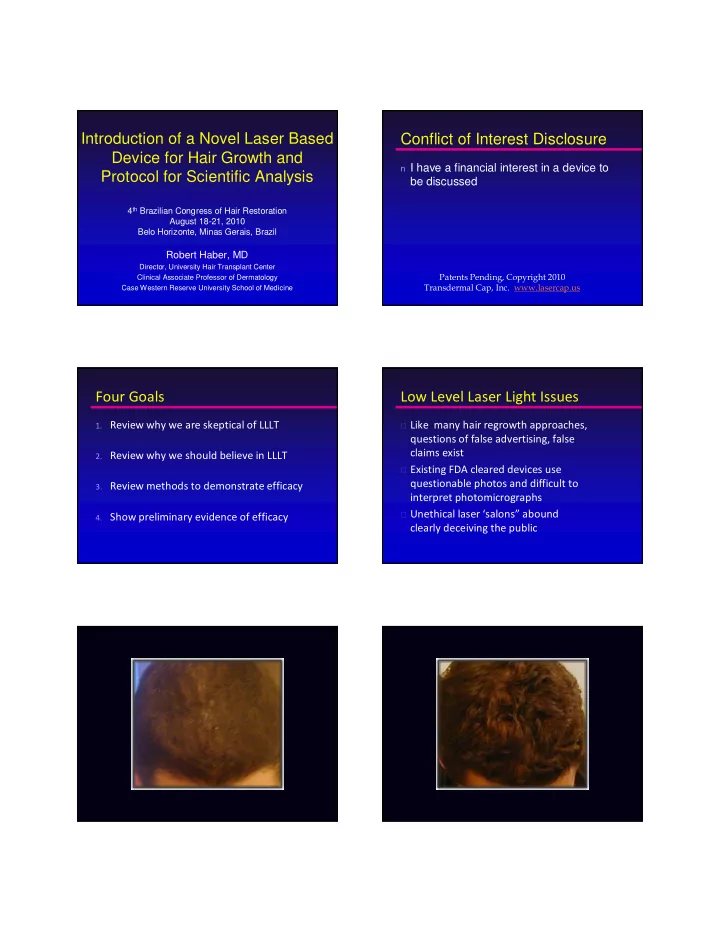
SLIDE 1 Introduction of a Novel Laser Based Device for Hair Growth and Protocol for Scientific Analysis
Robert Haber, MD
Director, University Hair Transplant Center Clinical Associate Professor of Dermatology Case Western Reserve University School of Medicine
4th Brazilian Congress of Hair Restoration August 18-21, 2010 Belo Horizonte, Minas Gerais, Brazil
Conflict of Interest Disclosure
n I have a financial interest in a device to
be discussed
- Four Goals
- 1. Review why we are skeptical of LLLT
- 2. Review why we should believe in LLLT
- 3. Review methods to demonstrate efficacy
- 4. Show preliminary evidence of efficacy
Low Level Laser Light Issues
Like many hair regrowth approaches,
questions of false advertising, false claims exist
Existing FDA cleared devices use
questionable photos and difficult to interpret photomicrographs
Unethical laser ‘salons” abound
clearly deceiving the public
SLIDE 2
SLIDE 3 Practical roadblocks to efficacy
225 movements in 15
minutes, once every 4 seconds
9 lasers, each
illuminating perhaps 9mm2
The scalp measures
600cm2 or 60,000 mm2
HairMax
Practical roadblocks to efficacy
Less than a third of the
scalp exposed in 15 minutes
During a one week
every other day treatment cycle, each mm of the scalp receives only 4 seconds
HairMax
Practical roadblocks to efficacy
The laser domes are far
more logical, with greater coverage and 107 lasers
However none have
FDA clearance, and there is tremendous inconvenience to the patient to have to visit the clinic so often
Laser Dome
Low Level Laser Light Issues
Natural therefore for ethical
practitioners to stay a safe distance from this new technology, and demand scientifically credible evidence of efficacy
SLIDE 4
Low Level Laser Light Issues
However, its not reasonable to expect
a greater level of efficacy than currently offered by FDA approved medications, such as minoxidil and finasteride
No change after long term use by
these products is considered a success, even if not a single new hair has emerged
Why Believe in LLLT?
Mike Hamblin, PhD, Harvard professor and
photobiology expert:
“Low level laser therapy has been shown in
thousands of peer-reviewed publications to increase cellular survival, proliferation and function.”
“LLLT is able to stimulate and preserve hair
follicles in patients with androgenetic alopecia and other hair loss disorders.”
Why Believe in LLLT?
And a growing number of credible
physicians worldwide have put their reputations on the line declaring their personal observations of efficacy
The LaserCap
My team set out to develop a superior device
with the coverage of a dome, but in a portable design
The LaserCap
We designed a device that fits in a variety of
hats, is powered by a portable battery pack, and contains 224 lasers
The LaserCap
The entire target zone is treated throughout
the duration of treatment, and the user can perform almost any activity during use, including walking, riding, running, preparing dinner, working, and more
SLIDE 5
Measures of Efficacy
Photos very difficult to control for hair length
and style, even if there is no attempt to deceive
Photomicrographs are very difficult to
interpret, providing only a tiny snippet of hair shaft for evaluation
Arbitrary visual separation of hairs into
terminal and non-terminal hairs allows bias to affect data
Measures of Efficacy
Measurement of hair
shaft diameter problematic
There is no way to
determine if the long axis or short axis is being measured
Measures of Efficacy
Measuring bundles of
hairs
New Approach
Measurement of individual hair shafts
tip to base
Assess changes in diameter and cross
sectional area over time
What is normal?
Conventional Wisdom Conventional Wisdom
SLIDE 6 Conventional Wisdom Normal Hair Shaft Change Over Time
Hutchinson PE, Thompson JR. (1994)
Hutchinson PE, Thompson JR. The cross-sectional size and shape of human terminal scalp hair. Br J Dermatol. 1997 Feb;136(2):159-65.
Nizzimov, J (2004)
Nizzimov, J. !"#$"#%$&'
Hair shaft diameter slowly decreases over
time, in absence of pattern hair loss
Normal Hair Shaft Change Over Time Normal Hair Shaft Change Over Time Hypothesis
An effective treatment modality would
reverse this slope
By increasing hair shaft diameter and
thus volume, will produce an increase in fullness
Hypothesis
SLIDE 7
Hypothesis Wire scan Spaghetti scan Spaghetti cross sectional area Linguini scan
SLIDE 8 Linguini cross sectional area Normal Patient Scan Normal Patient Cross Sectional Area Normal Patient 2 Scan
Normal Patient 2 Cross Sectional Area
Proof of Concept Study Design
Light cap which
illuminated only one half
Worn for 30 minutes
every other day
Hair samples were
from the treatment and the control side
SLIDE 9
Proof of Concept Study Design
Analyze hair shaft segments growing
before and after initiating therapy
Determine treatment effect
Control side raw data Control side cross sectional area Treatment side raw data Treatment side cross sectional area
SLIDE 10
Conclusions
These preliminary data cannot be used to
draw conclusions
They are encouraging however and seem
to support our hypothesis
We are still perfecting the hair shaft
evaluation process
Conclusions
We will be evaluating hair shafts from
patients who have initiated treatment with minoxidil and finasteride for comparison purposes.
We hope to begin FDA 510(k) clearance
trials in the near future
Thank You!