Introducing Act 64 - the Vermont Clean Water Act - and Vermonts Clean - - PowerPoint PPT Presentation

introducing act 64 the vermont clean water act
SMART_READER_LITE
LIVE PREVIEW

Introducing Act 64 - the Vermont Clean Water Act - and Vermonts Clean - - PowerPoint PPT Presentation

Introducing Act 64 - the Vermont Clean Water Act - and Vermonts Clean Water Goals Vermont Department of Environmental Conservation February 8, 2016 Clean Waters are a Critical Community Asset Protect health; Preserve the natural


slide-1
SLIDE 1

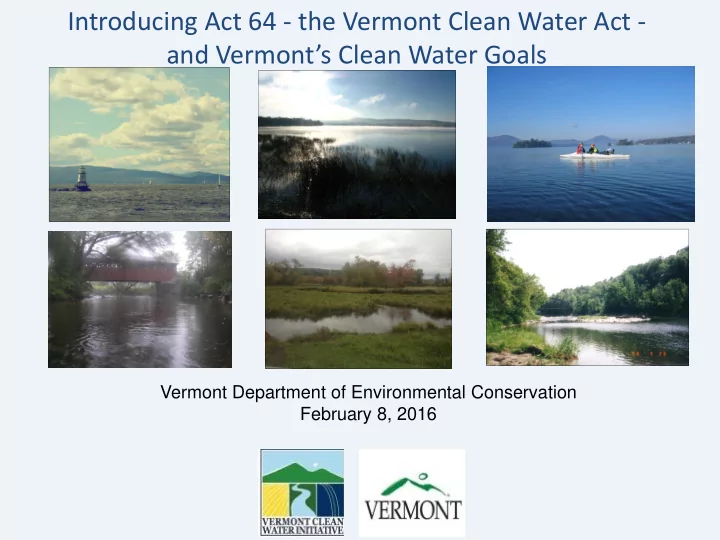
Introducing Act 64 - the Vermont Clean Water Act - and Vermont’s Clean Water Goals

Vermont Department of Environmental Conservation February 8, 2016
slide-2
SLIDE 2

Clean Waters are a Critical Community Asset

  • Protect health;
  • Preserve the natural beauty;
  • Enhance the ecological values of our waters;
  • Are an essential legacy for Vermont’s Future

Generations

slide-3
SLIDE 3

 Loss of uses such as boating, swimming, fishing  Decline in natural resource-based tourism  Decline in property values  Cost of water treatment  Cost of reducing the pollution

The decline in the health of our waters has quality of life and economic impacts

slide-4
SLIDE 4

Water Pollution

Water Pollution is the discharge of waste, litter, chemicals, sediment, heat, or

  • ther materials into water,

contaminating or degrading the quality of that water for

  • ther users
  • Aug. 2014 Algae Bloom,
  • St. Albans Bay

Photo: Courtesy of Friends of the Northern Lake Champlain

slide-5
SLIDE 5

Water Pollution – Point Sources

  • Examples: wastewater or industrial discharges

Illegal discharge of untreated sewage, dyed green for the assessment

slide-6
SLIDE 6

Water Pollution – Nonpoint Sources

  • Examples: Runoff from developed areas, agricultural

lands, logging operations and construction sites

  • Leading cause of water quality degradation
slide-7
SLIDE 7

Land uses can influence the generation of non-point sources of water pollution

slide-8
SLIDE 8

With consequences locally and downstream

slide-9
SLIDE 9

The best time to plant a tree is 20 years ago. The second best time is now.

  • - Chinese Proverb
slide-10
SLIDE 10
  • Supports clean water needs statewide
  • Supports phosphorus pollution reductions

in Lake Champlain, as required by the Environmental Protection Agency Vermont Clean Water Act (2015, Act 64)

slide-11
SLIDE 11

“All in” approach

Forestry Tactical Basin Planning Developed Land ≥ 3 acres Roads Agriculture

slide-12
SLIDE 12

Storm-damaged gravel road Eroding roadside ditch

Stormwater Management - Roads

slide-13
SLIDE 13

Goal: Reduce runoff and erosion associated with the State and municipal road network

  • Bring critical erosion areas along road drainage systems

and other sources of road runoff and erosion up to basic maintenance standards

  • Benefits include reduced sediment and nutrient pollution;

improved resilience to storm damages; lower long-term maintenance costs

Stormwater Management – Roads (continued)

slide-14
SLIDE 14

Time, Flexibility, Support

  • Municipal road general permit will

go into effect at the end of 2017

  • All municipalities must develop

road stormwater management plan by 2021

  • Applies to paved and unpaved

roads

  • 20-year implementation period

Stormwater Management – Roads (continued)

slide-15
SLIDE 15

Municipal Road Stormwater Management Plan

Inventory Prioritize Implement

Stormwater Management – Roads (continued)

slide-16
SLIDE 16

Support for Roads- outreach, technical assistance and funding

VTrans: Local Roads Program, Better Backroads grants, VTrans District staff DEC: Various programs with Watershed Management Division Partners: Regional planning commissions, Watershed groups, natural resources conservation districts

slide-17
SLIDE 17
  • Entire state

transportation network and facilities

  • Standards will be issued

in spring 2016

  • Will require retrofits of

existing state road systems

State roads will also need to comply with Act 64

Stormwater Management – Roads (continued)

slide-18
SLIDE 18
  • Current target: Parcels

with ≥ 3 acres of impervious surface

  • Require stormwater

retrofits of existing impervious surface

  • Standards developed as

part of permit development process

Act 64 and Existing Development

Goal: Treat stormwater runoff from existing impervious surfaces

slide-19
SLIDE 19

Act 64 and Existing Development (continued)

  • Requires ANR to adopt a general permit by Jan. 2018
  • Requires ANR to develop a schedule to require:

− Permit coverage in the Champlain Basin no later than 2023 − Permit coverage in the rest of the State no later than 2028

  • MS4s will need to develop phosphorus control plans
slide-20
SLIDE 20

Agricultural Water Quality

  • Accepted Agricultural Practices (AAPs), to be referred to

as “required agricultural practices (RAPs), are to be revised by July 1, 2006

  • “Small farms” are to be defined by July 2016
  • Increased financial aid and increased enforcement
slide-21
SLIDE 21

Revisions to RAPs

  • Increases vegetative setback standard for:

– Surface waters − 25 feet – Ditches −10 feet

  • Require standards for:

– Livestock exclusion from waterways – Soil conservation such as cover cropping in critical areas – New standards for tile drainage by January, 2018

slide-22
SLIDE 22

Planning for Clean Water

  • Tactical Plans are the

implementation vehicle for clean water activities and TMDLs

  • 15 Planning Basins
  • 5 Planners
  • Plans revisited every 5 years
  • Plan Implementation table

updated continuously

  • RPCs are assisting DEC in the

basin planning process

slide-23
SLIDE 23

Tactical Basin Plans Integrate: Monitoring & Assessment Results

Stream Geomorphic Assessment

Town Zoning and FEH Water Quality Monitoring Stormwater Master Plans Road Inventory and Erosion Risk Agricultural Assessments

23

slide-24
SLIDE 24

Tactical Basin Plans and their Implementation Tables:

Implementation Roadmaps for Clean Water Restoration Activities

slide-25
SLIDE 25

Implementation for TMDLs and target waters via Tactical Basin Planning

LIS LC Memph

slide-26
SLIDE 26

Tactical Plans and Municipalities

  • River Corridor plan priorities- crossings, floodplain

restoration, river corridor protection

  • Flood Resilience and Hazard Mitigation Planning
  • Stormwater Infrastructure reports and Master Plans
  • Road erosion inventories and town priorities
slide-27
SLIDE 27

Status of Addison County Tactical Plans

  • South Lake Champlain

2014, update with Phase II actions 2017

  • Otter Creek 2012, update

with Phase II actions 2019

  • Ethan Swift, Watershed

Coordinator.

slide-28
SLIDE 28

Vermont Clean Water Initiative Funding

State

Revenue Source FY16 Budget

Various AAFM fees $621,000 Capital Bill – Agriculture Best Management Practices (BMPs) Program (statewide) $1.4M Capital Bill – Ecosystem Restoration Grants (statewide) $3.75M Capital Bill – Clean Water and Drinking Water State Revolving Fund (SRF) Match (statewide) ~$1.3M Transportation Bill – Municipal Mitigation Grants (includes Better Back Roads Grants, statewide) $650,000 DEC Clean Water Permit Fees (statewide) ~$2.3M NEW: Clean Water Fund $5.3M VTrans Stormwater Compliance ~$2.1M

slide-29
SLIDE 29

Act 64 and the Clean Water Fund

0.2% increase on property transfer tax for FY16, FY17, FY18

Recommendation by Sector FY16 FY17 Total Administered By Sector Agriculture

$670,000 $1,975,000 $2,650,000

Municipal (roads, stormwater)

$800,000 $3,200,000 $4,000,000

Municipal Wastewater

  • $500,000

$500,000

Natural Resources

  • $1,150,000

$1,150,000

All Sectors – LIDAR Mapping

$430,000

  • $430,000

All Sectors – Partner Support

$100,000 $1,085,000 $1,185,000

Total Need

$2,005,000 $8,395,000 $10,400,000

slide-30
SLIDE 30

Clean Water Activities

Ag

Forests

Lakes Rivers Roads Waste- water Wet- lands Storm- water Financial Outcomes Performance Outcomes Environmental Outcomes Social Outcomes

Clean Water Investment & Performance Report

Tracking Clean Water Activities Statewide

slide-31
SLIDE 31

Steps for Clean Water Problem Solving: Getting your ducks in a row…

The Steps Description Step 0 Definition: What’s the problem? Step I Assessment/Planning: What can we do? Step II Design: What should we do? Step III Implementation: Let’s do it! Step IV Repayment (for loans)

slide-32
SLIDE 32

Step 0: Definition What is the problem?

  • Chronic road erosion problems
  • Untreated stormwater runoff
  • Order from ANR: CSOs, Illicit Discharges
  • Poor Water Quality
  • Cost of repairs
  • Financial and technical support
  • Flood risk
slide-33
SLIDE 33

Step 1: Assessment/Planning: What can we do?

Examples of assessment information

  • Check out Implementation Tables in Tactical Basin Plans
  • Roads: Inventories and erosion risk maps
  • Stormwater: municipality-wide stormwater assessments and

mapping

  • River and floodplain health assessments: river corridor

planning, geomorphic assessments, culvert assessments

slide-34
SLIDE 34

Who can help to Get Started?

  • ANR Basin Planner in your region
  • Local or regional partner

– Regional planning commission – Natural resources conservation district – Watershed or lake association

  • Facilities Engineering Division (FED) of ANR
  • Vermont Transportation Agency

– District Offices – Transportation Planners at the Regional Planning Commissions – VTrans Better Back Roads Program, Local Roads Program

slide-35
SLIDE 35
slide-36
SLIDE 36

Questions?

Vermont Clean Water Initiative Website:

cleanwater.vermont.gov/

  • Clean Water Initiative: Kari Dolan kari.dolan@vermont.gov
  • Monitoring, Assessment & Planning: Neil Kamman neil.kamman@vermont.gov
  • Water Infrastructure Financing: Bryan Redmond bryan.redmond@vermont.gov
  • Stormwater Management: Padraic Monks padraic.monks@vermont.gov
  • Municipal Roads: Jim Ryan jim.ryan@vermont.gov
  • Drinking Water: Jim Siriano Jim.siriano@vermont.gov