Intraoperative Imaging for EVAR What's New, What's Coming? None - - PowerPoint PPT Presentation

intraoperative imaging for evar what s new what s coming
SMART_READER_LITE
LIVE PREVIEW

Intraoperative Imaging for EVAR What's New, What's Coming? None - - PowerPoint PPT Presentation

4/6/2017 Disclosures Intraoperative Imaging for EVAR What's New, What's Coming? None Acknowledgements Matt Eagleton Stephon Haulon Gustavo Oderich Darren B. Schneider, MD Associate Professor of Surgery Chief, Vascular and


slide-1
SLIDE 1

4/6/2017 1

Darren B. Schneider, MD Associate Professor of Surgery Chief, Vascular and Endovascular Surgery

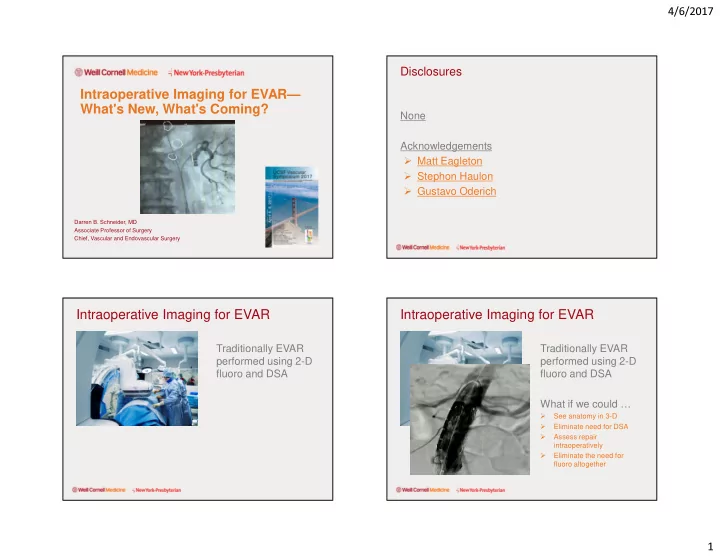
Intraoperative Imaging for EVAR— What's New, What's Coming?

Disclosures

None Acknowledgements Matt Eagleton Stephon Haulon Gustavo Oderich

Intraoperative Imaging for EVAR

Traditionally EVAR performed using 2-D fluoro and DSA

Intraoperative Imaging for EVAR

Traditionally EVAR performed using 2-D fluoro and DSA What if we could …

  • See anatomy in 3-D
  • Eliminate need for DSA
  • Assess repair

intraoperatively

  • Eliminate the need for

fluoro altogether

slide-2
SLIDE 2

4/6/2017 2

Improving Imaging for EVAR

Cone Beam CT (CBCT) Image fusion Digital zoom (radiation reduction) Non radiation-based imaging guidance (GPS navigation)

Cone Beam CT (CBCT)

Courtesy of G. Oderich GE Discovery CBCT

Pre-operative CTA Create anatomic markers

Fusion Imaging

Markers Pre-operative CTA Create anatomic landmarks Intra-op CBCT Image registration

Pre-op CTA + CBCT

Fusion Imaging

Image Registration

slide-3
SLIDE 3

4/6/2017 3

Pre-operative CTA Create anatomic landmarks Intra-op CBCT Image registration

Pre-op CTA + CBCT

Fuse to form 3-D model Overlay 3-D model on 2-D fluoro

Fusion Imaging

3-D on 2-D Overlay Benefits: Reduce need for DSA runs Identify optimal c- arm angles Reduce radiation dose Streamline case

Fusion Imaging

Verifying Fusion Registration

slide-4
SLIDE 4

4/6/2017 4

Fusion Imaging Accuracy

Affected by:

CTA slice thickness Patient movement Respiratory motion Vessel distortion from stiff guidewires and devices

Image Fusion

Courtesy of S. Haulon

Image Fusion : reposition anatomy without fluoro

Title or Job Number | XX Month 201X 16

Courtesy of S. Haulon

slide-5
SLIDE 5

4/6/2017 5

Courtesy of S. Haulon

Completion CBCT assessment

Courtesy of S. Haulon

Intra-op CBCT assessment

Courtesy of S. Haulon

Intra-op CBCT assessment

Courtesy of G. Oderich

slide-6
SLIDE 6

4/6/2017 6

Advanced Imaging Applications

HOME

New generation of clinical apps with seamless integration to PLAN, GUIDE & ASSESS complex procedures

Endo TAAA Trends and Learning Curve

755 1200 1040 525 475.1 423 366.9 340 200 400 600 800 1000 1200 1-10 11-20 21-30 31-40

PATIENTS

Procedure Trends

EBL (cc) Procedure Time (min)

Benefits of digital treatment of images Digital zoom and Collimation

Courtesy of S. Haulon

IOPS

  • Intraoperative Positioning System
  • What does it provide?

– Interactive 3D Vascular Imaging – EM tracking of endovascular “tools” within the vascular tree

Courtesy of M. Eagleton

slide-7
SLIDE 7

4/6/2017 7 Developed a Mathematical Model for Vascular Image Construction

  • Based on DICOM CT data
  • The model was tested by

assessing the relative geometry of the aortic branches

Goel VR, et al. IEEE Computer Graphics and Applications, May/June 2008

3-Dimensional Wireframe Model

Bare Angio

Model Over Angio

Model Aorta Branch vessels Celiac SMA LRA RRA

Overlay Fusion of Mathematical Model

slide-8
SLIDE 8

4/6/2017 8

DEVICE LOCALIZATION WITHIN THE MODEL

Navigation System Development

Sensors on Sheaths, Wires, Catheters Patient sensors – overcome patient/table movement

Display System Development Proof of Concept Testing

slide-9
SLIDE 9

4/6/2017 9

Merging of Imaging and Guidance in Model Preclinical Study – porcine model

April 6, 2017 34

Able to re-orient 3-D image to provide the optimal view And magnify image

April 6, 2017 36

slide-10
SLIDE 10

4/6/2017 10

Transition to Clinical Application

April 6, 2017 37

IOPS Guided Cannulation: Left Renal Artery

IOPS-Fluoro Correlation

April 6, 2017 38

Cannulation of Left Renal Artery with Catheter

Computer “Anticipated” Deformations

  • Can affect alterations at discrete sections of

the vessel

slide-11
SLIDE 11

4/6/2017 11

Can be applied to overlay imaging

.

Incremental Deformation

High stiffness Moderate stiffness Low stiffness

Low Stiffness

April 6, 2017 43

Medium Stiffness

slide-12
SLIDE 12

4/6/2017 12

High Stiffness What does IOPS provide

  • Enhanced three dimensional imaging
  • Ability to manipulate the imaging to provide

multiple, ideal views

  • Ability to track the endovascular tools within

the vascular image – correlating directly with in vivo localization

  • Provide superior imaging and navigation to

standard 3-D fluoroscopy

  • Fusion imaging provides continuous 3-D image

visualization to facilitate EVAR, especially complex cases:

  • Learning curve, but can easily be integrated into workflow
  • Facilitates device positioning, deployment, and target vessel

cannulation

  • Can reduce radiation dose
  • Completion CBCT can detect technical problems to

allow intraoperative correction

  • Future technology
  • Automated corrections for vessel deformation and movement
  • Non-radiation-based image guidance

Conclusions

DIVISION OF VASCULAR AND ENDOVASCULAR SURGERY