
SLIDE 1
Novel soiling measurement technology
Xander van Mechelen, CTO
Intersolar Middle East
September 25-26, 2017
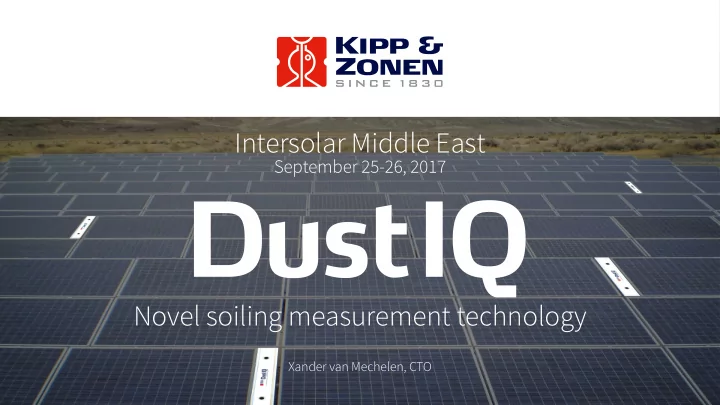
Intersolar Middle East September 25-26, 2017 Novel soiling - - PowerPoint PPT Presentation
Intersolar Middle East September 25-26, 2017 Novel soiling measurement technology Xander van Mechelen, CTO It is our mission to be a global, leading manufacturer of instruments that measure climate properties for the long term benefit of
Xander van Mechelen, CTO
September 25-26, 2017
Insight in the basics of Soiling
1.1 PV performance dependencies 1.2 Dust characteristics 1.3 Effects on PV panels 1.4 Existing solutions
New Instrument development
2.1 Novel technology 2.2 Testing and characterisation 2.3 Application 2.4 Conclusions
Three main parameters
(besides hardware issues)
Irradiance Temperature Soiling
High quality, good understanding Qualitative opinions & basic or no measurements
PV performance variations
Soiling the big unknown
Three main parameters
(besides hardware issues)
Soiling is the only parameter that you can influence!
Irradiance Temperature Soiling
High quality, good understanding Qualitative opinions & basic or no measurements
PV performance variations
Soiling the big unknown
Soiling losses are significant most attractive PV locations are troubled by soiling
Soiling loss location dependent, 0 to 2% per day Within one week, power loss can be >10% Rain events reduce soiling losses Current best practice: accepted loss 4.4% Business case for cleaning cost vs loss is location dependent
Soiling accumulation over days Soiling accumulation loss per day
Average of annual solar insolation [kWh/m2/day] 5.92 5.61 5.40 5.08 5.77 5.42 5.16 4.65 0.5 1 1.5
Libya Abu Dhabi, UAE Kuwait, Kuwait Mountain View, CA, USA Riyadh, Saudi Arabia Limassol, Cyprus Ogbomoso, Nigeria Dhaka, Bangladesh
2 5 1 51 101 201 151 251 301 351 10 15 20 25 30 Day Daily output power loss increase [%]
Sayyah et al. Solar energy (2014) Zorrilla-Casanova et al. (2011)
Loss (%) Rainfall (mm) 20 40 60 80 100 120 140 Daily losses Rainfall
About soiling and dust Sources of soiling
1000-500 500-250 250-125 125-63 63-31 31-16 16-8 8-4 < 4 0.00 0.00 0.82 4.78 8.16 16.47 23.82 20.19 25.75 Coarse grained Medium grained Fine grained Very fine grained Coarse silt Medium silt Fine silt Very fine silt Clay D(µm) % of the total sample Grain type Dust grain distribution and sediment types Quartz Calcite Albite, calcian, ordered Dolomite Muscovite Palygorskite Lizardite-1T Kaolinite 1Md SiO2 CaCO3 (Na, Ca) Al (Si, Al)3 O8 CaMg (CO3)2 KAl3Si3O10(OH)2 Mg5 (Si, Al)8 O20 (OH)2 8H2O Mg3Si2 O5 (OH)4 Al2Si2O5 (OH)4 Compound name Chemical formula Dust sample material composition obtained using XRD analysis
Zone 1 5.2 - 8.1 8.1 - 12 Zone 2 12 - 19 19 - 30 Zone 3 30 - 44 44 - 65 Zone 4 65 - 96 96 - 142
Dust intensity around world, based on M. Maghami et al. 2016
Humidity and dew can be a determining factor in soiling impact; ‘stickiness’ of dust Local grain size determins optimimum PV tilt angle
Acculumation speed of dust can be a sort of a local ‘constant’ and maintenance can be more or less planned Timing of cleaning practices is local knowledge (season, time of day) Evolving technologies for cleaning robots as an intergral part of PV plant design
Qualitative insights for dust practices
Local insights and inventions of best practices
Existing solutions
Inspiration for a new product
All based on 2 panel comparison: € 9,000 to € 30,000
Inspiration: can we... prevent daily cleaning/maintenance? avoid moving parts/fluids? provide multiple sensors across the plant for a similar budget? measure in more representative wind conditions? improve ease of installation?
Moroni & Partners UKC DDSolar Atonometrics Soiling Campbell
DustIQ principle
Optical Soiling Measurement (OSM) Technology
Reflection → Transmission loss → Soiling loss
LED Photodiode ‘clean’ signal ‘soiled’ signal LED Photodiode
DustIQ signal response
response curve
Signal strength at different soiling rates
Netto loss [mV] Transmission loss [%]
Photodiode LED Pyranometer
Sun or lamp
Soiling X% Soiling Y% Signal X1 Signal Y1 Signal X2 Signal Y2 Glass plate Situation X Situation Y
DustIQ Curves
Different curves for different colors of dust
Test dust vs Abu Dhabi and Jordan
black dust brown dust white dust Abu Dhabi Jordan
Transmission loss [%] Netto loss [mV]
DustIQ Characterization
Designed for Inhomogeneity
diameter more than enough
3 µm 10 µm 20 µm 40 µm
Transmission loss DustIQ signal [mV]
5
10 15 20 25
No grain size effects
Field application
Field application Understanding of output
Transmission Loss(dust type) [%] = Reflected signal x Manufacturer calibration x Field calibration(dust type) Soiling Ratio(dust type) [%] = 100% - Transmission Loss
Determine your dust color Field calibration Install next to panel Mounting
Three main parameters PR by two sensors
Irradiance Temperature Soiling Pyranometer DustIQ DustIQ
1 3 2
Soiling Ratio 95 - 90% Soiling Ratio 90 - 80% Soiling Ratio 80 - 50% Measurement interval Ambient temperature range Weight Instrument dimensions +/- 1 to 2% +/- 2 to 4% +/- 5 to 10% 1 min, IEC61724 compliant
5 kg 990 x 160 x 40 mm Soiling Ratio 100 - 95% +/- 0.5 to 1% Technical specifications DustIQ
Results
DustIQ specification
Patents applied for in Europe & China International coverage Self-calibrating for dust color/LED/photodiode changes, etc.
Near future optimization
Compensate for soiling ratio variations during the day
Most accurate around noon and during the night (no dew) Dependence on solar inclination angle Effect holds for both DustIQ and 2 panel comparison methods
5 10 15 20 25 06:00 08:24 10:48 13:12 15:36 18:00 20:24 22:48
TL (%) Local time
solar noon solar noon +2 hr solar noon - 2hr
Near future optimization
Compensate for soiling ratio variations during the day
Soiling Ratio [SR]
0.83 0.84 0.85 0.86 0.87 10:33 11:45 12:57 14:09
Variation SR with the angle of incidence due to artificial soiling at Delft for 14% Tloss
Time Time
15:21 16:33
Photo of roof PV setup with artificially soiled PV panels and SR as function of varying solar angle over the course of a day
Near future optimization
Compensate for soiling ratio variations during the day
TL (%) solar noon soiling ratio
20 40
22% 18% 14% 9% 4% 22% 18% 14% 9% 4%
60 80 100 40 3 5 30 25 20 15 10 5
Irradiance losses for solar angle with equation fit
SA (degrees)
∆ 3% ∆ 7%
SR(out) can be different from instantaneous SR and can be compensated by calculations to make DustIQ accurate 24/7
Data to end-user Afer processing
Data to SCADA
1 to 3% uncertainty 4 to 6% uncertainty
Near Future
Timing optimization of your cleaning robots
DustIQ to detect dew Clean when dew is just gone, and before the sun ‘bakes’ the dust firmly to the PV modules DustIQ to trigger the cleaning robots in this timeslot
Introduced novel soiling measurement technology We can Performance demonstrated high sensitivity/precision signals linear grain size independent color characterisation dew detection Field application and shared data will improve future usage test locations in Delf and Spain. Planned: Arizona and Qatar First delivery mid December 2017
prevent daily cleaning/maintenance? avoid moving parts/fluids? provide multiple sensors across the plant for a similar budget? measure in more representative wind conditions? improve ease of installation?
For more information please mail donald.van.velsen@kippzonen.com