@GoingPlacesEdu www.goingplaces.edu.au
International student exchange in an era of internationalisation: - - PowerPoint PPT Presentation
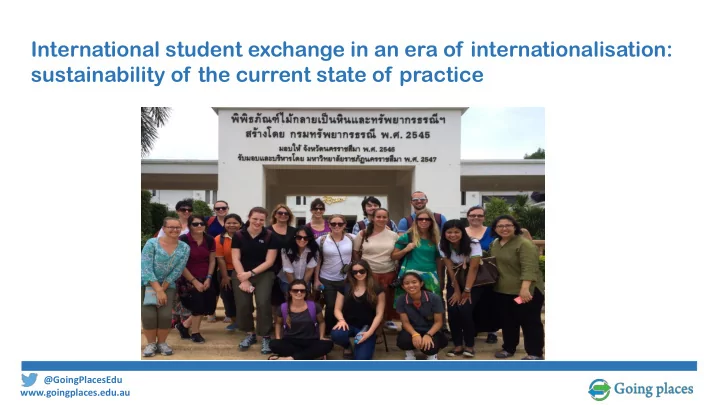
International student exchange in an era of internationalisation: sustainability of the current state of practice @GoingPlacesEdu www.goingplaces.edu.au Our ur foc ocus us to today Why we are researching student exchange? The Going
@GoingPlacesEdu www.goingplaces.edu.au
Our ur foc
- cus
us to today
Why we are researching student exchange? The ‘Going Places’ project Issues of reciprocity and sustainability in exchange
@GoingPlacesEdu www.goingplaces.edu.au
Stu tudent dent exchang hange is is on
- n th
the e ri rise
Harrison & Potts, 2016, p.4
@GoingPlacesEdu www.goingplaces.edu.au
New Col
- lombo
- mbo Pla
lan n – Mob
- bility
ility Prog
- gram
am
1000 2000 3000 4000 5000 6000 2014 2015 2016
Aims to support up to 10,000 students to participate in an international study experience in the Indo- Pacific Region by the end of 2016, with further growth in future years.
(Department of Foreign Affairs and Trade, 2016).
@GoingPlacesEdu www.goingplaces.edu.au
The he na narrativ tive of
- f exchang
hange
Transforming lives
Experience new cultures, make friends from all over the world and gain a competitive edge whilst travelling the globe.
@GoingPlacesEdu www.goingplaces.edu.au @GoingPlacesEdu www.goingplaces.edu.au
International social work student exchange: facilitating good practice in Australia and the Indo-Pacific.
@GoingPlacesEdu www.goingplaces.edu.au
Our ur rel elationships tionships
@GoingPlacesEdu www.goingplaces.edu.au
So what have we done so far…
- Quantitative Online Survey with Australian
Schools of Social Work
- Qualitative Interviews with 10 Australian
academics, 10 host organisation staff and academics, and 13 travelling Australian students
@GoingPlacesEdu www.goingplaces.edu.au
Su Survey y of Aust strali alian an Sc School
- ls
s of So Soci cial al Work
- 30 Schools of Social Work
- 90% completed the Survey (27 schools).
- 85% engaged in international exchange
activity (23 schools).
- What
t do th they do?
- field placement (20 schools)
- study abroad programs (13 schools)
- short-term programs (9 schools).
@GoingPlacesEdu www.goingplaces.edu.au
Wher ere do Austr tral alian ian Schools
- ols of Social
ial Wor
- rk
k have e exchang ange e rela elationships? tionships?
@GoingPlacesEdu www.goingplaces.edu.au
Exchang hange e practice actice an and d soc
- cial
ial wor
- rk
k val alues ues: : cha halleng llenges es an and d te tens nsions ions
‘Internationalisation of curriculum and international social work education offerings are not easy goals to achieve. They involve multiple transformations of both people and institutions’ (Brydon in Crisp, 2015, p. 10).
Respect for persons – recognises and respects group identity, interdependence, reciprocity and collective needs of particular communities. Social justice – advocates change to social systems and structures that preserve inequalities and injustice. Professional integrity – make considered and ethically accountable professional decisions.
@GoingPlacesEdu www.goingplaces.edu.au
Su Survey y data ta: : rec eciprocity
- city
Responses Host their students for field placements 9 Host their staff for visiting scholar activities 9 Host their students for a short-term study program 6 Collaborative research activities 6 Collaborative teaching activities 5 Joint conferences 3 Joint curriculum development 2 Other (joint conference presentation) 1
Note: N = 15
@GoingPlacesEdu www.goingplaces.edu.au
- Reciprocity is not universally understood, defined or readily
implemented.
- Descriptions of reciprocity in practice included:
- sharing resources
- making a contribution in the host country
- two-way flow of students and staff.
Qual alita tativ tive e inte terview w data ta: rec eciproci
- city
ty
@GoingPlacesEdu www.goingplaces.edu.au
Su Sust stai aina nable e prac actice? tice?
- Exchange programs rely heavily on personal connections
- Occasionally Institutionally driven
Well, I think one of the things that we could have done more of is not to rely on particular points of contact as much maybe as we’ve had to. So for example, if the key person in India and the key person here were both suddenly to not be there, we would have to re-negotiate the whole thing. Now it’s been sustainable because both of those people are committed to being involved in this and at that end and at this end the team has worked with them and it’s been a team effort in both places. But take those two individuals out of the equation and I think that that would really require total re-negotiation.
@GoingPlacesEdu www.goingplaces.edu.au
I always feel that there’s insufficient - and this is me - insufficient time to really set it up properly and somehow we scrape it together, … But the exchanges happen and the students are happy so I think that’s probably are far as it goes.
Su Sust stai aina nable e prac actice? tice?
There’s no extra - it’s done within existing resources.
- Inadequate Resourcing
- Creative responses to challenging situations
- Individual ‘champions’
We’ve had to allocate staff resources to it that we’ve had to claw that
- ut of a program.
@GoingPlacesEdu www.goingplaces.edu.au
The narrative of exchange is often simplified and the work required to set up exchanges and ma main inta tain in relationships lacks vis isibility ibility and sup uppor port.
Su Susta taina nable e prac actice? tice?
@GoingPlacesEdu www.goingplaces.edu.au
Su Susta taina nable e prac actice? tice?
Host
- rganisation
staff Students Sending University Staff Host university staff Family Friends & peers Past students Sending institution priorities Host institution priorities Policies and rhetoric Policies and rhetoric Community Funders Clients Workload demands Workload demands
- Lack of resourcing negatively impacts on the possibility of
reciprocity, equality in relationships and sustainability. Data collected from Australian institutions, students and hosts from the Indo-Pacific region indicates that despite good intentions, exchange arrangements can be ad ad-hoc hoc and goals such as reciprocity
- city and mutu
tual al ben enef efit t can be difficult to achieve in the absence of strong insti tituti tutional
- nal
su suppor port. We wonder what this might mean for negotiating exchange programs in an ethical and socially just way? In su summ mmary ary
@GoingPlacesEdu www.goingplaces.edu.au
Wher ere e to to from m her ere? e?
Jan – April 2017 Workshops to explore ‘good practice’ principles. Brisbane, Melbourne, Sydney, India, Thailand and Singapore. Mar-June 2017 Workshop data analysis and formulation of a ‘good practice’ guide.
June – July 2017 Dissemination of final project outcomes.
@GoingPlacesEdu www.goingplaces.edu.au
Follow: @GoingPlacesEdu Sign up for updates: www.goingplaces.edu.au
Contact: Debra Miles Team Leader debra.miles@jcu.edu.au
Kee eep in to touc uch: h:
@GoingPlacesEdu www.goingplaces.edu.au
Ref efer erences ences
Department of Foreign Affairs and Trade (2016). New Colombo Plan Fact Sheet. Retrieved from http://dfat.gov.au/people-to-people/new-colombo-plan/resources/Pages/new- colombo-plan-fact-sheet.aspx Harrison, L. & Potts, D. (2016). Learning Abroad at Australian Universities. The Current
- Environment. Universities Australia and International Education Association of Australia.
Retrieved from https://www.universitiesaustralia.edu.au/uni-participation- quality/students/outbound-mobility/IEAA-Research-on-Learning-Abroad#.V-DAAvl97mF