> Internal migration International migration 740 mln (UNDP, - - PowerPoint PPT Presentation

internal migration international migration 740 mln undp
SMART_READER_LITE
LIVE PREVIEW

> Internal migration International migration 740 mln (UNDP, - - PowerPoint PPT Presentation

Chil ild tr d traffic fficking is ing is also a labour ur is issue ue ILO Worst Forms of Child Labour Convention, 1999 (No.182) - WFCL is a) child slavery (including trafficking), b) prostitution, c) illicit activities and d) hazardous


slide-1
SLIDE 1

Chil ild tr d traffic fficking is ing is also a labour ur is issue ue

Broad context - Growing populations & crisis in (job) opportunities:

  • Mostly ‘young’ populations in South;

E.g. Sub Sahara Africa 44 % < 15 yrs.;

  • Where populations grow fast & have large youth cohort – more out-

migration; If not well prepared – risk of trafficking;

  • Internal migration

International migration 740 mln (UNDP, ‘09) 214 mln (UN 2010)

  • 80.7 million youth aged 15-24 are unemployed (ILO, 2010);
  • Sizeable informal economy
  • Weak law enforcement

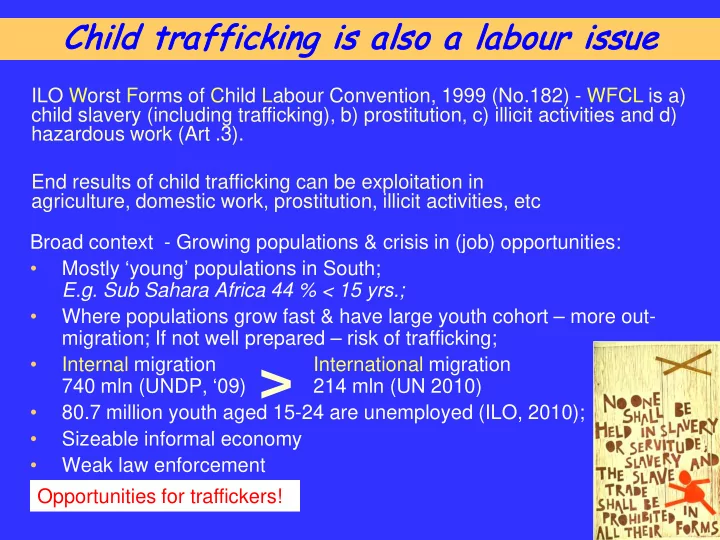
ILO Worst Forms of Child Labour Convention, 1999 (No.182) - WFCL is a) child slavery (including trafficking), b) prostitution, c) illicit activities and d) hazardous work (Art .3). End results of child trafficking can be exploitation in agriculture, domestic work, prostitution, illicit activities, etc

>

Opportunities for traffickers!

slide-2
SLIDE 2

Global estim timate te of f size ize of f pr problem

  • Better
  • sampling techniques
  • design of questionnaire
  • indicators of exploitation and coercion;

Ways forward for national estimation:

  • HH-based surveys at source to capture returnees;
  • HH-based surveys at destination to capture victims;
  • Establishment based surveys where possible;
  • Triangulation + avoid double counting.

ILO, 2005: 2.45 million persons in forced labour as a result of trafficking (‘stock’, not ‘flow’; Capture – recapture method); 40 to 50% is children under 18;

Progr gress in m in measur urement nt te techniq nique ues fo for na natio tiona nal e estim timate tes

Political will crucial

slide-3
SLIDE 3

Micro level Macro level

  • 4. Community

risks at source

  • 3. Family risk

factors

  • 5. Workplace risks

at destination

  • 1. External & institutional risk factors

Recruiters Intermediaries Employers Clients In Transit 2.Individual risk factors Vulnerable child At Source At Destination Distant relative

Ris isk fa facto tors & & vul vulne nerabil ility ity a at m t many ny leve vels

slide-4
SLIDE 4

Safe fe(r (r) m ) migr igratio tion… n…

Policies and services at source (prior to departure)

  • To postpone migration: education and youth employment;
  • Access to cheap credit;
  • Pre-departure orientation, including life skills training;
  • Licensed and monitored recruitment agencies;
  • Hold recruitment agencies liable for exploitation if employer

cannot be charged. Policies and services (in transit)

  • Trained police and workers in the transport sector monitor

trafficking;

  • Information services on trains/busses/ferries & at stations;
  • Link between sending & receiving area;
  • Functioning hotline services - trained staff &

referral services. Law enforcement against traffickers is crucial. Other options include:

slide-5
SLIDE 5

…f …for d r dece cent w work* rk*

Policies and services at destination (and in workplace)

  • Apply minimum employment age;
  • Extend the reach of labour law & regulate the informal economy;
  • Improved labour inspection;
  • Complaints & settlement mechanisms;
  • Punish exploiters & hurt them in pocket;
  • Drop-in centers that offer information, counseling,

legal assistance, NFE. * for youth of working age (i.e. 15) Also engage actors beyond government:

  • Address public indifference to exploitation;
  • Youth empowerment and self protection;
  • Engage the business community;
  • Youth able to join or associate with trade unions;
  • Universities!

http://www.ilo.org/ipec/areas/Traffickingofchildren/lang--en/index.htm

For more please contact: Hans van de Glind at vandeglind@ilo.org or visit: