Interdisciplinarity, Ecosystem Services and Resilience: Exploring - - PowerPoint PPT Presentation

interdisciplinarity ecosystem services and resilience
SMART_READER_LITE
LIVE PREVIEW

Interdisciplinarity, Ecosystem Services and Resilience: Exploring - - PowerPoint PPT Presentation

S c h o o l o f G e o g r a p h y , G e o l o g y a n d t h e E n v i r o n m e n t Interdisciplinarity, Ecosystem Services and Resilience: Exploring Peatland Futures Dr Caroline Upton (cu5@le.ac.uk) Focus on challenge led and


slide-1
SLIDE 1

Dr Caroline Upton (cu5@le.ac.uk)

S c h o o l o f G e o g r a p h y , G e o l o g y a n d t h e E n v i r o n m e n t
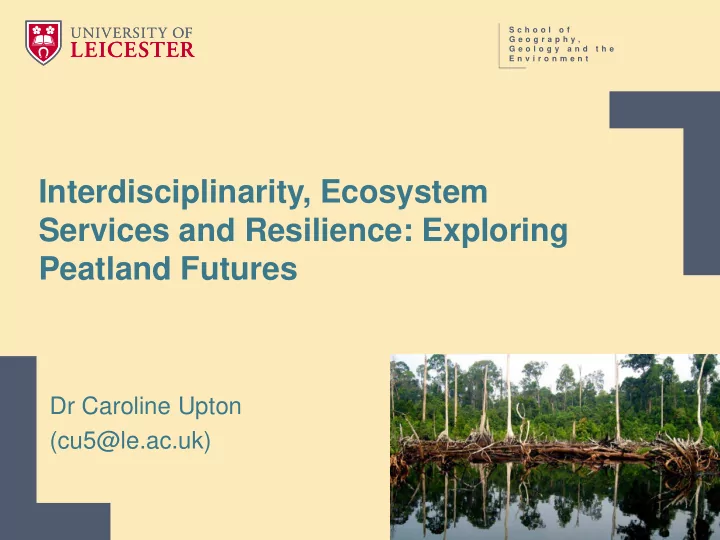
Interdisciplinarity, Ecosystem Services and Resilience: Exploring Peatland Futures

slide-2
SLIDE 2
slide-3
SLIDE 3

Focus on ‘challenge led and interdisciplinary research’ for

  • innovation
  • policy impact
slide-4
SLIDE 4

if you dream, as some of you, I doubt not, have a right to dream, of future discoveries and inventions, let me tell you that the fertile field of discovery lies for the most part on those borderlands where one science meets another… Try also to understand that though the sciences are defined from one another in books, there runs through them all what philosophers used to call the commune vinculum, a golden interweaving link, to their mutual support and interpretation………. (D’Arcy, 1903)

slide-5
SLIDE 5

GCRF ‘Building Resilience’ theme:

Project: ‘Resilient Pastoralism: Towards Sustainable Futures in Rangelands’ (NE/P01626X/1)

  • International: UK, Kenya, Mongolia (UOL PI: Upton)
  • Interdisciplinary:

– Remote sensors – Human Geographers – Anthropologists – Animal Scientists – Economists – Ecologists Explicit incorporation of arts and humanities…

slide-6
SLIDE 6

‘Resilient Pastoralism’ (RP) project Key questions:

  • What are diverse stakeholder/ cultural meanings of

environmental change and resilience?

  • What information requirements do stakeholders have .. that

would help them build locally meaningful and culturally appropriate forms of resilience to both short and long term shocks?

  • To what extent have previous projects/ donor initiatives

delivered these & been taken up by local stakeholders and policy makers? What are the barriers to uptake?

  • How can new datasets and innovative methods & approaches

be used to develop richer understandings of resilience & facilitate uptake?

  • How can these lessons be scaled up?
slide-7
SLIDE 7

RP Methods and Approaches

slide-8
SLIDE 8
  • Production and co-analysis of Remote Sensing (RS) data

products

  • Key Informant Interviews,

– Local Households – Policy and NGO Communities

  • Focus Group Discussions (FGDs), incl. analyses of

Remote Sensing data products

  • ‘Resilience Stories’
  • PhotoVoice
slide-9
SLIDE 9

PhotoVoice

Goals:

  • Recording and reflecting communities’/

individual’s concerns;

  • Promotion of critical dialogue through discussion
  • f images;
  • Policy engagement and impact- through creating,

defining, utilising images.. (Pearce et al., 2017)

slide-10
SLIDE 10

RP Policy Issues and Impact

  • Mapping specific policies & points of

engagement

  • Ongoing multi-stakeholder engagement through

workshops

  • ‘splitting apart’ of integrated, interdisciplinary

approaches

slide-11
SLIDE 11

SUSTAINPEAT (BBSRC; 2017-2019)

  • PI Sofie Sjogersten, University of Nottingham
  • Indonesia & Malaysia
  • Smallholder livelihoods & agricultural systems in

peatland environments

  • Oil palm conversion
  • Interdisciplinary
  • More explicit engagement with ES paradigm

– Remaking of the world’ into collection of ES – Cultural ES particularly challenging/ problematic

slide-12
SLIDE 12

Include:

  • Modelling
  • ES valuation (non economic) & ranking: SOLVES
  • Choice modelling
  • Visual methods
  • Coming together through scenario development
  • Exploring actions for policy traction and

engagement

SUSTAINPEAT Methods and Approaches

slide-13
SLIDE 13