Integrating sustainable cattle ranching, forestry and landscape - - PowerPoint PPT Presentation

integrating sustainable cattle ranching forestry and
SMART_READER_LITE
LIVE PREVIEW

Integrating sustainable cattle ranching, forestry and landscape - - PowerPoint PPT Presentation

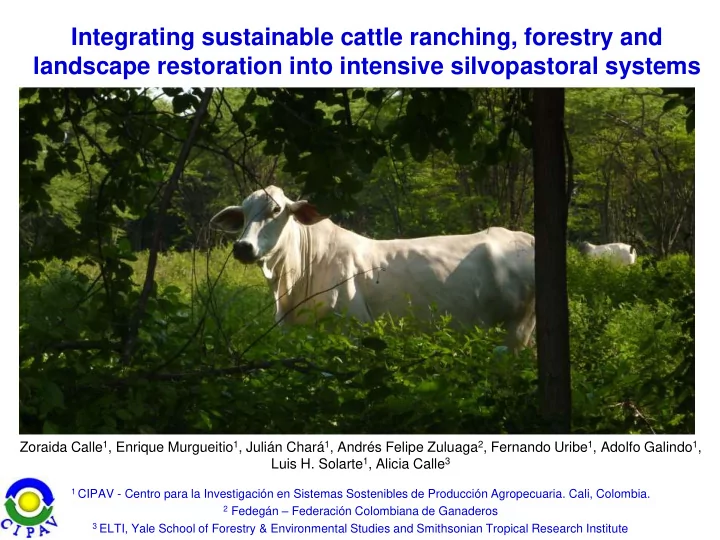
Integrating sustainable cattle ranching, forestry and landscape restoration into intensive silvopastoral systems Zoraida Calle 1 , Enrique Murgueitio 1 , Julin Char 1 , Andrs Felipe Zuluaga 2 , Fernando Uribe 1 , Adolfo Galindo 1 , Luis H.


slide-1
SLIDE 1

Zoraida Calle1, Enrique Murgueitio1, Julián Chará1, Andrés Felipe Zuluaga2, Fernando Uribe1, Adolfo Galindo1, Luis H. Solarte1, Alicia Calle3

1 CIPAV - Centro para la Investigación en Sistemas Sostenibles de Producción Agropecuaria. Cali, Colombia. 2 Fedegán – Federación Colombiana de Ganaderos 3 ELTI, Yale School of Forestry & Environmental Studies and Smithsonian Tropical Research Institute

Integrating sustainable cattle ranching, forestry and landscape restoration into intensive silvopastoral systems

slide-2
SLIDE 2

Cattle ranching often involves a very low density of cattle grazing in degraded pastures that resemble biological deserts.

FAO, 2006, 2009; Steinfeld et al., 2006; Boucher et al., 2012

slide-3
SLIDE 3

550 million hectares in Latin America

FAO, 2002; IGAC 2002

Cattle ranching is the main current land use

458,4 550,1 100 200 300 400 500 600

1961 2007 Land area (million ha)

Area occupied by pastures in LA & C

In Latin America, cattle ranching activities have expanded mostly at the expense of forests.

slide-4
SLIDE 4

Cattle ranching, a leading driver of:

Land use change is the main cause of biodiversity loss

(Millenium Ecosystem Assessment, 2005)

Greenhouse gas emissions that contribute to climate change

(Steinfeld et al., 2006)

Altered water cycles:

  • Reduced infiltration and water storage
  • Increased runoff

(Ward & Robinson, 2000)

Land degradation: a loss of potential resources through:

  • Soil erosion
  • Deterioration of the physical,

chemical and biological soil properties

  • Deforestation and long term

loss of natural vegetation

(Steinfeld et al., 2006)

The livestock sector: a leading driver of deforestation, land degradation, pollution, climate change, the sedimentation of coastal areas and invasions by alien species (FAO and LEAD, 2006)

slide-5
SLIDE 5
  • Average annual per

hectare stocking rate: 0.59 animals

  • Average annual per

hectare productivity:

– 19.9 kg of beef – 89.7 L of milk

Land use efficiency?

  • Minimum animal loads
  • Low per animal and per hectare production

indexes

  • Meager contributions to rural employment

Los Santos province, Arco Seco region, Panama

Photo: Fernando Uribe

FAO, 2006

slide-6
SLIDE 6

Cattle ranching can be:

  • Conventionally managed in treeless

pastures: a driver of ecosystem degradation

  • Sustainably managed with silvopastoral

systems: Tool for rehabilitating degraded lands.

  • Silvopastoral systems integrated with

connectivity corridors and protected areas: Part of a strategy for the ecological restoration of agricultural landscapes.

slide-7
SLIDE 7

1. A large and growing demand exists for all cattle products. 2. This activity is deeply rooted in the Spanish and Portuguese ancestry of the region. 3. It has often been a reaction to agricultural failures that result from biophysical constraints 4. It has become instrumental as a means to consolidate land control.

Cattle ranching is not likely to decline any time soon in Latin America!

slide-8
SLIDE 8

Environmental transformation of livestock production: a priority for Latin America

Cattle production needs to shift from its current path of degradation of the natural and social capitals, onto one which generates goods (milk, meat, and timber) while maintaining some ecosystem attributes and services.

slide-9
SLIDE 9

This change should consist of 4 basic elements:

  • 1. Increasing plant

biomass and diversity

  • 2. Curbing soil

degradation and promoting its recovery

  • 3. Protecting water

sources and using them rationally

  • 4. Increasing animal

productivity on a per hectare basis.

slide-10
SLIDE 10

Rehabilitation of cattle ranching lands must:

  • 1. Increase productivity and profitability of

the production system

  • 2. Enhance the generation of

environmental goods and services.

  • 3. Facilitate the

release of fragile, marginal and strategic areas for ecological restoration.

slide-11
SLIDE 11

Silvopastoral Systems - SPS

  • Agroforestry

arrangements that combine fodder plants, such as grasses and leguminous herbs, with shrubs and trees for animal nutrition and complementary uses.

Pezo & Ibrahim, 1998; Harvey 2004

slide-12
SLIDE 12

Four silvopastoral systems

Mixed fodder bank (cut-and-carry system) Living fence Scattered trees in pastureland Intensive silvopastoral system

slide-13
SLIDE 13

Intensive silvopastoral system ISS

A system that can be directly grazed by livestock. It combines:

Murgueitio et al., 2011

Fodder shrubs planted at high densities (>10,000 plants ha-1), intercropped with Highly-productive pastures 500 timber trees planted in east- west lines to minimize shading.

slide-14
SLIDE 14

What is intensive about ISS?

Efficiency of biological processes:

Photosynthesis & biomass production Nitrogen fixation Solubilization of soil phosphorus and

  • ther nutrients

Organic matter and soil biological activity The “inputs” of the system are the natural processes themselves

slide-15
SLIDE 15

The key to successful ISS is the adequate selection of the species, particularly the fodder shrub that is the backbone of the system.

Two species have shown the best results:

  • Mexican sunflower Tithonia diversifolia Helms
  • and in particular leucaena Leucaena leucocephala (Lam.) de Wit
slide-16
SLIDE 16
  • Efficient nitrogen fixer that

makes N readily available to neighboring plants.

  • Associates well with grasses.
  • Avidly consumed by cattle but

elastic enough to withstand repeated browsing

  • Regrows rapidly and vigorously
  • Conserves soil moisture and

extracts nutrients from deep layers not available to other legumes

  • Litter decomposes rapidly.
  • Provides much higher levels of

energy, protein and minerals than do improved grasses.

Leucaena leucocephala (Lam.) de Wit

Well adapted to periodic cattle browsing

Shelton & Brewbaker, 1994; Hughes, 1998; Calle et al., 2011

slide-17
SLIDE 17

Lucerna Farm, Bugalagrande, Valle del Cauca, Colombia

Lucerna Farm 1990 Star grass monoculture 2011 Intensive SPS (30.000 Leucaena ha-1) Chemical fertilizer 450-500 kg urea ha-1 yr-1 No fertilizer! Animal load 3.5 cows ha-1 4.5 cows ha-1 Milk production 9000 L ha-1 yr-1 15.000 L ha-1 yr-1

slide-18
SLIDE 18

Maximum biomass production is not achieved in treeless grass monocultures but in agroforests combining pastures, trees and shrubs.

Shifting paradigm in tropical cattle ranching

slide-19
SLIDE 19

Alcala Ulloa La Tebaida Circasia

Regional Integrated Silvopastoral Approaches to Ecosystem Management (RISAEM) Project, 2002-2007 La Vieja river basin, Colombia

  • 20-24°C
  • 990 - 1800 m.a.s.l.

Calarcá

slide-20
SLIDE 20

68,860 individuals; 232 ant species

Foto: C. Gallego

Ant species richness at La Vieja landscape

Ant species

Rivera, Armbrecht & Calle (submitted to Agr. Ecosys. & Env.) 110 113 105 109 85 82 53 17 10 9 6 11 7 2 50 100 150 Forest SPS Fruit trees Living fence Bamboo forest ISPS Treeless pasture Non exclusive species Exclusive ant species

slide-21
SLIDE 21
  • 4,02

18,91 41,84 64,76 87,69

Cobertura vegetal

52,45 71,98 91,50 111,03 130,55

Riqueza SPS Forest Intensive SPS Treeless pasture * Spearman ρ = 0.75, N=7, p<0.005

Tree cover vs. ant species richness

Tree cover (%) Ant species richness

Bamboo forest

slide-22
SLIDE 22

Biodiversity Vegetation

Calle A, Montagnini & Zuluaga, 2009

71% 54% 36% 32% 21% 11% 54% 50% 50% 25% 21% 14%

10 20 30 40 50 60 70 80

Dramatic increase in bird abundance Increased plant and animal diversity More sightings of small wild mammals in pastures More sightings of animals in forests and riparian corridors Enhanced pest control resulting from higher biodiversity Increased sightings of endangered or rare species Higher tree diversity Increased tree regeneration in pastures Increased use of native species for reforestation Increaed regeneration of rare species More variety of plant species for animal nutrition Reduced pressure on forests

RISAEM Project Farmers’ perceptions on the benefits of the adopted silvopastoral systems

slide-23
SLIDE 23

Silvopastoral systems as a landscape matrix at El Chaco Farm, Piedras, Tolima

Riparian buffer and secondary forest Silvopastoral matrix Silvopastoral matrix Rice monoculture matrix

Rice monoculture matrix

slide-24
SLIDE 24

Silvopastures enhance landscape connectivity

2011

slide-25
SLIDE 25

Mainstreaming Biodiversity into Sustainable Cattle Ranching Project

Ganadería Colombiana Sostenible

slide-26
SLIDE 26

Connectivity corridors – MBSCR Project

Core strip (10 m wide) Buffer strips (25 m wide)

  • Natural ecosystem fragments
  • Forest restoration

Only farmers that commit to strict conservation receive payment

  • Natural ecosystem fragments
  • Scattered trees
  • Intensive silvopastoral systems
  • Live fences
  • Wind breaks

Payment for land uses sufficiently compatible with conservation

slide-27
SLIDE 27

Reference agroecosystem:

.

Silvopastoral systems at El Hatico reserve

El Cerrito, Valle del Cauca, Colombia

Pioneered the use of silvopastoral systems in Colombia in the 1970s.

slide-28
SLIDE 28

Transformation of a conventional farm

1970s:

  • Low tree cover: < 10 trees ha-1
  • Herbicides, irrigation and

chemical fertilizers Currently:

  • 70 tree species in

silvopastures

  • Certified organic milk
slide-29
SLIDE 29

5 plant strata

Creeping grass cover Cynodon plestostachys, Panicum maximum, Cynodon dactylon and Paspalum notatum Leucaena 10.000-15.000 shrubs ha-1 Medium sized trees Prosopis juliflora, Senna spectabilis, Guazuma ulmifolia, Guarea guidonia, 30-50 ha-1 Large trees Ceiba pentandra, Samanea saman, Enterolobium cyclocarpum at low density Palms Syagrus zancona, Attalea butyracea, and Roystonea regia and timber trees Swietenia macrophylla, Cedrela odorata, Zanthoxylum rhoifolium.

Silvopastoral systems: a complex and wildlife-friendly matrix

slide-30
SLIDE 30

Change in milk production and its relation to the expansion of intensive silvopastoral systems at El Hatico reserve

7436 8298 9770 11684 17026 16798 18290 18486

10 20 30 40 50 60 70 80 90 100

4000 8000 12000 16000 20000

1996 1997 1998 1999 2000 2001 2002 2003

Litros/Ha. Hectáreas Con Leucaena Hectáreas Sin Leucaena Area Total

Milk production L ha-1 yr-1 El Hatico, 2003

# Cows 299 286 259 266 230 Animal load 3.35 3.21 2.91 3.74 4.50 304 4.82 259 5.22 244 5.04

Area (Ha)

slide-31
SLIDE 31

7.436 18.486

5000 10000 15000 20000

1996 2003

Litros ha-1 año-1

Milk production

2,5 4,1

0,5 1 1,5 2 2,5 3 3,5 4 4,5

1996 2003

Ton MS ha-1 año-1

Protein

56.876 70.222

20000 40000 60000 80000

1996 2003

Mcal ha-1 año-1

Metabolizable energy

20 40 60 80 100 120 140 160

1996 2003

kg ha-1 año-1

Calcium

More milk, higher quality

slide-32
SLIDE 32

2 4 6 8 10 12 14 50 100 150 200 250 300

Rainfall (mm month-1) Average daily milk production

Monthly rainfall (mm) Daily milk production cow-1 2008 2009 2010 El Niño

La Niña

2011 2012 El Niño

Milk production at El Hatico farm (2008-2012)

slide-33
SLIDE 33

4,9 4,6 4,4 4,3 3,7 3,4 3,6 2,9 1 2 3 4 5 6

ISPS (< 5 yrs) ISPS (5-10 yrs) ISPS (>10 yrs) treeless pasture forest

Organic matter (%) under tree crown pasture

Vallejo 2012, El Hatico

Soil organic matter (%) in ISPS, conventional pasture and forest at El Hatico

Baseline (1994) 2010-2012

slide-34
SLIDE 34

Caribbean region Rainfall: 1000-1200 mm Monomodal regime, few rain events

Lands degraded by cotton monoculture Rehabilitation with silvopastoral systems

Cesar river valley, Colombia

slide-35
SLIDE 35

Biomass production January, 2006 August, 2006 First grazing April 2006 January 2007 Animal body condition Carrying capacity and productivity

1.2 large animals 1.7 L milk cow-1 day-1 5.1 large animals 4.1 L milk cow-1 day-1

slide-36
SLIDE 36

Land area required to produce 1 ton

  • f beef yr-1 in the dry Caribbean

region of Colombia (ha)

14.8 3 1.1

2 4 6 8 10 12 14 16 Conventional pasture Improved Pasture Intensive SPS

Land area (hectares)

“Improved pastures” are conventionally managed with herbicides, irrigation and chemical fertilizers

slide-37
SLIDE 37

Temperature variation in treeless pastures and intensive silvopastoral systems ISPS during the driest months of 2007 in the Colombian dry Caribbean region

Lopera, Cuartas & Murgueitio, 2008

34 41 20,7 28,3 35,4 40,9 21 28,1 36,3 40,5 23,3 25,7 20 25 30 35 40 45 min max min max min max min max min max min max Treeles pasture ISPS Treeles pasture ISPS Treeles pasture ISPS January February March Temperature (°C)

Climate change adaptation: Silvopastoral systems are 12°C cooler!

US$2 billion: estimated cost of the lack of shade in US cattle production (heat stress).

slide-38
SLIDE 38

A win-win situation The productive advantages that make SPS attractive for landowners ultimately

  • riginate from the

environmental benefits they provide.

slide-39
SLIDE 39

Silvopastoral system with Cordia gerascasthus

slide-40
SLIDE 40
  • Collected only 8 times since 1856
  • Endemic and highly vulnerable
  • Excellent performance in

silvopastoral systems

Outstanding native tree: Mimosa trianae Benth

slide-41
SLIDE 41

Caryodendron orinocense H. Karst. Euphorbiaceae

The Colombian nut: inchi or cacay

slide-42
SLIDE 42

Caesalpinia ebano FABACEAE

EN; Endemic from Colombian Caribbean region

slide-43
SLIDE 43

Mahogany Swietenia macrophylla King

slide-44
SLIDE 44
slide-45
SLIDE 45

In summary, we propose that

  • The mainstreaming of silvopastoral systems in degraded

tropical landscapes can simultaneously address environmental and productive issues, making cattle ranching part of the solution rather than the problem.

slide-46
SLIDE 46

Unasylva 239, vol 63, 2012 Journal of Sustainable Forestry (in press) A Strategy for Scaling-up Intensive Silvopastoral Systems in Colombia

ZORAIDA CALLE1, ENRIQUE MURGUEITIO1, JULIÁN CHARÁ1, CARLOS HERNANDO MOLINA1,

4, ANDRÉS FELIPE ZULUAGA2, ALICIA CALLE3

slide-47
SLIDE 47

¡Gracias!

zoraida@cipav.org.co

Colciencias, Ministerio de Agricultura y Desarrollo Rural (Colombia), TWB, GEF, TNC, Fedegán

Researchers: Inge Armbrecht, Leonardo Rivera (Universidad del Valle); Carlos Hernando Molina and Enrique José Molina (El Hatico and CIPAV); Victoria Vallejo; John Jairo Lopera (CIPAV) Cattle ranchers: Olimpo Montes, Molina Durán family, Roberto Mejía