
WELLESLEY CS 240 9/8/15 1
Integer ¡Representation
Representation ¡of ¡integers: ¡unsigned ¡and ¡signed Sign ¡extension Arithmetic ¡ and ¡shifting Casting
2
But ¡first, ¡encode ¡deck ¡of ¡cards.
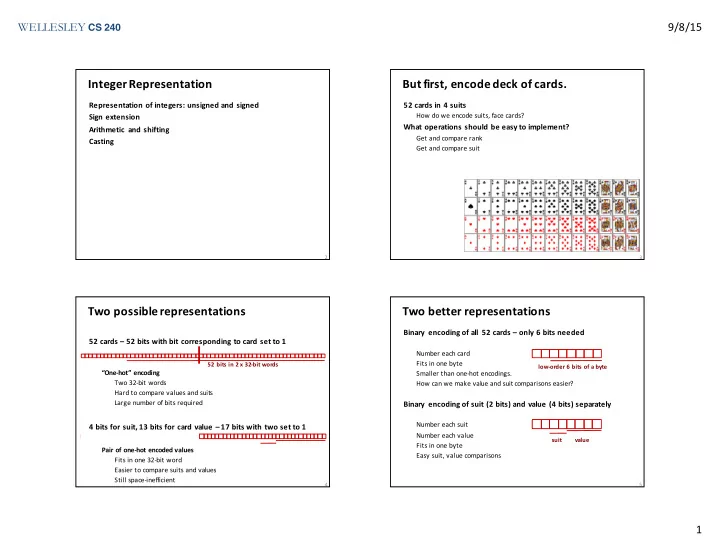
52 ¡cards ¡in ¡4 ¡suits
How ¡do ¡we ¡encode ¡suits, ¡face ¡cards?
What ¡operations ¡should ¡be ¡easy ¡to ¡implement?
Get ¡and ¡compare ¡rank Get ¡and ¡compare ¡suit
3
Two ¡possible ¡representations
52 ¡cards ¡– 52 ¡bits ¡with ¡bit ¡corresponding ¡to ¡card ¡set ¡to ¡1
“One-‑hot” ¡encoding Two ¡32-‑bit ¡words Hard ¡to ¡compare ¡values ¡and ¡suits Large ¡number ¡of ¡bits ¡required
4 ¡bits ¡for ¡suit, ¡13 ¡bits ¡for ¡card ¡value ¡– 17 ¡bits ¡with ¡two ¡set ¡to ¡1
Pair ¡of ¡one-‑hot ¡encoded ¡values Fits ¡in ¡one ¡32-‑bit ¡word Easier ¡to ¡compare ¡suits ¡and ¡values Still ¡space-‑inefficient
4
52 ¡bits ¡in ¡2 ¡x ¡32-‑bit ¡words
Two ¡better ¡representations
Binary ¡ encoding ¡of ¡all ¡ 52 ¡cards ¡– only ¡6 ¡bits ¡needed
Number ¡each ¡card Fits ¡in ¡one ¡byte Smaller ¡than ¡one-‑hot ¡encodings. How ¡can ¡we ¡make ¡value ¡and ¡suit ¡comparisons ¡easier?
Binary ¡ encoding ¡of ¡suit ¡(2 ¡bits) ¡and ¡value ¡(4 ¡bits) ¡separately
Number ¡each ¡suit Number ¡each ¡value Fits ¡in ¡one ¡byte Easy ¡suit, ¡value ¡comparisons
5
low-‑order ¡6 ¡bits ¡of ¡a ¡byte suit value