2 4 0 Integer Representation 100 10 1 weight 10 2 10 1 10 0 - - PowerPoint PPT Presentation

2 4 0
SMART_READER_LITE
LIVE PREVIEW

2 4 0 Integer Representation 100 10 1 weight 10 2 10 1 10 0 - - PowerPoint PPT Presentation

positional number representation Wellesley CS 240 = 2 x 10 2 + 4 x 10 1 + 0 x 10 0 2 4 0 Integer Representation 100 10 1 weight 10 2 10 1 10 0 position 2 1 0 Base determines: Bits, binary numbers, and bytes Fixed-width


slide-1
SLIDE 1

Integer Representation

Bits, binary numbers, and bytes Fixed-width representation of integers: unsigned and signed Modular arithmetic and overflow

1

Wellesley CS 240

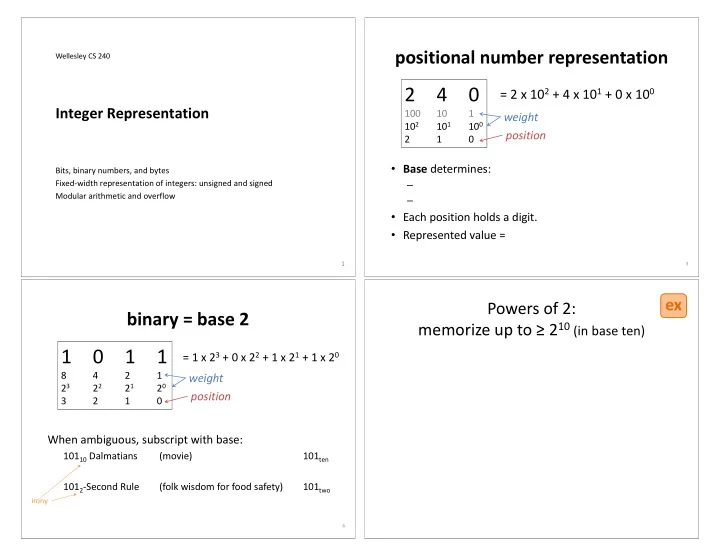
positional number representation

  • Base determines:

– –

  • Each position holds a digit.
  • Represented value =

3

2 4

100 10 1 102 101 100 2 1

= 2 x 10² + 4 x 101 + 0 x 100

position weight

binary = base 2

When ambiguous, subscript with base:

10110 Dalmatians (movie) 101ten 1012-Second Rule (folk wisdom for food safety) 101two

4

1 1 1

8 4 2 1 23 22 21 20 3 2 1

= 1 x 23 + 0 x 22 + 1 x 21 + 1 x 20 position weight

irony

Powers of 2: memorize up to ≥ 210 (in base ten) ex

slide-2
SLIDE 2

conversion and arithmetic

1910 = ?2 10012 = ?10 24010 = ?2 110100112 = ?10 1012 + 10112 = ?2 10010112 x 210 = ?2

7

Show powers, strategies.

ex

byte = 8 bits

Smallest unit of data

used by a typical modern computer

Binary 000000002 -- 111111112 Decimal 00010 -- 25510 Hexadecimal 0016 -- FF16

Programmer’s hex notation (C, etc.): 0xB4 = B416 = B4hex

Octal (base 8) also useful.

Why do 240 students often confuse Halloween and Christmas?

0000 1 1 0001 2 2 0010 3 3 0011 4 4 0100 5 5 0101 6 6 0110 7 7 0111 8 8 1000 9 9 1001 A 10 1010 B 11 1011 C 12 1100 D 13 1101 E 14 1110 F 15 1111

9

What do you call 4 bits? a.k.a. octet

word |wərd|, n.

Natural (fixed size) unit of data used by processor.

– Word size determines:

10 31 30 29 28 27 26 25 24 23 22 21 20 19 18 17 16 15 14 13 12 11 10 9 8 7 6 5 4 3 2 1 0 0 0 0 0 0 0 0 0 1 0 1 0 1 1 1 1 1 0 0 0 0 0 0 0 0 0 1 0 0 0 0 0

MSB: most significant bit LSB: least significant bit

(size in bytes)

Java Data Type C Data Type

32-bit word 64-bit word

boolean 1 1 byte char 1 1 char 2 2 short short int 2 2 int int 4 4 float float 4 4 long int 4 8 double double 8 8 long long long 8 8 long double 8 16

fixed-size data representations

11

Depends on word size

slide-3
SLIDE 3

Fixed-width integer encodings

Unsigned

  • non-negative integers only

Signed

  • both negative and non-negative integers

n bits offer only 2n distinct values. Terminology:

13

0110010110101001

“Most-significant” bit(s)

  • r “high-order” bit(s)

“Least-significant” bit(s)

  • r “low-order” bit(s)

MSB LSB

(4-bit) unsigned integer representation

n-bit unsigned integers: minimum = maximum =

14

1 1 1

8 4 2 1 23 22 21 20 3 2 1

= 1 x 23 + 0 x 22 + 1 x 21 + 1 x 20 position weight

modular arithmetic, overflow

15 0000 0001 0011 1111 1110 1100 1011 1010 1000 0111 0110 0100 0010 0101 1001 1101 1 2 3 4 5 6 7 8 9 10 11 12 13 14 15

unsigned overflow = "wrong" answer = wrap-around

= carry 1 out of MSB = math answer too big to fit

x+y in n-bit unsigned arithmetic is (x + y) mod 2N in math

4-bit unsigned integers

11 + 2 13 + 5

Unsigned addition overflows if and only if a carry bit is dropped.

1011 + 0010 1101 + 0101 sign-magnitude

Most-significant bit (MSB) is sign bit

0 means non-negative 1 means negative

Remaining bits are an unsigned magnitude 8-bit sign-magnitude: Anything weird here?

00000000 represents _____ 01111111 represents _____ 10000101 represents _____ 10000000 represents _____

17

!!!

ex

00000100 +10000011 Arithmetic?

Example: 4 - 3 != 4 + (-3)

Zero?

slide-4
SLIDE 4

(4-bit) two's complement signed integer representation

4-bit two's complement integers:

minimum = maximum =

19

1 1 1

  • 23

22 21 20

= 1 x -23 + 0 x 22 + 1 x 21 + 1 x 20

two’s complement vs. unsigned

20

_ _ …_ _ _

2n-1 2n-2 … 22 21 20

  • 2n-1 2n-2

… 22 21 20 two's complement places unsigned places

What's the difference?

n-bit minimum = n-bit maximum =

8-bit representations

21

1 0 0 0 0 0 0 1 1 1 1 1 1 1 1 1 0 0 0 0 1 0 0 1 0 0 1 0 0 1 1 1

n-bit two's complement numbers: minimum = maximum =

ex

4-bit unsigned vs. 4-bit two’s complement

22 0000 0001 0011 1111 1110 1100 1011 1010 1000 0111 0110 0100 0010 0101 1001 1101 1 2 3 4 5 6 7 8 9 10 11 12 13 14 15 0000 0001 0011 1111 1110 1100 1011 1010 1000 0111 0110 0100 0010 0101 1001 1101 + 1 + 2 + 3 + 4 + 5 + 6 + 7 – 8 – 7 – 6 – 5 – 4 – 3 – 2 – 1

11

  • 5

difference = ___ = 2___

1 0 1 1

1 x 23 + 0 x 22 + 1 x 21 + 1 x 20 1 x -23 + 0 x 22 + 1 x 21 + 1 x 20

4-bit unsigned 4-bit two's complement

slide-5
SLIDE 5

two’s complement addition

23 0000 0001 0011 1111 1110 1100 1011 1010 1000 0111 0110 0100 0010 0101 1001 1101 + 1 + 2 + 3 + 4 + 5 + 6 + 7 – 8 – 7 – 6 – 5 – 4 – 3 – 2 – 1

2 + 3 0010 + 0011

Modular Arithmetic

  • 2

+ 3 1110 + 0011

  • 2

+ -3 1110 + 1101 2 + -3 0010 + 1101 two’s complement overflow

24 0000 0001 0011 1111 1110 1100 1011 1010 1000 0111 0110 0100 0010 0101 1001 1101 + 1 + 2 + 3 + 4 + 5 + 6 + 7 – 8 – 7 – 6 – 5 – 4 – 3 – 2 – 1

6 + 3 0110 + 0011 Modular Arithmetic

  • 1

+ 2 1111 + 0010

Addition overflows if and only if the arguments have the same sign but the result does not. if and only if the carry in and carry out of the sign bit differ.

Some CPUs/languages raise exceptions on overflow. C and Java cruise along silently... Feature? Oops?

A few reasons two’s complement is awesome

Addition, subtraction, hardware Sign Negative one Complement rules

Another derivation

How should we represent 8-bit negatives?

  • For all positive integers x, x and –x should sum to zero.
  • Use the standard addition algorithm.

00000001 00000010 00000011 + + + 00000000 00000000 00000000

  • Find a rule to represent –x where that works…

27

ex