Instructional Cycle FOR DISCUSSION 1. BUILD UNIT by identifying - - PowerPoint PPT Presentation

instructional cycle
SMART_READER_LITE
LIVE PREVIEW

Instructional Cycle FOR DISCUSSION 1. BUILD UNIT by identifying - - PowerPoint PPT Presentation

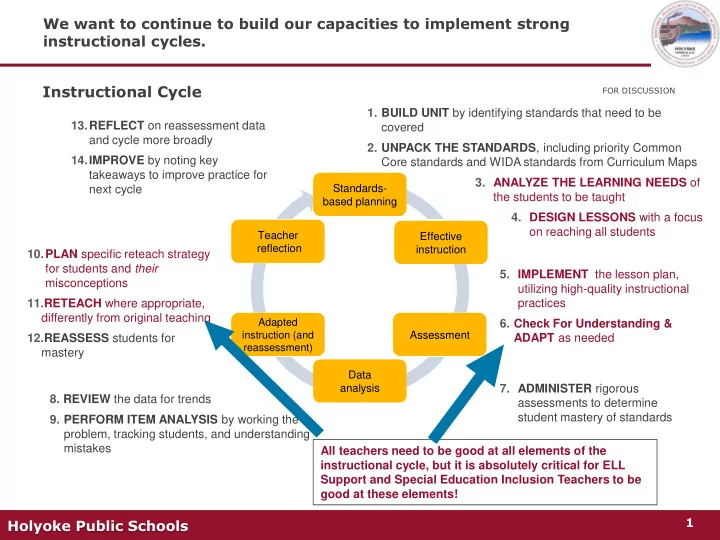
We want to continue to build our capacities to implement strong instructional cycles. Instructional Cycle FOR DISCUSSION 1. BUILD UNIT by identifying standards that need to be 13.REFLECT on reassessment data covered and cycle more broadly 2.


slide-1
SLIDE 1

Holyoke Public Schools

1

We want to continue to build our capacities to implement strong instructional cycles. Instructional Cycle

FOR DISCUSSION

Standards- based planning Effective instruction Assessment Data analysis Adapted instruction (and reassessment) Teacher reflection

  • 1. BUILD UNIT by identifying standards that need to be

covered

  • 2. UNPACK THE STANDARDS, including priority Common

Core standards and WIDA standards from Curriculum Maps

  • 3. ANALYZE THE LEARNING NEEDS of

the students to be taught

  • 4. DESIGN LESSONS with a focus
  • n reaching all students
  • 7. ADMINISTER rigorous

assessments to determine student mastery of standards 10.PLAN specific reteach strategy for students and their misconceptions 11.RETEACH where appropriate, differently from original teaching 12.REASSESS students for mastery

  • 8. REVIEW the data for trends
  • 9. PERFORM ITEM ANALYSIS by working the

problem, tracking students, and understanding mistakes 13.REFLECT on reassessment data and cycle more broadly 14.IMPROVE by noting key takeaways to improve practice for next cycle

Standards- based planning Effective instruction Data analysis Adapted instruction (and reassessment) Teacher reflection Assessment

  • 5. IMPLEMENT the lesson plan,

utilizing high-quality instructional practices

  • 6. Check For Understanding &

ADAPT as needed All teachers need to be good at all elements of the instructional cycle, but it is absolutely critical for ELL Support and Special Education Inclusion Teachers to be good at these elements!

slide-2
SLIDE 2

Holyoke Public Schools

2

Equal access Mastering core academic standards Proficiency

We need a shared understanding of the purpose of ELL and Special Education Services.

The point of providing ELL and Special Education services is to ensure equal access to meaningful educational

  • pportunities for all

students. The way we know our students have accessed meaningful educational

  • pportunities is when they

master core academic standards, as measured by achieving proficiency on state assessments. So the most critical purpose of ELL and Special Education teachers is to provide ELLs and Students With Disabilities (SWDs) the instruction and services/supports they need to become proficient readers (or make progress toward proficiency).

slide-3
SLIDE 3

Holyoke Public Schools

3

Too much of our current thinking about ELL supports and Special Ed inclusion is focused more on adult inputs than student outcomes. The logic of an input-based approach

Identify approaches and programs to be used with students (e.g., push-in/pull-out, Lindamood Bell, Word Generation, etc.) Teacher set basically a static schedule and provide services according to a schedule. Everyone hopes that student

  • utcomes

improve.

slide-4
SLIDE 4

Holyoke Public Schools

4

The ELL or inclusion teacher:

  • Constantly tracks each

student’s assessment results

  • Identifies which students

are/aren’t making progress

  • Identifies needed changes in

instruction of students not making progress The ELL or inclusion teacher:

  • Provides direct services

targeted to address each student’s needs based on analysis of assessment results The ELL or inclusion teacher:

  • Proactively engages the

classroom teachers to make sure students in their caseloads get what they need during regular instruction (i.e., the “whatever it takes” approach” We need to move to an approach where teachers plan and adapt flexibly based on a relentless focus on student outcomes.

The logic of an outcomes-based approach

FOR DISCUSSION

Use data frequently to monitor student progress Provide targeted student support Proactively work with classroom teachers to meet student needs Student Outcomes

slide-5
SLIDE 5

Holyoke Public Schools

5

The caseload model is a specific way of implementing an outcomes approach to ELL and Inclusion instruction. Features of the

caseload approach

Features

Know their caseload

Strong sense

  • f

responsibility and urgency

Track assessment results Use all available resources Know the curriculum scope and sequence Share strategies & practices needed to differentiate and scaffold instruction

Deliver effective and efficient Specialized Services

  • Manageable workload
  • Targeted services to

address disability related needs

  • Monitored progress

Case Manager Responsibilities

  • Attend all Team meetings
  • Ensure progress reports are

completed, printed and provided to the team leader, and home room teacher of each student no later than the day report cards are sent home to parents.

  • Provide summaries of the needs
  • f the students on their caseload

to general education teachers Among others… Service Models

  • Consult
  • Push-in
  • Pull-out
  • Co-teach
  • Carry over into regular

education and home

slide-6
SLIDE 6

Holyoke Public Schools

6

ELL and Inclusion teachers need tools in order to implement a caseload approach. Sample student progress tracker

Student IEP? (Y/N) ELL Level Based on data, is the student making significant progress toward proficiency in ELA and Math (Y/N)? And how am I supporting this student to progress toward proficiency? September – December January – March April - June

Holyoke Public Schools Caseload Teacher—Student Progress Tracker

Teacher: School: Teacher Type (ELL or Special Ed): Grade Levels supported:

A big emphasis

  • n looking at

student work!

slide-7
SLIDE 7

Holyoke Public Schools

7

While there are many similarities between Special Education teachers and ESL teachers, there are some distinctions.

  • Clear and specific specialist schedules
  • Clear and specific data reflecting student performance

 Examples of completed and corrected student work given by specialist  Specialist ‘grade book’  Progress reports that reflect student performance data English as a Second Language Teacher Expectations: Special Education Teacher Expectations:  Clear and specific paraprofessional binders  Clear and specific IEP goals and

  • bjectives

 Clear and specific plans to address each domain of language learning