
SLIDE 1
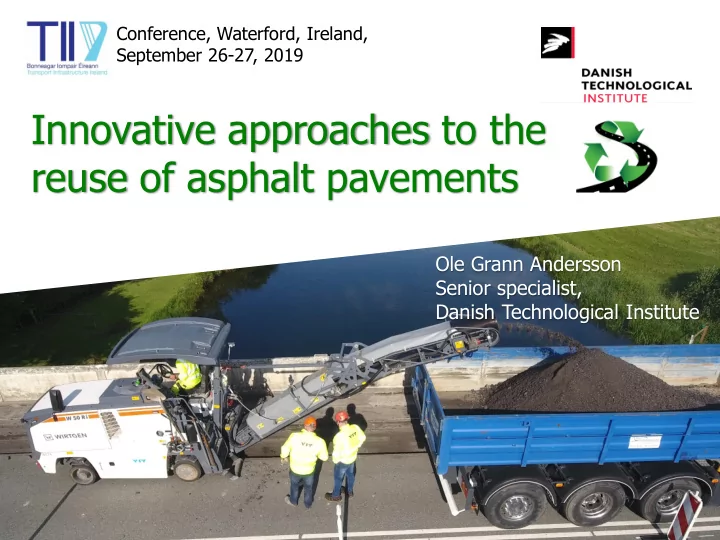
Innovative approaches to the reuse of asphalt pavements
Conference, Waterford, Ireland, September 26-27, 2019
Ole Grann Andersson Senior specialist, Danish Technological Institute
Innovative approaches to the reuse of asphalt pavements Ole Grann - - PowerPoint PPT Presentation
Conference, Waterford, Ireland, September 26-27, 2019 Innovative approaches to the reuse of asphalt pavements Ole Grann Andersson Senior specialist, Danish Technological Institute TII Waterford 2019 Reuse of asphalt Why more focus on
Conference, Waterford, Ireland, September 26-27, 2019
Ole Grann Andersson Senior specialist, Danish Technological Institute
TII Waterford 2019 – Reuse of asphalt
TII Waterford 2019 – Reuse of asphalt
▪ Old hardened bitumen ‘refreshed’ with new soft bitumen/rejuvenator ▪ Aggregates in RAP similar to aggregates in new ▪ Thus: Reuse RAP in new hot-mix asphalt – Higher value than to reuse as gravel or land fill (where the binder is not reused) ▪ RAP is a valuable resource – not waste!
AGGREGATES BITUMEN ASPHALT
100%
TII Waterford 2019 – Reuse of asphalt
▪ EU waste directive:
▪ Strive to avoid waste and deposit. ▪ Recycle rather than reuse or deposit ▪ Use at highest level of value chain! (here: asphalt wearing course) ▪ Everyone – Road owners, consultants, producers/contractors are all responsible to allow more recycling/reuse
▪ Product standards for asphalt (EN 13108-series): RAP is fully approved as constituent material
TII Waterford 2019 – Reuse of asphalt
▪ Good experience with RAP in asphalt base courses since 1980’es – Practical approach DK: No specified limitations, as long as the finished product fulfils same requirements as virgin asphalt ▪ Dense graded AC wearing courses: < 30% RAP* ▪ SMA and opengraded AC: < 15% RAP* ▪ ABB binder course for heavy traffic: 0% RAP *) however seldomly accepted by DRD and road owners
(project start 2015)
TII Waterford 2019 – Reuse of asphalt
Clear potential for more recycling in asphalt wearing courses! Especially SMA, but also ABB binder courses
ASPHALT PRODUCTION 2014 2015 2016 Total production, tons 3.720.000 3.720.000 3.820.000 RAP in % of total 19% 18% 20% Base courses, tons 1.960.000 1.820.000 1.920.000 RAP in % of base courses 29% 29% 30% Wearing courses, tons 1.760.000 1.900.000 1.900.000 RAP in % of wearing courses, t 8% 8% 10%
TII Waterford 2019 – Reuse of asphalt
▪ R&D project carried out 2015 – 2018 ▪ Supported by Danish Environmental Protection Agency ▪ Project budget: 800.000 Euro. ▪ Project partners from across the road sector:
▪ YIT Denmark A/S (Asphalt contractor) ▪ Danish Road Directorate ▪ KL (Union of Danish municipalities) ▪ Danish Asphalt Industry ▪ Danish Technological Institute (project management)
MUDP-Projekt
TII Waterford 2019 – Reuse of asphalt
▪ More sustainable asphalt production: Higher content of reclaimed asphalt in the asphalt production. ▪ Environmental benefit: Reduced CO2-emission – less global warming ▪ Socio-economic benefit: Reduced import of aggregates and bitumen ▪ Quality: Same quality and durability as virgin asphalt is a must! ▪ Implementation: DRD specifications to be revised accordingly
TII Waterford 2019 – Reuse of asphalt
Local gravel Crushed rock Base courses Wearing courses
TII Waterford 2019 – Reuse of asphalt
▪ Mill off and store wearing course RAP separately - Do not mix with base ▪ Keep wearing course RAP from large milling jobs seperately (smaller quantities in a ‘mixed wearing course’ RAP stockpile) ▪ Special, fine milling (extra milling ‘teeth’) will cause too much fines
TII Waterford 2019 – Reuse of asphalt
▪ Store RAP at asphalt plants according to DEPA regulations (simple) ▪ Keep water content low: Store dry under roof and save energy/CO2 ▪ Asphalt plant modification may be needed ▪ Compensate for hardened RAP binder by use of soft bitumen (or rejuvenator) according to CEN-standards
TII Waterford 2019 – Reuse of asphalt
▪ Very comprehensive laboratory test program carried out. ▪ Tests based on SMA and ABB– both based on crushed rock aggregates ▪ 20-30% RAP from wearing courses added (quantity dep. on grading) ▪ 2 types RAP (SMA-RAP and mixed AC-RAP) + Reference 0% RAP. ▪ Tests including Material stiffness, Rutting resistance, Durability (Fatigue test),Water sensitivity (ITSR, Modified Lottman), binder properties, binder rheology (DSR), FTIR etc. Conclusion: Same values with/without 20-30% RAP from old wearing courses
TII Waterford 2019 – Reuse of asphalt
ABB 16 with 0% and 25% RAP, SMA 11 with 0% and 30% RAP ▪ Same laboratory test values, including durability/fatigue test etc. ▪ Same visual appearance, texture, workability, level of compaction, evenness, skid resistance, CPX noise level etc.
TII Waterford 2019 – Reuse of asphalt
▪ Comprehensive LCA calculations performed ▪ LCA ‘Cradle-to-gate’ used as finished pavement documented to be the same with/without up to 30% RAP from wearing courses ▪ Calculations based on approved models and data (GaBi, ReCiPe) ▪ Basis for model is an asphalt plant in Central Jutland, DK. ▪ Although transport distances may vary the model is evaluated to be very ‘robust’
TII Waterford 2019 – Reuse of asphalt
Environmental impact from production af ABB with 0% and 25% RAP and SMA with 0% and 30% RAP (as motorway demonstration)
For SMA 14% CO2-reduction ~ 0,5% reduction per % RAP
ABB 25% RAP ABB 0% RAP SMA 30% RAP SMA 0% RAP
Effect even larger if environmental impact from RAP ‘harvesting’ (milling) is not included!
Calculated effects on a long row of different environmental aspects such as bio-diversity, ozone depletion, global warming (CO2), etc.
TII Waterford 2019 – Reuse of asphalt
LCA-result, single-score model: In total 22% reduced environmental impact from use of 30% RAP
SMA 0% RAP SMA 30% RAP
Areas of Harm human Harm on Ressources Total score Protection health eco-systems
TII Waterford 2019 – Reuse of asphalt
▪ LCC-calculations (life-cycle-cost) included ▪ Saved import of constituent materials contra local milling/transport works and plant modification costs ▪ Modelling difficult. Resource and production costs etc. are competition- sensitive information. Simple calculation showed 12% savings. ▪ Socio-economic benefit on national trade balance from import savings
TII Waterford 2019 – Reuse of asphalt
✓ Large potential for increased use of RAP in wearing and binder causes. ✓ SMA and ABB: Add up to 30% RAP from wearing courses. Also valid for traditional AC-wearing courses ✓ Same functional properties and same expected durability ✓ 30% RAP in SMA/ABB: 14-22% reduction of CO2 emissions! ✓ Socio-economic benefit: Reduced import of bitumen/rock aggregates ✓ In line with governmental strategy, environmental legislation etc. ✓ Everyone has a responsibility to strive for higher sustainability
TII Waterford 2019 – Reuse of asphalt
TII Waterford 2019 – Reuse of asphalt