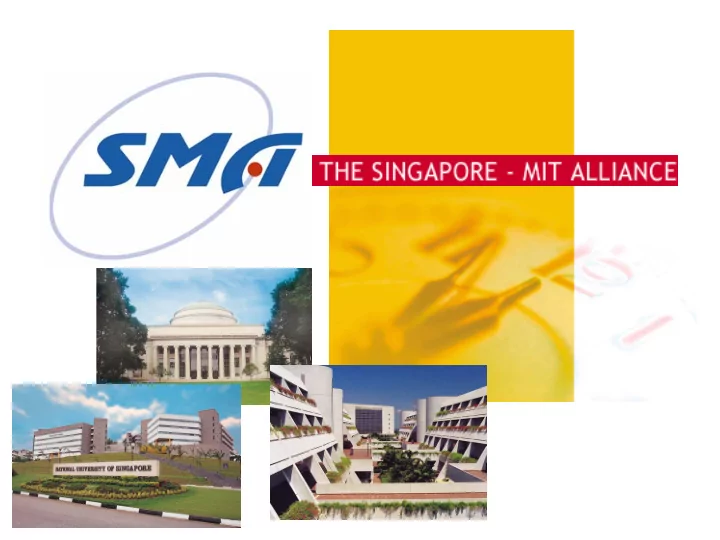
Vision To set a new standard for international collaboration in - - PowerPoint PPT Presentation
Vision To set a new standard for international collaboration in graduate education and research in engineering and science, and in accomplishing this goal, place SMAs programmes at the forefront of graduate education in Asia and the world
Vision To set a new standard for international collaboration in graduate education and research in engineering and science, and in accomplishing this goal, place SMA’s programmes at the forefront of graduate education in Asia and the world
Mission To educate engineering leaders who combine academic excellence in the engineering sciences with the entrepreneurial spirit and a global outlook
Objectives
- Educate young engineers to be the leaders of a
technologically advanced economy which will form the heart of this region’s future
- Create a cohort of excellent students and faculty
with creativity and entrepreneurial spirit
- Develop a nucleus for students and faculty
conversant in global collaborative education and research
Introduction
- Singapore-MIT Alliance (SMA) is a global
partnership between Massachusetts Institute of Technology (MIT), National University of Singapore (NUS) and Nanyang Technological University (NTU)
- Founded in November 1998, SMA is the
world’s largest interactive distance education initiative
- It provides graduate studies leading to:
- Professional Master’s (S.M.) degree
by coursework and project
- Research Doctorate (Ph.D.) degree
by research and coursework
The Programmes
The Five programmes offered by SMA are:
- Advanced Materials for Micro- and
Nano- Systems (AMM&NS)
- High Performance Computation for
Engineered Systems (HPCES)
- Innovation in Manufacturing Systems
and Technology (IMST)
- Molecular Engineering of Biological and
Chemical Systems (MEBCS)
- Computer Science (CS)
Advanced Materials for Micro- and Nano- Systems (AMM&NS)
- Unique and modern in content
- focus on Micro- and Nano-Systems for
microelectronic applications
- encompass processing, microstructure,
properties and performance
- Emphasis in fundamental principles
involving thermodynamics, kinetics, electronic,
- ptical and magnetic properties
- Web-based capabilities for characterisation at a distance
- Additional electives for Ph.D candidates can be chosen
from MIT list of courses Eligibility: Science, Electrical & Electronic Eng, Physics, Chemistry
SEM Image of a Bolometer Pixel
High Performance Computation for High Performance Computation for Engineered Systems (HPCES) Engineered Systems (HPCES)
- Engineering Science and Systems Optimization
- Modeling, Simulation, Design, Optimisation, Visualisation
- Professional Master’s focuses on the critical and effective application
- f existing simulation and optimization software
- Research doctorate emphasizes the formulation, analysis and
implementation of existing and new computational techniques
- Students gain access to state-of-the-art HPC resources at IHPC and work
closely with experienced engineers and scientists Eligibility: Maths, Engineering, Science
- Emphasis on innovation and entrepreneurship
- Couple engineering to business
- Exposure to strategies in global manufacturing
- Pro-seminars by prominent personnel from industry
- To develop understanding in adv manufacturing processes (mfg physics);
supply chain issues (mfg systems); global design approaches and issues (product design); business issues (business fundamentals); strategies and critical issues in global mfg (pro-seminar) and provide valuable practical exposure through theme projects Eligibility: All fields of Engineering, Business
Innovation in Manufacturing Systems & Technology (IMST)
Molecular Engineering of Biological and Chemical Systems (MEBCS)
- Unique, multidisciplinary programme at the cutting edge of Life Science
and Chemical Technologies
- New courses which integrate a molecular-level understanding of
biological and chemical phenomena with advances in process engineering
- Exposure to state-of-the-art concepts in structured
fluids, surface functionalisation, microstructure tailoring and materials design, molecular and cellular aspects of biotechnology, genomics, bioinformatics, proteomics, drug design and delivery
- Graduates are posed to be become leading researchers
and professionals in chemical and life science industries Eligibility: Chemical Eng, Chemistry, Materials Eng
Facilities at the Bioprocessing Technology Centre, NUS
Computer Science (CS)
- Train students to discover and develop new, marketable technology
- Provide solid foundation to enable adaptation
- Web applications and infrastructure
- Embedded systems
- Coursework includes Computer System Engineering, Analysis and
Design of Algorithms, Artificial Intelligence, Database Technology, Pervasive Computing, Research Methodology, Advance Graphics and Theory of Parallel Computation
- Ph.D. students require additional elective at MIT
- Project – either with industry or faculty
- Research (Ph.D.)
Eligibility: Computer Science and related subjects (ECE and Maths)
Candidature
The S.M. degree (Professional Master’s degree)
- Requires one academic year of study
- To read certain number of prescribed subjects
- To participate in an industry or research project for a period of 6
months or 1 year depending on the programme. A dissertation is to be submitted at the end of the academic year.
The Ph.D. degree (Doctor of Philosophy)
- Requires to pass the Ph.D. Qualifying Examination prior to
confirmation of Ph.D. candidature
- To read certain number of prescribed subjects
- Requires completion of original research of high quality in
the form of an acceptable thesis
- Normally, it takes about three to four years to complete
SMA’S Uniqueness
Joint-Teaching & Co-Supervision
- Some 50 professors from MIT and another 50 from NUS, NTU
and the national research institutes (RIs) co-teach the courses and co-supervise the research students
- Lectures are delivered through a combination of
- Face-to-face classroom teaching and
- State-of-the-art interactive distance learning
technology via internet2
- MIT fellows spend up to a semester in Singapore each year
to conduct classes and research
SMA’s Uniqueness
Immersion Programme – The MIT Experience
- All SMA students spend two and a half weeks
at MIT for Immersion.
- A series of entrepreneurship seminars is
delivered by Chief Executive Officers and founders of start-up companies
- Attend classes held at MIT’s campus
Semester-Stay
- Ph.D. students spend up to six months at
MIT to attend graduate courses and conduct research
- Experience of working with MIT faculty
- Opportunity to interact with MIT
students
SMA’s Uniqueness
Resources
- Access to the combined resources at
the three premier academic institutions
- Interactive Distance Education
Environment
- Student Atheneum
9 x IBM p640 4-way Power3 Processors SUN E10000
IBM SP2 Switch for High Speed Interconnect
7 x IBM P690 (Regatta H) 32-way Processors SGI Origin 2000 Enterprise Storage System (4 TB SAN) IBM RS/6000 SP IBM Linux Cluster
1164.8 GFLOGS 224 Processors 512GB RAM
Research Students Industry IHPC Researchers Research Institutions
IHPC’s IHPC’s TERASCALE COMPUTING PLATFORMS COMPUTING PLATFORMS
Distance Education Distance Education
- Synchronous learning via video conferencing
- High speed Internet2 connectivity
- H.323 conferencing over packet network
- H.320 conferencing over ISDN for backup
- T.120 data sharing for presentation materials
- Dual screen setup
- Multi-party linkup
- Asynchronous learning
- Research Interaction
- Lessons Learnt
Synchronous Learning Platform Synchronous Learning Platform Room A
PC
view 1
Video conference
view 2
via Internet2
Room B
PC
view 2
Video conference
view 1
via Internet2 via ISDN
Synchronous Learning Platform Synchronous Learning Platform Room A
PC
view 1
Video conference
view 2
Real time digitization Video Server Access via web for revision network
Synchronous Learning Platform Synchronous Learning Platform
- Mode of Interaction
- Face to face via video
- Shared viewing and annotation of a physical document
- Wacom tablet (LCD display with graphics tablet) for easier
annotation of powerpoint presentation
Multi-Party Linkup Multi-Party Linkup Multi-Party Linkup
NTU NTU NUS NUS MIT MIT
Multi-Party Linkup Multi-Party Linkup
- MIT Industrial Liaison Programs
- Entrepreneurship in a Global Economy: an examination of
today’s economic environment Prof Lester Thurow, Professor of Management & Economics; Dean Emeritus of the MIT Sloan School of Management
- Project Oxygen: Towards Pervasive, Human-Centred Computing
Prof Victor Zue, Professor of Electrical Engineering & Computer Science; Director, MIT Laboratory for Computer Science
- Sustaining Creative Communities
Dean William J Mitchell, Dean, School of Architecture and Planning; Architectural Advisor to MIT’s President
Multi-Party Linkup Multi-Party Linkup
- MIT Enterprise Forum
Solving the Weakest Link: Sales MIT panelist:
- Howard Anderson, Founder & Chairman of The Yankee Group;
Founding Partner & Senior Managing Director of YankeeTek Ventures
- Ken Morse, Managing Director of the MIT Entrepreneurship Centre
- Tim Kraskey, Managing Director of Yankee Ventures; Founder &
General Partner of The Mentor Group
- Lectures held between NUS, MIT, Cambridge
University (UK)
- Offered 2 modules, SMA5107 and SMA5108
- Each module has two 1½ hrs sessions per week
- SG time: 8:30pm – 10:00pm
- MIT time: 8:30am – 10:00am
- UK time: 1:30pm – 3:00pm
SMA Network Configuration SMA Network Configuration
- Internet2 is the backbone that was built by US to facilitate a high
speed connection for research and education network. It is a subset
- f the commodity internet.
- SingAREN, the Internet2 service provider
- SingAREN operates a OC-3 packet over SONET link from Singapore
POP to Seattle POP,WA, USA.
- From Seattle POP, it is connected to Internet2 at 155 Mbps
SMA Network Configuration SMA Network Configuration
NUS Singapore POP Seattle POP OC-3 POS NTU MIT 155 Mbps
SMA Network Configuration SMA Network Configuration
- SMA subscribes to premium service from SingAREN with a 3Mbps
bandwidth to operate video conferencing
- Premium service used to cost SGD 5000 per Mbps
- Revised to SGD 2000 per Mbps since April 2003
- Bandwidth utilization is rate-limited. Routers will drop data
packets when subscribed bandwidth is exceeded.
- Loss of data packets lead to audio/video breakage, thus degrading
the quality of beaming sessions
Network Monitoring Network Monitoring
- PingPlotter provides graphical output
Network Monitoring Network Monitoring
- Standardized MRTG graphing
Room Facilities Room Facilities Singapore
- NUS - CIT Auditorium
- NUS - CIT Smart Classroom
- NTU - CED Smart Classroom
- NUS - Engineering Smart Classroom
- NUS – School of Computing Conference Room
MIT
- Bechtel Lecture Hall, 1-390
- Park Room for Innovative Education, 3-370
- SMA Classroom, 8-404
- Learning Networks Central (LiNC) , 9-057
Room Facilities Room Facilities
Asynchronous Learning Asynchronous Learning
- Asynchronous learning is achieved using Stellar, MIT’s web
delivery system
- Stellar allows posting and reviewing materials
- Materials includes class videos, lecture notes, reading materials
and assignments
- Includes rich feature such as discussion forum to promote
student interaction
- Classes are recorded and archived for on-demand viewing
within 12 hours
Asynchronous Learning Asynchronous Learning
Video-On-Demand Video-On-Demand
- Video format
- Single screen streaming
- Dual screen streaming (Sept 2001)
- Video Segmentation (Feb 2002)
Video-On-Demand Video-On-Demand
- Single screen streaming at a resolution of 640x480
Video-On-Demand Video-On-Demand
- Dual screen streaming
Video-On-Demand Video-On-Demand
- Video segmentation
Student clicks to play segment of video
Research Interaction Research Interaction
- Promote frequent and easy interaction between
students and professors outside class hours
- Students and professors are able to meet at their
- wn convenience
- Available facilities
- NUS - SMA Office
- NTU - Student Atheneum
- NUS - School of Computing
- MIT - 8-408
- MIT - 66-319
Research Interaction Research Interaction Frequency of Research Interactions
2 4 6 8 10 12 14 16 18 Jan Feb Mar Apr May Jun Jul Aug Sep
Lessons Learnt in Distance Education Lessons Learnt in Distance Education
- Joint Technical Committee
- Committee comprises members from various faculty and
department
- Adhoc meetings to discuss arising issues
- Regular meetings (at least once a year) to discuss areas of
improvement
Lessons Learnt in Distance Education Lessons Learnt in Distance Education
- Pedagogical Issues
- Adaptation is required by teaching staff
- Usage of new equipment in teaching
- Disruption in the flow of lessons due to glitches
- Interaction with remote students is a challenge
- Faculty Liaison Officers work with lecturers on pedagogical
and technical aspects
- Logistical Issues
- Timetabling and time zones
- Dissemination of information via single point of contact
- Last minute change in schedule should be avoided
Lessons Learnt in Distance Education Lessons Learnt in Distance Education
- Technical Issues in Synchronous Learning
- Lecture rooms are huge. Multiple cameras are required for
good ‘line of sight’ for the audiences.
- Adopt open microphone system initially for audience. It
picks up too much ambient noise Remedy: Replace to push-to-talk system to reduce ambient noise and shorten delay in camera tracking for improved Q&A sessions
- Ambient sound is required to improve sense of presence.
This is especially important when teaching staff cracks a joke and expects response from students. Remedy: Place one to two microphones in the room to pick up ambient sound.
Lessons Learnt in Distance Education Lessons Learnt in Distance Education
- Technical Issues in Synchronous Learning (cont.)
- Bandwidth restriction (100 Mbps) of campus firewall.
Remedy: Video conference equipment are not behind firewall
- Video conference is a time sensitive application. Change in