
SLIDE 1
March 28th, 2010
Pankaj Doshi National Chemical Laboratory, Pune
Inhaled Drug Delivery Science and Technology March 28 th , 2010 - - PowerPoint PPT Presentation
Inhaled Drug Delivery Science and Technology March 28 th , 2010 Pankaj Doshi National Chemical Laboratory, Pune What are we going to learn in this presentation? Respiratory system and its functioning Respiratory Illness: causes and
March 28th, 2010
Pankaj Doshi National Chemical Laboratory, Pune
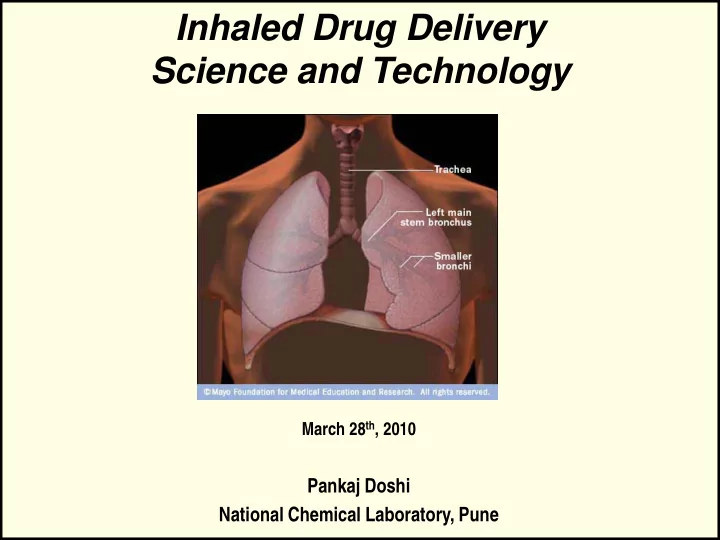
Oral Cavity – Mouth Nasal Cavity – Nose Pharynx Larynx Trachea Bronchi Bronchiole Alveoli
http://health.allrefer.com
www.nhlbi.nih.gov
www.nhlbi.nih.gov
www.nhlbi.nih.gov
www.nhlbi.nih.gov
Short-Acting beta Agonist Given to patient for quick relief of bronchospasm in conditions such as asthma and chronic obstructive pulmonary disease. Example: Salbutamol, Ventolin, Aerolin etc. Long-Acting Beta Agonist Usually prescribed for severe persistent asthma following previous treatment with a short-acting beta agonist. These medicine causes broncho-dialation by relaxing the smooth muscle in the airway so as to treat the exacerbation of
Example: Salmeterol, Formoterol, Bambuterol etc.
All forms of corticosteroids reduce inflammation in the airways that carry air to the lungs (bronchial tubes) and decrease the mucus made by the bronchial
Example: Beclomethasone, Fluticasone, Ciclesonide
Metered dose inhalers (MDIs) are pressurised, hand- held devices that use propellants to deliver doses of medication to the lungs of a patient. This sends a measured dose of medicine into your mouth using a small amount of pressurized gas. Sometimes a "spacer" is placed between the drug reservoir and your mouth to control the amount you inhale. Medicine is forced into the spacer, which you then squeeze as you inhale the medicine quickly. Aerosols fell out of favour a few years ago when the common propellant chlorofluorocarbon (CFC), a gas that depletes the atmosphere's ozone layer, was banned throughout the world http://medicine.org.uk
Dry Powder Inhaler delivers medicine in powder form. The medication is commonly held either in a capsule for manual loading or a proprietary form from inside the inhaler The dose that can be delivered is typically less than a few tens of milligrams in a single breath since larger powder doses may lead to provocation of cough. Most DPIs rely on the force of patient inhalation to entrain powder from the device and subsequently break-up the powder into aerosol particles that are small enough to reach the lungs. Insufficient patient inhalation flow rates may lead to reduced dose delivery and incomplete de-aggregation of the powder, leading to unsatisfactory device performance. www.youtube.com
Anderson Impactor
Streamlines Nozzle Impactor Plate
Single stage cross-section
Stage 6 0.65-1.1 Stage 7 0.43-0.65 Stage 2 4.7-5.8 Stage 1 5.8-9.0 Preseparator (10 µm and above) Stage 5 1.1-2.1 Stage 4 2.1-3.3 Stage 3 3.3-4.7
Mouth, throat
Simulation of Human Respiratory System
Blending Drug blend Filling DPI Device Overwrap Lactos e Classification
Lactose
Fines
Lactose
Coarse Micronization Drug Storage In use
Product in package Naked device Temperature and humidity in storage Temperature and humidity during patient use Only fine drug particles (FPM) are therapeutic FDA requires tight limits on FPM Airflow Generated By Patient’s Inspiratory Effort
FPM
Inspiratory Force Flow & Pressure De-aggregation Fine Particle Mass Oropharyngeal Deposition (mouth and throat) Pulmonary Delivery
FPM
Formulation Dispersion
drug carrier Actual drug-carrier particles
therapeutic effect
deep lung
aerosolize
Constrained Design Space:
together but...
the lungs
Total Torque
angular velocity of each particle particle moment of inertia
v1 v2 v3 Ω1 Ω2 Ω3 F12 , T12 F23 , T23 F31 , T31 Newton’s law for linear and angular motion
Total force
velocity of each particle position of each particle particle mass
DEM solves the Newton’s equation of Motion for each particle in the system
and rotation of each individual particle