Improving Outcomes in COPD: A Closer Look into Genetics Cynthia L. - - PDF document

improving outcomes in copd a closer look into genetics
SMART_READER_LITE
LIVE PREVIEW

Improving Outcomes in COPD: A Closer Look into Genetics Cynthia L. - - PDF document

6/12/2019 Scan with Camera for Pre-Test or Click on Link https://msu.co1.qu altrics.com/jfe/for m/SV_7R7xAW6Es 9I85q5 Improving Outcomes in COPD: A Closer Look into Genetics Cynthia L. McNerlin MSN, ANP-BC, FCCP DNP Project 3 Disclosures:


slide-1
SLIDE 1

6/12/2019 1

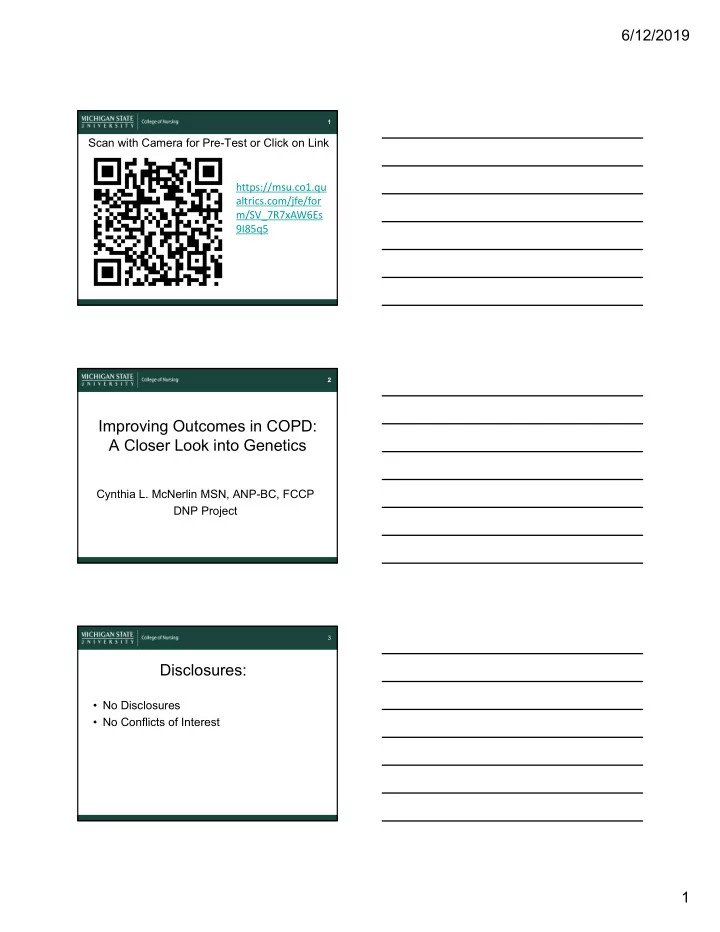
Scan with Camera for Pre-Test or Click on Link https://msu.co1.qu altrics.com/jfe/for m/SV_7R7xAW6Es 9I85q5

Improving Outcomes in COPD: A Closer Look into Genetics

Cynthia L. McNerlin MSN, ANP-BC, FCCP DNP Project

Disclosures:

  • No Disclosures
  • No Conflicts of Interest

3

slide-2
SLIDE 2

6/12/2019 2

Objectives

  • Outline the basic concepts of COPD
  • Understand the genetic cause of COPD
  • Understand the concepts of Alpha-1

Antitrypsin Deficiency (AATD)

– Identify patients at risk – Identify screening methods – Identify ways to aid in screening – Identify resources available

4

Brief Overview of COPD

  • Definition: air flow limitation that is not fully reversible
  • Diagnosed with PFT with bronchodilator
  • Progressive decline in both physiologic features and

functional status

  • Symptoms may include chronic cough, wheeze,

dyspnea, excessive phlegm production

  • ≈ 20% of smokers have COPD (worldwide)
  • Pulmonary rehab improves functional status
  • Treatment aim is not cure but slowed

progression, improved functional status and QOL

5

COPD Burden

  • 3rd leading cause of morbidity/mortality
  • Cost to the annual health care budget:

$36B (Projected to be $49B in 2020)

  • Added to the CMS reimbursement

repayment penalty act in 2014.

  • 251 million cases of COPD globally in

2016.

  • 3.17 million deaths were caused by the

disease in 2015 (5% of all deaths).

6

https://www.cdc.gov/copd/infographics/copd-costs.html
slide-3
SLIDE 3

6/12/2019 3

Additional Costs

  • 16.4 million sick days per

year – Accounts for $3.9B COPD related illness

  • Unplanned office visits,

frequent calls for poorly controlled symptoms

  • Poor HRQOL scores
  • Unmet National Quality

Measures for COPD

7

Non-Smoking causes of COPD

  • Burning of bio-mass fuels
  • Environmental exposures- pollutants
  • Occupational exposure
  • Developmentally impaired lung growth
  • Exposure to indoor air pollution can affect the unborn

child and increase risk for COPD later in life

  • Genetic factors- Alpha-1 Antitrypsin Deficiency

– (3-5% of COPD patients)

8

Brief Review of AAT and Deficiency

Alpha-1 Antitrypsin:

  • Circulating Protein that protects

vital tissue from the destructive effects of neutrophil elastace

  • Manufactured and secreted by

the liver.

  • Normal Gene code “M”. (MM)

9

Deficiency:

  • Inherited autosomal co-dominant;

1:1500-1:3000

  • Deficient codes: ‘S’, ‘F’, ‘I’, ‘null’ &

‘Z’.

  • Abnormal combinations: anything

that’s not ‘MM’

  • ‘Z’ allele is the most pathogenic
  • Deficiency of this protective enzyme

is causally-linked to multiple chronic diseases (Lung & Liver disease)

https://www.genome.gov/19518992/learning-about-alpha1-antitrypsin-deficiency-aatd/

slide-4
SLIDE 4

6/12/2019 4

10

Alpha-1 Myths

  • All COPD is caused by smoking
  • AATD can be dx with PFT
  • Alpha-1 is rare, so I don’t need to test my patients
  • Alpha-1 results exclusively in emphysema
  • I don’t need to test for alpha-1 since there are no treatments
  • If I test, I only have to consider homozygous patients (Pi ZZ)
  • There is no need to test a smoker for alpha-1
  • I do not need to test older patients for alpha-1
  • A diagnosis of alpha-1 can be made on serum levels alone
  • I know an alpha-1 patient when I see one
  • Alpha’s cannot donate blood

11

Comparison to commonly recognized diseases

12

slide-5
SLIDE 5

6/12/2019 5

Prevalence

  • Same for men and women

13

Historical Timeline

14 2016: US Prevalence < 10% 2003: ATS/ERS Guidelines 2000: Free Test Kits Available 1987: Enzyme Replacement Therapy Developed 1963: Discovery of AATD 53 yrs. 15

Most Individuals with AATD Escape Detection

10% Diagnosed 90% Undiagnosed No Signs

  • r

Symptoms Symptoms but Misdiagnosed

Stoller, J. K., & Aboussouan, L. S. (2012).

slide-6
SLIDE 6

6/12/2019 6

Populations at Risk

16

COPD

  • 3-5% Risk

Emphysema

  • 3% of all

emphysema cases

Liver Disease

  • Hepatocellular

CA

  • Cirrhosis

Panniculitis

  • 1 per 1,000

Vasculitis

  • Giant Cell

Arteritis

  • Wegners’
  • Lupus
  • PMR
  • RA

Spontaneous PTX

  • 7.7% risk

Cerebral Aneurysms

  • 11% risk

Lung Cancers

  • Increase in

adenocarcinomas and squamous cell carcinomas in carrier status

How is AATD Diagnosed?

  • Dried blood sample using free test kits

– Genotype (M,S,Z,F,I,null) – Serum Level

  • Lab order of serum level AND genotype
  • Test while in-patient?
  • Home Genetics tests?

– May not be an accurate result – 23&Me limits allele testing to ‘z’ and ‘s’ alleles

17

Punnett Square for AATD Risk

18

M M M MM MM Z MZ MZ

slide-7
SLIDE 7

6/12/2019 7

Offspring Risk with 2 MZ

19

M Z M MM MZ Z MZ ZZ

Child #1 Child #2 Child #3 Child #4

Case Review #1

  • 22yo never smoker
  • Spontaneous PTX (x8) since age 9

– s/p Talc and mechanical pleurodesis

  • Aspiring to be an airline pilot
  • Bullous emphysema on Chest CT upper

lobe predominant

20 21

slide-8
SLIDE 8

6/12/2019 8

Case Review #2

  • 49 yo never smoker
  • Hx coiling 5 yrs ago for Cerebral Aneurysm
  • No evidence of lung disease on PFT
  • Tested for AATD

22 23 24

slide-9
SLIDE 9

6/12/2019 9

Pathology of the ‘S’

  • Cerebral Aneurysms
  • Lung Cancers

– Large Cell Types

25 26

Age 64 Lifelong smoker Age 70 Never smoker

Case Review: Brothers

27

slide-10
SLIDE 10

6/12/2019 10

Pathology of the ‘Z’

  • Manifestations of liver disease
  • Abnormal accumulation of damaged AAT in the

hepatocyte

  • Improper folding of allele impacts transportation into

circulation (disease of gain)

– Neonatal hepatitis – Adult cirrhosis / NASH – Hepatoma

  • Manifestations of lung disease

– Emphysema (disease of loss) – COPD

28 29

Emphysema Features

  • Breakdown of the alveolar / capillary

interface

  • CXR – flat diaphragms, hyperlucency

30

slide-11
SLIDE 11

6/12/2019 11

31

Education for AATD

32

  • Alphas CAN donate blood *

Augmentation

  • Weekly infusion of replacement enzyme

– Plasma derivative – Out patient clinic – Home infusion (self infusion/nurse infusion)

  • Helps maintain therapeutic levels of AAT
  • Does not improve rates of lung infections
  • 3 companies offer enzyme replacement

– One provides the free test kits to your

  • ffices

33

slide-12
SLIDE 12

6/12/2019 12

Impact

34

Guidelines

35

Characteristic of Healthcare in west MI

  • Grand Rapids, Muskegon & Holland: Population 1,321,557
  • Heavily weighted on 3 major health systems: Spectrum Health,

Mercy Health and U of M (Metro). < 10% are Independent providers.

  • No specific policy for AATD screening.
  • AATD is not included in the infant dried blood sampling done at

birth (State)

  • Provider discretion
  • Left to the patient to do their own homework
  • Resources include Local Certified Alpha Clinic (Spring Lake),

Alpha 1 Foundation Website, state/local health dept

slide-13
SLIDE 13

6/12/2019 13

Human Genome Project

  • Completed and Published in 2003
  • In 2016-

– 63% of providers were already in practice when the HGP was published – Missing academic opportunities for genetics education

37

Methods to Improve Screening

  • Incorporate these concepts into

daily practice

  • EHR Alerts

– ICD 10 – CDSR

  • Scheduling / Use of Medical

Assistants

  • Use waiting room brochures for

patients to help remind providers

38

Case Review #1

  • 22yo nonsmoker
  • Spontaneous PTX (x8) since age 9

– s/p Talc and mechanical pleurodesis

  • Aspiring to be an airline pilot
  • Bullous emphysema on Chest CT upper

lobe predominant

39

slide-14
SLIDE 14

6/12/2019 14

Case Review #1

  • 22yo nonsmoker
  • Spontaneous PTX (x8) since age 9

– s/p Talc and mechanical pleurodesis

  • Aspiring to be an airline pilot
  • Bullous emphysema on Chest CT upper

lobe predominant

40

ZZ

Case Review: Brothers

  • 70 yo never smoker
  • FEV1 39%
  • Alpha MM

41

  • 64 yo lifelong smoker
  • FEV1 53%
  • Alpha MZ

Impossible to determine Alpha status solely based on PFT data

Alpha-1 Myths

  • All COPD is caused by smoking
  • AATD can be dx with PFT
  • Alpha-1 is rare, so I don’t need to test my patients
  • Alpha-1 results exclusively in emphysema
  • I don’t need to test for alpha-1 since there are no treatments
  • If I test, I only have to consider homozygous patients (Pi ZZ)
  • There is no need to test a smoker for alpha-1
  • I do not need to test older patients for alpha-1
  • A diagnosis of alpha-1 can be made on serum levels alone
  • I know an alpha-1 patient when I see one
  • Alpha’s cannot donate blood

42

slide-15
SLIDE 15

6/12/2019 15

Take Home Points…

  • AATD is not a zebra
  • Keep thinking outside

the box

  • Use guidelines as a

‘guide’ but keep up on current evidence in the literature

43

Questions/Comments

Contact: cindymcnerlin@gmail.com

44

Post Test

https://msu.co1 .qualtrics.com/jf e/form/SV_1Yo GYthpq9N1drv