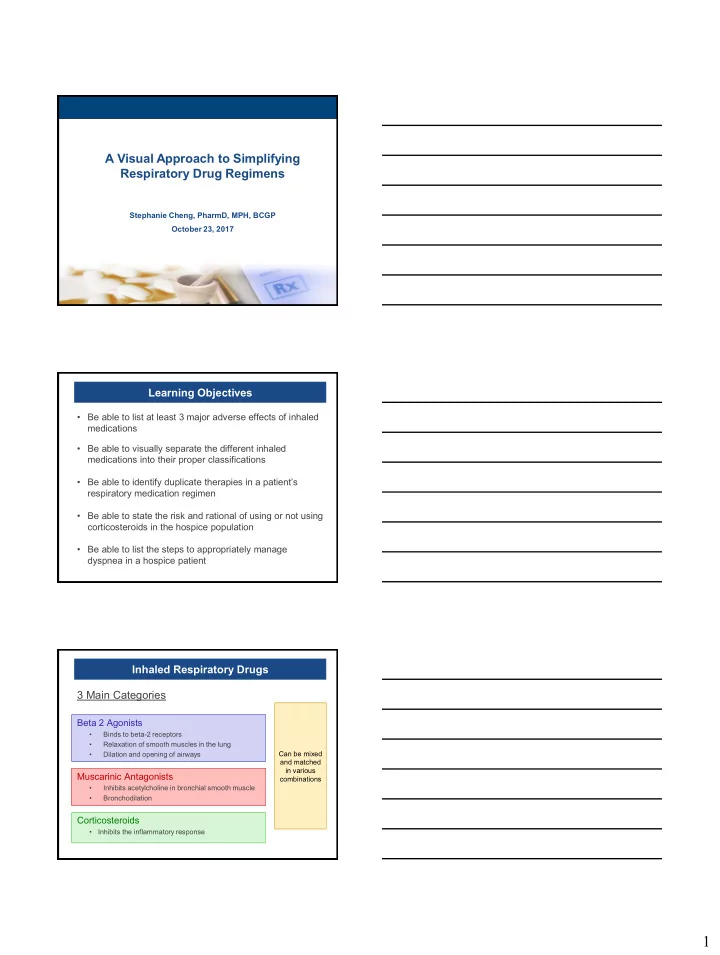
1 Adverse Effects of Inhaled Medications Drug Category Adverse - - PDF document

1
SMART_READER_LITE
LIVE PREVIEW

1 Adverse Effects of Inhaled Medications Drug Category Adverse - - PDF document

A Visual Approach to Simplifying Respiratory Drug Regimens Stephanie Cheng, PharmD, MPH, BCGP October 23, 2017 Learning Objectives Be able to list at least 3 major adverse effects of inhaled medications Be able to visually separate the


slide-1
SLIDE 1

1

A Visual Approach to Simplifying Respiratory Drug Regimens

Stephanie Cheng, PharmD, MPH, BCGP October 23, 2017

Learning Objectives

  • Be able to list at least 3 major adverse effects of inhaled

medications

  • Be able to visually separate the different inhaled

medications into their proper classifications

  • Be able to identify duplicate therapies in a patient’s

respiratory medication regimen

  • Be able to state the risk and rational of using or not using

corticosteroids in the hospice population

  • Be able to list the steps to appropriately manage

dyspnea in a hospice patient

Inhaled Respiratory Drugs 3 Main Categories

Beta 2 Agonists

  • Binds to beta-2 receptors
  • Relaxation of smooth muscles in the lung
  • Dilation and opening of airways

Muscarinic Antagonists

  • Inhibits acetylcholine in bronchial smooth muscle
  • Bronchodilation

Corticosteroids

  • Inhibits the inflammatory response

Can be mixed and matched in various combinations Can be mixed and matched in various combinations

slide-2
SLIDE 2

2

Adverse Effects of Inhaled Medications

Drug Category Adverse Effects

Beta 2 agonists

Tachycardia (up to 200 beats/minute), arrhythmias, nervousness, headache, tremor, dry mouth, palpitation, nausea, dizziness, sleeplessness, hypertension or hypotension

Muscarinic antagonists

Dizziness, headache, dry mouth, dyspepsia, nausea, UTI, urinary retention, constipation

Corticosteroids

Increase risk of upper respiratory tract infections, headache, pharyngitis

Dosage Forms

  • Handheld Inhaler

– Metered dose inhaler (MDI) – Dry powder inhaler (DPI) – Aerolizers – HandiHaler – Twisthaler – Flexhaler

  • Nebulized solution
  • Oral tablet (Albuterol tablet, corticosteroid: prednisone)
  • Beta 2 agonists and muscarinic antagonists

– Short-acting and long-acting formulations

Handheld inhalers

  • Require adequate inhalation force
  • Require coordination to use
  • Are generally more expensive

compared to the nebulized solution Handheld inhalers

  • Require adequate inhalation force
  • Require coordination to use
  • Are generally more expensive

compared to the nebulized solution

Respiratory Medications NOT in Combination

Beta 2 Agonists

  • Handheld Inhaler
  • Short Acting
  • Albuterol HFA (Ventolin HFA, Proair HFA, Proventil

HFA)

  • Levalbuterol HFA (Xopenex HFA)
  • Long acting
  • Formoterol (Foradil Aerolizer)
  • Indacaterol (Arcapta Neohaler)
  • Olodaterol (Striverdi Respimat)
  • Salmeterol (Serevent Diskus)
  • Nebulized solution
  • Short Acting
  • Albuterol (AccuNeb)
  • Levalbuterol (Xopenex)
  • Long Acting
  • Arformoterol (Brovana)
  • Formoterol (Perforomist)
  • Oral - Albuterol

Beta 2 Agonists

  • Handheld Inhaler
  • Short Acting
  • Albuterol HFA (Ventolin HFA, Proair HFA, Proventil

HFA)

  • Levalbuterol HFA (Xopenex HFA)
  • Long acting
  • Formoterol (Foradil Aerolizer)
  • Indacaterol (Arcapta Neohaler)
  • Olodaterol (Striverdi Respimat)
  • Salmeterol (Serevent Diskus)
  • Nebulized solution
  • Short Acting
  • Albuterol (AccuNeb)
  • Levalbuterol (Xopenex)
  • Long Acting
  • Arformoterol (Brovana)
  • Formoterol (Perforomist)
  • Oral - Albuterol

Corticosteroids

  • Handheld Inhaler
  • Beclomethasone (Qvar)
  • Budesonide (Pulmicort Flexhaler)
  • Ciclesonide (Alvesco)
  • Fluticasone (Flovent HFA/Diskus)
  • Mometasone (Asmanex Twisthaler)
  • Nebulized solution
  • Budesonide (Pulmicort Respules)
  • Oral – Prednisone

Corticosteroids

  • Handheld Inhaler
  • Beclomethasone (Qvar)
  • Budesonide (Pulmicort Flexhaler)
  • Ciclesonide (Alvesco)
  • Fluticasone (Flovent HFA/Diskus)
  • Mometasone (Asmanex Twisthaler)
  • Nebulized solution
  • Budesonide (Pulmicort Respules)
  • Oral – Prednisone

Muscarinic Antagonists

  • Handheld Inhaler
  • Short Acting
  • Ipratropium HFA (Atrovent HFA)
  • Long Acting
  • Aclidinium (Turdorza Pressair)
  • Tiotropium (Spiriva

Handihaler/Respimat)

  • Umeclidinium (Incruse Ellipta)
  • Nebulized solution - Ipratropium

Muscarinic Antagonists

  • Handheld Inhaler
  • Short Acting
  • Ipratropium HFA (Atrovent HFA)
  • Long Acting
  • Aclidinium (Turdorza Pressair)
  • Tiotropium (Spiriva

Handihaler/Respimat)

  • Umeclidinium (Incruse Ellipta)
  • Nebulized solution - Ipratropium

End in

  • sone or -nide

End in

  • sone or -nide

End in

  • terol

End in

  • terol

End in

  • ium

End in

  • ium
slide-3
SLIDE 3

3

Respiratory Medications NOT in Combination

Corticosteroids Beta 2 agonists Muscarinic antagonists Short acting Long acting Short acting Long acting Handheld Inhaler

(MDI or DPI)

Beclomethasone

(Qvar)

Albuterol HFA

(Ventolin HFA, Proair HFA, Proventil HFA)

Formoterol

(Foradil Aerolizer)

Ipratropium HFA

(Atrovent HFA)

Aclidinium

(Turdorza Pressair)

Budesonide

(Pulmicort Flexhaler)

Indacaterol

(Arcapta Neohaler)

Tiotropium

(Spiriva Handihaler, Spiriva Respimat)

Ciclesonide

(Alvesco) Levalbuterol HFA (Xopenex HFA)

Olodaterol

(Striverdi Respimat)

Fluticasone

(Flovent HFA, Flovent Diskus)

Salmeterol

(Serevent Diskus)

Umeclidinium

(Incruse Ellipta)

Mometasone

(Asmanex Twisthaler)

Nebulized Solution Budesonide

(Pulmicort Respules)

Albuterol

(AccuNeb)

Arformoterol

(Brovana)

Ipratropium

Levalbuterol (Xopenex)

Formoterol

(Perforomist)

Oral Prednisone Albuterol

Respiratory Medications in Combination

Beta 2 Agonist + Muscarinic Antagonists

  • Short Acting – PRN or Routine Use

– Handheld Inhaler – Albuterol/Ipratropium (Combivent Respimat) – Nebulized solution – Albuterol/Ipratropium (DuoNeb)

  • Long acting – Routine Use Only

– Vilanterol/Umeclidinium (Anoro Ellipta) – Olodaterol/Tiotropium (Stiolto Respimat)

Corticosteroid + Beta 2 Agonist

  • Long acting – Routine Use Only

– Budesonide/formoterol (Symbicort) – Fluticasone/salmeterol (Advair HFA, Advair Diskus) – Fluticasone/vilanterol (Breo Ellipta) – Mometasone/formoterol (Dulera)

All long-acting inhalers are handheld inhalers All long-acting inhalers are handheld inhalers

Respiratory Medications in Combination

Corticosteroids Beta 2 Agonist Muscarinic Antagonists Short-Acting – PRN or Routine Use

Handheld Inhaler (MDI) Nebulized Solution

Long-Acting – Routine Use Only

Handheld Device

(MDI or DPI)

Albuterol / Ipratropium

(Combivent Respimat)

Albuterol / Ipratropium

(Duoneb)

Vilanterol / Umeclidinium

(Anoro Ellipta)

Olodaterol / Tiotropium

(Stiolto Respimat)

Budesonide / Formoterol

(Symbicort)

Fluticasone / Salmeterol

(Advair HFA, Advair Diskus)

Fluticasone / Vilanterol

(Breo Ellipta)

Mometasone / Formoterol

(Dulera)

slide-4
SLIDE 4

4

Approach to a Patient’s Inhaled Medications

1) Separate the PRN orders from Routine orders

a) For PRN therapy, the patient should only be on a regimen that contains one beta 2 agonist and/or one muscarinic antagonist. b) For Routine therapy, the patient does not have to have something from all 3 categories, but if they are on something, they should only have one of that type of medication on board.

2) See if there are any duplicate therapies 3) Discontinue any duplicate therapies 4) Are there any medications you can consolidate?

Corticosteroids and long acting beta 2 agonists and muscarinic antagonists should NOT be used on a PRN basis. Corticosteroids and long acting beta 2 agonists and muscarinic antagonists should NOT be used on a PRN basis.

Patient Case #1

  • Terminal Diagnosis – COPD
  • Medication List

– Proair HFA (albuterol) – 2 puffs q4-6 hours PRN – Combivent Respimat (albuterol/ipratropium) – 1 puff q4 hours PRN – Spiriva Handihaler (tiotropium) – 1 cap inhaled once daily – Xopenex (levalbuterol) – 3mL vial via neb four times a day – Advair (fluticasone/salmeterol) – 1 inhalation BID – Duoneb (albuterol/ipratropium) – 3mL vial via neb four times a day – Prednisone 10mg PO daily – Duoneb (albuterol/ipratropium) – 3mL vial via neb q4-6 hours PRN

Patient Case #1 – Step 1

  • Proair HFA (albuterol) – 2 puffs q4-6 hours PRN
  • Combivent Respimat (albuterol/ipratropium) – 1 puff q4 hours PRN
  • Spiriva Handihaler (tiotropium) – 1 cap inhaled once daily
  • Xopenex (levalbuterol) – 3mL vial via neb four times a day
  • Advair (fluticasone/salmeterol) – 1 inhalation BID
  • Duoneb (albuterol/ipratropium) – 3mL vial via neb four times a day
  • Prednisone 10mg PO daily
  • Duoneb (albuterol/ipratropium) – 3mL vial via neb q4-6 hours PRN

Separate PRN orders from Routine orders Separate PRN orders from Routine orders

slide-5
SLIDE 5

5

Patient Case #1 – Step 1

PRN orders

  • Proair HFA (albuterol) – 2 puffs q4-6 hours PRN
  • Combivent Respimat (albuterol/ipratropium) – 1 puff q4 hours PRN
  • Duoneb (albuterol/ipratropium) – 3mL vial via neb q4-6 hours PRN

Routine orders

  • Spiriva Handihaler (tiotropium) – 1 cap inhaled once daily
  • Xopenex HFA(levalbuterol) – 2 puffs four times a day
  • Advair (fluticasone/salmeterol) – 1 inhalation BID
  • Duoneb (albuterol/ipratropium) – 3mL vial via neb four times a day
  • Prednisone 10mg PO daily

Separate PRN orders from Routine orders Separate PRN orders from Routine orders

Patient Case #1 – Step 2

PRN orders

  • Proair HFA (albuterol) – 2 puffs q4-6 hours PRN
  • Combivent Respimat (albuterol/ipratropium) – 1 puff q4 hours PRN
  • Duoneb (albuterol/ipratropium) – 3mL vial via neb q4-6 hours PRN

Routine orders

  • Spiriva Handihaler (tiotropium) – 1 cap inhaled once daily
  • Xopenex HFA(levalbuterol) – 2 puffs four times a day
  • Advair (fluticasone/salmeterol) – 1 inhalation BID
  • Duoneb (albuterol/ipratropium) – 3mL vial via neb four times a day
  • Prednisone 10mg PO daily

See if there are any duplicate therapies See if there are any duplicate therapies

Duplicate Inhaled Therapy Template

Dosage Form

Corticosteroids Beta 2 Agonists Muscarinic Antagonists

PRN Handheld Inhaler Nebulizer

Routine

Handheld Inhaler Nebulizer Oral

slide-6
SLIDE 6

6

Patient Case #1 – Step 2

Dosage Form

Corticosteroids Beta 2 Agonists Muscarinic Antagonists

PRN Handheld Inhaler Nebulizer Routin e Handheld Inhaler Nebulizer Oral

PRN

Albuterol / Ipratropium

(Combivent Respimat)

Albuterol / Ipratropium

(Duoneb) Albuterol HFA (Proair)

Patient Case #1 – Step 2

Dosage Form

Corticosteroids Beta 2 Agonists Muscarinic Antagonists

PRN Handheld Inhaler Albuterol HFA (Proair) Nebulizer

Routine

Handheld Inhaler Nebulizer Oral Tiotropium (Spiriva)

Routine

Fluticasone / Salmeterol

(Advair)

Albuterol / Ipratropium

(Duoneb) Albuterol / Ipratropium (Combivent Respimat) Albuterol / Ipratropium (DuoNeb) Levalbuterol (Xopenex HFA) Prednisone

Patient Case #1 – Step 2

Dosage Form

Corticosteroids Beta 2 Agonists Muscarinic Antagonists

PRN Handheld Inhaler Albuterol HFA (Proair) Nebulizer

Routine

Handheld Inhaler Tiotropium (Spiriva) Levalbuterol (Xopenex HFA) Nebulizer Oral Prednisone Albuterol / Ipratropium (Combivent Respimat) Albuterol / Ipratropium (DuoNeb) Fluticasone / Salmeterol (Advair) Albuterol / Ipratropium (DuoNeb)

Do you see the duplicate therapies? Do you see the duplicate therapies?

slide-7
SLIDE 7

7

Patient Case #1 - Step 3

  • Determine the severity of the patient’s COPD or lung condition.
  • If they are taking nebulized inhaled medications, they most likely do not

have enough positive inhalation force to use handheld inhalers.

  • Consider keeping the nebulized solutions and D/C the handheld inhalers.

Discontinue any duplicate therapies Discontinue any duplicate therapies

Hospice patients with a terminal diagnosis of COPD or lung cancer generally do not have enough positive inhalation force to use handheld devices and should be on nebulized therapy. Hospice patients with a terminal diagnosis of COPD or lung cancer generally do not have enough positive inhalation force to use handheld devices and should be on nebulized therapy.

Step 3 Discontinue any duplicate therapies

Dosage Form

Corticosteroids Beta 2 Agonists Muscarinic Antagonists

PRN Handheld Inhaler Albuterol HFA (Proair) Nebulizer Routine Handheld Inhaler Tiotropium (Spiriva) Levalbuterol (Xopenex HFA) Nebulizer Oral Prednisone Albuterol / Ipratropium (Combivent Respimat) Albuterol / Ipratropium (DuoNeb) Fluticasone / Salmeterol (Advair) Albuterol / Ipratropium (DuoNeb)

Which medications would you discontinue? Which medications would you discontinue? Step 3 Discontinue any duplicate therapies

Dosage Form Corticosteroids Beta 2 Agonists Muscarinic Antagonists

PRN Handheld Inhaler Albuterol HFA (Proair) Nebulizer Routine Handheld Inhaler Tiotropium (Spiriva) Levalbuterol (Xopenex HFA) Nebulizer Oral Prednisone Albuterol / Ipratropium (Combivent Respimat) Albuterol / Ipratropium (DuoNeb) Fluticasone / Salmeterol (Advair) Albuterol / Ipratropium (DuoNeb) The combination therapy of using DuoNeb routinely and PRN, plus prednisone (if a steroid medication is needed) is the most cost-effective therapy for hospice patients with a terminal diagnosis of COPD or lung cancer. The combination therapy of using DuoNeb routinely and PRN, plus prednisone (if a steroid medication is needed) is the most cost-effective therapy for hospice patients with a terminal diagnosis of COPD or lung cancer.

slide-8
SLIDE 8

8

Step 4 Consolidating Medications

Dosage Form Corticosteroids Beta 2 Agonists Muscarinic Antagonists

PRN Nebulizer Routine Nebulizer Oral Prednisone Albuterol / Ipratropium (DuoNeb) Albuterol / Ipratropium (DuoNeb)

Are there any medications you can consolidate? Are there any medications you can consolidate?

Patient Case #2

  • Terminal diagnosis – CHF and COPD
  • Medications

– Ventolin HFA (albuterol) – 2 puffs q4-6 hours PRN – Lasix (furosemide) – 20mg tab BID – Potassium chloride – 20mEq tab BID – Advair (fluticasone/salmeterol) – 1 inhalation BID – Levothyroxine – 75mcg tab daily – Ipratropium neb – 1 vial via neb four times a day – Lisinopril – 10mg tab daily – Lorazepam – 1mg q4 hours PRN – Duoneb (albuterol/ipratropium) – 3mL vial via neb q4-6 hours PRN – Haloperidol – 1mg BID

Patient Case #2 – Step 1

  • Ventolin HFA (albuterol) – 2 puffs q4-6 hours PRN
  • Advair (fluticasone/salmeterol) – 1 inhalation BID
  • Ipratropium neb – 1 vial via neb four times a day
  • Duoneb (albuterol/ipratropium) – 3mL vial via neb q4-6 hours PRN

Separate PRN orders from Routine orders Separate PRN orders from Routine orders

slide-9
SLIDE 9

9

Patient Case #2 – Step 1

  • PRN

– Ventolin HFA (albuterol) – 2 puffs q4-6 hours PRN – Duoneb (albuterol/ipratropium) – 3mL vial via neb q4-6 hours PRN

  • Routine

– Ipratropium neb – 1 vial via neb four times a day – Advair (fluticasone/salmeterol) – 1 inhalation BID

Separate PRN orders from Routine orders Separate PRN orders from Routine orders

Patient Case #2 – Step 2

  • PRN

– Ventolin HFA (albuterol) – 2 puffs q4-6 hours PRN – Duoneb (albuterol/ipratropium) – 3mL vial via neb q4-6 hours PRN

  • Routine

– Ipratropium neb – 1 vial via neb four times a day – Advair (fluticasone/salmeterol) – 1 inhalation BID

See if there are any duplicate therapies See if there are any duplicate therapies

Patient Case #2 – Step 2

Dosage Form Corticosteroids Beta 2 Agonists Muscarinic Antagonists

PRN Handheld Inhaler Nebulizer Routine Handheld Inhaler Nebulizer Oral

PRN

Albuterol / Ipratropium

(Duoneb) Albuterol HFA (Ventolin)

slide-10
SLIDE 10

10

Patient Case #2 – Step 2

Dosage Form Corticosteroids Beta 2 Agonists Muscarinic Antagonists

PRN Handheld Inhaler Albuterol HFA (Ventolin) Nebulizer Routine Handheld Inhaler Nebulizer Oral Ipratropium neb

Routine

Fluticasone / Salmeterol

(Advair) Albuterol / Ipratropium (DuoNeb)

Patient Case #2 – Step 2

Dosage Form Corticosteroids Beta 2 Agonists Muscarinic Antagonists

PRN Handheld Inhaler Albuterol HFA (Proair) Nebulizer Routine Handheld Inhaler Nebulizer Ipratropium neb Albuterol / Ipratropium (DuoNeb) Fluticasone / Salmeterol (Advair)

Do you see the duplicate therapies? Do you see the duplicate therapies? Patient Case #2 – Step 3

Dosage Form Corticosteroids Beta 2 Agonists Muscarinic Antagonists

PRN Handheld Inhaler Albuterol HFA (Proair) Nebulizer Routine Handheld Inhaler Nebulizer Ipratropium neb Albuterol / Ipratropium (DuoNeb) Fluticasone / Salmeterol (Advair)

Discontinue any duplicate therapies Discontinue any duplicate therapies

slide-11
SLIDE 11

11

Patient Case #2 – Step 3

Dosage Form Corticosteroids Beta 2 Agonists Muscarinic Antagonists

PRN Handheld Inhaler Albuterol HFA (Proair) Nebulizer Routine Handheld Inhaler Nebulizer Ipratropium neb Albuterol / Ipratropium (DuoNeb) Fluticasone / Salmeterol (Advair)

Discontinue any duplicate therapies Discontinue any duplicate therapies Patient Case #2 – Step 4

Dosage Form Corticosteroids Beta 2 Agonists Muscarinic Antagonists

PRN Nebulizer Routine Handheld Inhaler Nebulizer Ipratropium neb Albuterol / Ipratropium (DuoNeb) Fluticasone / Salmeterol (Advair)

Is there any medications you can consolidate? Is there any medications you can consolidate? Patient Case #2 – Step 4

Dosage Form Corticosteroids Beta 2 Agonists Muscarinic Antagonists

PRN Nebulizer Routine Handheld Inhaler Nebulizer Ipratropium neb Albuterol / Ipratropium (DuoNeb) Fluticasone / Salmeterol (Advair)

  • Patients with end stage COPD generally do not have enough

positive inhalation force to use handheld inhalers.

  • The patient is already on nebulized solutions.
  • Plan
  • D/C Advair and Ipratropium neb
  • Use Duoneb routinely and PRN
  • Add oral Prednisone, if a steroid is necessary
slide-12
SLIDE 12

12

Note regarding inhaled corticosteroids use in COPD

  • The use of inhaled corticosteroids (ICS) in COPD is controversial.
  • Routine use of ICS has been associated with an increased risk of

pneumonia, thrush, dysphonia and reduction in bone density.

  • ICS are also expensive medications that has been shown to have a

minimal impact on COPD exacerbations.

  • In a Cochrane Database Systematic Review, the risk of COPD

exacerbations have only been reduced by one exacerbation per patient every four years for patients who were taking an ICS compared to salmeterol alone.

Nannini, Laserson, Poole. Combined corticosteroid and long-acting beta-2 agonists for chronic

  • bstructive pulmonary disease. Cochrane Database Syst Rev 2012;(9):CD006829.

Note regarding inhaled corticosteroids use in COPD

  • In the WISDOM (Withdrawal of Inhaled Glucocorticoids and

Exacerbations of COPD) trial, published in the NEJM 2014, ICS were withdrawn from patients who were receiving both a long-acting beta agonists and a long-acting muscarinic antagonists over a period of 12 weeks.

  • These patients did not experience an increase in exacerbation or

worsening of their condition over the 52 week study period with the withdrawal of ICS. The study authors recommended discontinuation of ICS for patients with severe or very severe COPD. The study authors recommended discontinuation of ICS for patients with severe or very severe COPD.

Magnussen, Disse, Rodriguea-Roisin, et al. Withdrawal of inhaled glucocorticoids and exacerbations of COPD. N. Engl. J. Med. 2014;371:1285-4.

Note regarding inhaled corticosteroids use in COPD

  • The REDUCE study, published in JAMA 2013, demonstrated that a

short 5-day course of oral prednisone 40mg to manage acute COPD exacerbations was noninferior to a 14 day course.

  • Time to next COPD exacerbation in patients with very severe

COPD (GOLD stage IV disease)

– 5 day steroid group = 43.5 days – 14 day steroid group = 29 days

Therefore, a short 5-day course with taper of oral prednisone 40mg/day would be appropriate for acute COPD exacerbations compared to a 14 day course. Therefore, a short 5-day course with taper of oral prednisone 40mg/day would be appropriate for acute COPD exacerbations compared to a 14 day course.

Leuppi JD, Schuetz P, Bingisser R, et al. Short-term vs conventional glucocorticoid therapy in acute exacerbations of chronic obstructive pulmonary disease: the REDUCE randomized clinical

  • trial. JAMA. 2013;309:2223-2231.
slide-13
SLIDE 13

13

Management of Dyspnea

Step 1: Non-pharmacological interventions Step 1: Non-pharmacological interventions

  • Elevate the head of the bed
  • Use a fan to move cool air over the patient

‒ Open a window if possible

  • Eliminate environmental irritants
  • Give reassurance during acute distress
  • If feasible, teach the patient breathing exercises and

relaxation techniques

  • Mouth breathing and supplemental oxygen will dry out the
  • mouth. Maintain adequate humidity in the room and provide

good oral hygiene Management of Dyspnea

Step 2: Optimize current inhaled therapy Step 2: Optimize current inhaled therapy

  • Optimize Oxygen treatment
  • Optimize nebulized inhaled medications

‒ Discontinue duplicate therapies ‒ Replace handheld inhalers with nebulized treatment Management of Dyspnea

Step 3: Addition of an opioid to reduce respiratory rate Step 3: Addition of an opioid to reduce respiratory rate

Morphine (MSIR, Roxanol) 5 – 10mg PO/SL q1 hour PRN OR Oxycodone (OxyIR, OxyFast) 2.5 – 7.5mg PO/SL q1 hour PRN Titrate to effect and monitor respiratory rate Titrate to effect and monitor respiratory rate

slide-14
SLIDE 14

14

Management of Dyspnea

Step 4: Addition of a benzodiazepine to reduce anxiety Step 4: Addition of a benzodiazepine to reduce anxiety

Lorazepam 0.5 – 2mg PO/SL/IV q4 hours PRN

Summary

  • Approach to a patient’s inhaled medications

1) Separate PRN orders from Routine orders 2) See if there are any duplicate therapies 3) Discontinue any duplicate therapies 4) Are there any medications you can consolidate?

  • Duoneb (routinely and prn), plus Prednisone (if a steroid medication is

needed) is the most cost-effective therapy for hospice patients with a terminal diagnosis of COPD or lung cancer.

  • Inhaled corticosteroids should be discontinued in patients with severe or very

severe COPD.

  • A short 5-day course with a taper of oral Prednisone 40mg/day would be

appropriate for acute COPD exacerbations.

  • Management of dyspnea

1) Non-pharmacological interventions 2) Optimize current inhaled therapy 3) Addition of an opioid to reduce respiratory rate 4) Addition of a benzodiazepine to reduce anxiety

Conclusion

  • By identifying and discontinuing duplicate inhaled

respiratory therapies, patients would be able to avoid potential toxicity and adverse effects.

  • This also helps hospices reduce costs towards more

cost-effective medications

slide-15
SLIDE 15

15

Questions?

Stephanie Cheng, PharmD, MPH, BCGP

Clinical Pharmacist Hospice Pharmacy Solutions scheng@hospicepharmacysolutions.com