INFORMATION TECHNOLOGY CYBERSECURITY CLOUD COMPUTING PRESENTED TO - - PowerPoint PPT Presentation

information technology cybersecurity cloud computing
SMART_READER_LITE
LIVE PREVIEW

INFORMATION TECHNOLOGY CYBERSECURITY CLOUD COMPUTING PRESENTED TO - - PowerPoint PPT Presentation

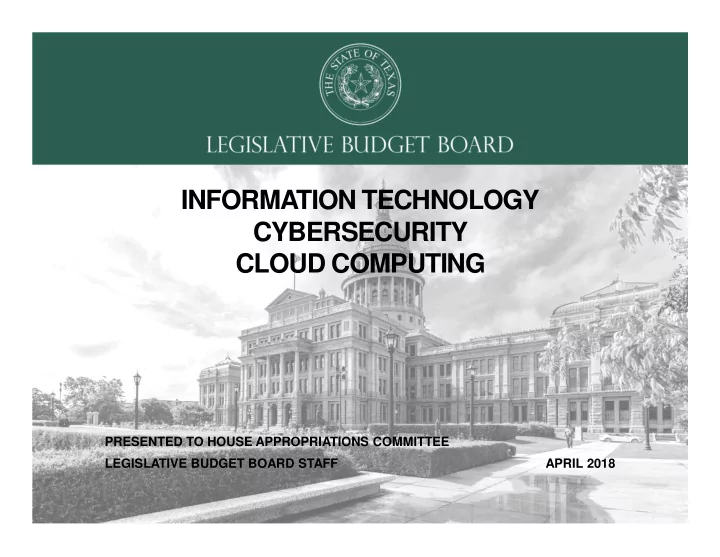
INFORMATION TECHNOLOGY CYBERSECURITY CLOUD COMPUTING PRESENTED TO HOUSE APPROPRIATIONS COMMITTEE LEGISLATIVE BUDGET BOARD STAFF APRIL 2018 Statement of Interim Charge Monitor the ongoing implementation of Article IX, Sec. 9.13 of the General


slide-1
SLIDE 1

INFORMATION TECHNOLOGY CYBERSECURITY CLOUD COMPUTING

LEGISLATIVE BUDGET BOARD STAFF PRESENTED TO HOUSE APPROPRIATIONS COMMITTEE APRIL 2018
slide-2
SLIDE 2

APRIL 18, 2018 LEGISLATIVE BUDGET BOARD ID: 5229 2

Statement of Interim Charge

Monitor the ongoing implementation of Article IX, Sec. 9.13

  • f the General Appropriations Act and determine if state

agencies are realizing cost savings and/or security enhancements in state operations related to cybersecurity, information technology, and cloud computing. Study trends in cloud computing and IT delivery services, and identify whether additional cost efficiencies, economies of scale, or IT modernization could be achieved.

slide-3
SLIDE 3

APRIL 18, 2018 LEGISLATIVE BUDGET BOARD ID: 5229 3

Presentation Overview

  • General Appropriations Act, (2018-19 Biennium) Article

IX, Section 9.13

  • Information Technology (Major Information Resources

Projects)

  • State Operations Related to Cybersecurity
  • Cloud Computing Services
slide-4
SLIDE 4

APRIL 18, 2018 LEGISLATIVE BUDGET BOARD ID: 5229 4

Article IX, Section 9.13 General Appropriations Act

  • State agencies shall consider cloud computing service options,

including any cost savings associated with purchasing those service

  • ptions from a service provider or a statewide technology center

established by DIR when making purchases for a major information resources projects.

  • DIR is required to report to the Governor, Lieutenant Governor, and

Speaker of the House of Representatives on the use of cloud computing service options by state agencies on or before November 15 of each even-numbered year.

  • The report must include use cases that provide cost savings and

benefits, including security enhancements. Agencies are to assist DIR in the creation of the report.

slide-5
SLIDE 5

APRIL 18, 2018 LEGISLATIVE BUDGET BOARD ID: 5229 5

Information Technology (IT)

  • In FY 2017, Department of Information Resources (DIR) provided a

report to the Legislative Budget Board (LBB) on prioritization of state agencies' cybersecurity projects and projects to modernize or replace legacy systems.

  • SB 1 85(R), Article IX, Section 9.10 requires the continuation of the

report.

  • DIR also is working with state agencies to introduce an Application

Development Decision Framework. This is designed to guide agencies toward best practices in areas such as the identification of user needs, purchasing and development, deployment of cloud technologies, and staffing models.

  • SB 532, 85 R requires DIR to collect certain information from state

agencies on the status and condition of information technology infrastructure and report no later than November 15 of each even- numbered year to the Governor, Lieutenant Governor, Speaker of the House of Representatives, and staff of the LBB.

slide-6
SLIDE 6

APRIL 18, 2018 LEGISLATIVE BUDGET BOARD ID: 5229 6

Major Information Resources Projects

  • The Quality Assurance Team (QAT), which includes representatives
  • f the Comptroller of Public Accounts (CPA), DIR, LBB, and the

State Auditor’s Office (advisory member), is charged with overseeing the development of major information resources projects.

  • QAT is currently overseeing 79 major information resources projects

with current estimated costs of $1.5 billion over the life of the projects.

  • SB 533, 85 R, requires a state agency assessment of proposed

technical architecture for project to ensure agency is using industry accepted architecture standards in planning for implementation.

  • With major information resource projects, some agencies are

beginning to use an Agile methodology for major Information Technology projects. Agile uses incremental, iterative work sequences known as sprints.

slide-7
SLIDE 7

APRIL 18, 2018 LEGISLATIVE BUDGET BOARD ID: 5229 7

State Operations for Cybersecurity Controls

  • For FY 2018-19, DIR was appropriated $21.5 million in All Funds to

provide security policy, assurance, education, and awareness; and assist state entities in identifying security vulnerabilities.

  • Additionally, DIR:
  • Provides a monthly online Cybersecurity Newsletter;
  • Hosts the Information Security Forum; and
  • Created the Texas Cybersecurity Strategic Plan for FYs 2018-

2023 that establishes policy and governance security standards for agencies and institutions of higher education; which are closely aligned with the Federal Information Security Management Act.

  • In addition to the $21.5 million appropriation to DIR for on-going

cybersecurity services, in FY 2018-19 other agencies received $24.0 million for new cybersecurity projects and initiatives.

slide-8
SLIDE 8

APRIL 18, 2018 LEGISLATIVE BUDGET BOARD ID: 5229 8

Cybersecurity in the State Budget

  • State Agency Staff (FTEs)
  • Data Center Services (DCS)
  • Centralized Accounting and Payroll/Personnel System (CAPPS)
  • Capital Budgets
  • Ongoing Maintenance (Daily Operations)
  • Major Information Resources Projects

Cybersecurity costs are included in various strategies, projects, and programs in the budget, including:

slide-9
SLIDE 9

APRIL 18, 2018 LEGISLATIVE BUDGET BOARD ID: 5229 9

Cloud Computing Services

  • Infrastructure as a service
  • Platform as a service
  • Software as a service

Three types of Cloud Computing Service Models: Four types of Cloud Computing Deployment Models:

  • Private Cloud
  • Community Cloud
  • Public Cloud
  • Hybrid Cloud
slide-10
SLIDE 10

APRIL 18, 2018 LEGISLATIVE BUDGET BOARD ID: 5229 10

Cloud Computing Services

  • 76 percent of servers in the Data Center Services (DCS) program

are using a private or public cloud service, allowing for improved

  • perational efficiency, optimized delivery services and cost-savings.
  • The DCS program has the ability to meet the growing technology

needs for cloud services. The two state data centers offer storage, disaster recovery in fully managed facilities that include uninterrupted power source, networking, business continuity, and enhanced physical security.

  • In 2015, DCS implemented hybrid cloud services with two major

public cloud providers, Amazon Web Services (AWS) and Microsoft’s Azure, for computing and storage.

slide-11
SLIDE 11

APRIL 18, 2018 LEGISLATIVE BUDGET BOARD ID: 5229 11

Cloud Computing Services

  • Cloud services offer alternatives to traditional IT delivery models,

and are intended to reduce the burden of aging infrastructure and provide flexible, lower-cost, IT service delivery.

  • In 2016, Department of State Health Services estimated a cost

savings of 40 percent over three years using AWS. This estimate is self-reported by DSHS and has not been independently verified.

  • CPA used a cloud-based commerce platform to replace legacy

application architecture with TxSmartBuy2.0 (TSB2). Since the implementation of TSB2, CPA has reduced its maintenance costs to less than $3.3 million annually, a 64 percent annual savings. These savings are not necessarily indicative of what other agencies may experience.

  • SB 532, 85 R requires DIR to submit a report to the Legislature and

Governor’s Office no later than November 15 of each even- numbered year on the use of cloud computing service options by state agencies.

slide-12
SLIDE 12

Contact the LBB

Legislative Budget Board www.lbb.state.tx.us 512.463.1200

APRIL 18, 2018 12 LEGISLATIVE BUDGET BOARD ID: 5229