Information Retrieval Venkatesh Vinayakarao Term: Aug Dec, 2018 - - PowerPoint PPT Presentation

information retrieval
SMART_READER_LITE
LIVE PREVIEW

Information Retrieval Venkatesh Vinayakarao Term: Aug Dec, 2018 - - PowerPoint PPT Presentation

https://vvtesh.sarahah.com/ Information Retrieval Venkatesh Vinayakarao Term: Aug Dec, 2018 Indian Institute of Information Technology, Sri City Thou shalt not compute MRR nor ERR . Thou shalt not use MAP. Nobert Fuhr. Love Tarun


slide-1
SLIDE 1

Venkatesh Vinayakarao (Vv)

Love Tarun

Information Retrieval

Venkatesh Vinayakarao

Term: Aug – Dec, 2018 Indian Institute of Information Technology, Sri City https://vvtesh.sarahah.com/

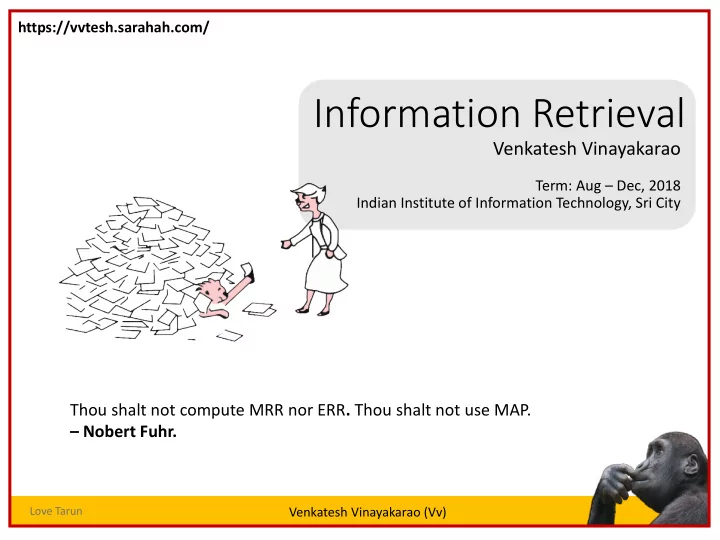
Thou shalt not compute MRR nor ERR. Thou shalt not use MAP. – Nobert Fuhr.

slide-2
SLIDE 2

In ad hoc document retrieval, the system is given a short query q and the task is to produce the best ranking of documents in a corpus, according to some standard metric such as average precision (AP).

Simple Applications of BERT for Ad Hoc Document Retrieval, Yang, Zhang and Lin, University of Waterloo, 2019 Earlier we had drop-downs for query field. Nowadays, query is a free-text!

slide-3
SLIDE 3

Standard Test Collections for Ad Hoc Retrieval

  • Cranfield Collection [1950]: Contains 1398 abstracts of

journal articles, 225 queries, exhaustive judgments for all query-document pairs.

  • Text Retrieval Conference (TREC) [1992]: 1.89 billion

documents, relevance judgments for 450 information

  • needs. Judgments for top-k documents.
  • GOV2: 25 Million .gov web pages!
  • NTCIR and CLEF: Cross language information retrieval

collection has queries in one language over a collection with multiple languages.

  • Reuters-RCV1, 20 Newsgroups, …
slide-4
SLIDE 4

The SIGIR Museum

slide-5
SLIDE 5

Evaluation

  • Various evaluation methods
  • Precision/Recall
  • Mean Average Precision
  • Mean Reciprocal Rank
  • If first relevant doc is at kth position, RR = 1/k.
  • NDCG
  • Non-Boolean/Graded relevance scores
  • DCG = r1 + r2/log22 + r3/log23 + … rn/log2n

How to compare Search Engines? How good is an IR system?

slide-6
SLIDE 6

Precision and Recall

Image Source: Wikipedia

slide-7
SLIDE 7

Precision and Recall

  • An IR system retrieves the following 20 documents.
  • There are 100 relevant documents in our collection.
  • Hollow squares represent irrelevant documents.
  • Solid squares with ‘R’ are relevant.
  • What is Precision?
  • What is Recall?

R R R R R R R R

slide-8
SLIDE 8

Precision and Recall

  • An IR system retrieves the following 20 documents.
  • There are 100 relevant documents in our collection.
  • Hollow squares represent irrelevant documents.
  • Solid squares with ‘R’ are relevant.
  • What is Precision? Precision = 8/20.
  • What is Recall? Recall = 8/100.

R R R R R R R R

slide-9
SLIDE 9

Can we do better? Can we have one number to express quality?

A minor deviation ahead!

slide-10
SLIDE 10

F-Measure

  • One measure of performance that takes into

account both recall and precision.

  • Harmonic mean of recall and precision:

P R

R P PR F

1 1

2 2

+

= + =

Harmonic Mean’aaa?

slide-11
SLIDE 11

Arithmetic Mean

  • What is the arithmetic mean of:
  • 1,2,3
  • 1,2,3,4,5
  • 1,2,3,4,5,6,7
  • What is the arithmetic mean of:
  • 1 … 99

Answer:

1 𝑜 σ𝑜=1 99

𝑜 =

1 𝑜 . 𝑜(𝑜+1) 2

=

99.100 99.2 = 50

slide-12
SLIDE 12

Arithmetic Mean

  • What is the arithmetic mean of:
  • 7,8,9 ?
  • 11,13,15?
  • What is the arithmetic mean of:
  • 1, 9, 10
  • 6.7
  • 1, 8, 10
  • 6.3
  • 1, 7, 10
  • 6
slide-13
SLIDE 13

Geometric Mean

  • What is the geometric mean of 2 and 8 ?
  • Answer: 2.8 =

16 = 4. (Arithmetic Mean is

2+8 2

= 5.)

slide-14
SLIDE 14

Geometric Mean

  • What is the geometric mean of:
  • 7,8,9 ? AM=8, GM=7.96
  • 11,13,15? AM=13, GM=12.89
  • What is the geometric mean of:
  • 1, 9, 10
  • AM=6.7, GM=4.48
  • 1, 8, 10
  • AM=6.3, GM=4.31
  • 1, 7, 10
  • AM=6, GM=4.1
slide-15
SLIDE 15

Quiz

Computer A Computer B Computer C Program 1 1 10 20 Program 2 1000 100 20

Which computer will you prefer?

Time taken by two programs to execute on different computers.

slide-16
SLIDE 16

Quiz

Computer A Computer B Computer C Program 1 1 10 20 Program 2 1000 100 20

Which computer will you prefer?

Time taken by two programs to execute on different computers.

slide-17
SLIDE 17

Quiz

Computer A Computer B Computer C Program 1 1 10 20 Program 2 1000 100 20

Which computer will you prefer?

Geometric Mean gives a consistent ranking for normalized values. A B C

  • Prg. 1

1 10 20

  • Prg. 2

1 0.1 0.02

  • A. Mean

1 5.05 10.01

  • G. Mean

1 1 0.63 A B C

  • Prg. 1

0.1 1 2

  • Prg. 2

10 1 0.2

  • A. Mean

5.05 1 1.1

  • G. Mean

1 1 0.63 A B C

  • Prg. 1

0.05 0.5 1

  • Prg. 2

50 5 1

  • A. Mean

25.03 2.75 1

  • G. Mean

1.581 1.58 1

slide-18
SLIDE 18

Harmonic Mean

  • What is the harmonic mean of 2 and 8 ?
  • Answer:

2

1 2+1 8

= 3.2

slide-19
SLIDE 19

Harmonic Mean

  • What is the harmonic mean of:
  • 7,8,9 ? AM=8, GM=7.96, HM=7.92
  • 11,13,15? AM=13, GM=12.89, HM=12.79
  • What is the harmonic mean of:
  • 1, 9, 10
  • AM=6.70, GM=4.48, HM=2.48
  • 1, 8, 10
  • AM=6.30, GM=4.31, HM=2.45
  • 1, 7, 10
  • AM=6.00, GM=4.10, HM=2.41
slide-20
SLIDE 20

Quiz

  • Can you compute the average speed?

60 Km 60 Km/h 20 Km/h 1 hour 3 hours

AM = 40, GM = 63.25, HM = 30

Compute AM, GM and HM of 60 and 20

slide-21
SLIDE 21

Precision and Recall

Why Harmonic Mean for PR?

slide-22
SLIDE 22

Precision and Recall

F1-Score A Mean for Precision and Recall

𝑮𝟐 = 𝟑 𝑸𝑺 𝑸 + 𝑺

A more generalized formula:

See “The truth of the F-measure” for a detailed discussion. https://www.toyota-ti.ac.jp/Lab/Denshi/COIN/people/yutaka.sasaki/F-measure-YS-26Oct07.pdf

slide-23
SLIDE 23

Compute Precision and Recall

  • Case 1:
  • Case 2:

R R R R R R R R R R R R R R R R 1 2 3 4 5 6 7 8 9 10 20 documents retrieved. Assume that there are 100 relevant documents.

slide-24
SLIDE 24

Compute Precision and Recall

  • Case 1: Precision = 8/20, Recall = 8/100
  • Case 2: Precision = 8/20, Recall = 8/100

R R R R R R R R R R R R R R R R

Which IR system will you prefer?

slide-25
SLIDE 25

P, R and F are set based (computed on unordered sets of documents) measures. Can we do better for ranked documents?

slide-26
SLIDE 26

Precision@k

  • We cut-off results at k and compute precision.
  • P@1 = 0
  • P@2 = ½
  • P@3 = 2/3
  • P@4 = 2/4

R R R R R R R R R R R R R

Disadvantage: If there are only 4 relevant documents in entire collection, and if we retrieve 10 documents, max precision achievable is only 0.4.

slide-27
SLIDE 27

Recall@k

  • Assume that there are 100 relevant documents.
  • R@1 = 0
  • R@2 = 1/100
  • R@3 = 2/100
  • R@4 = 2/100

R R R R R R R R R R R R R

slide-28
SLIDE 28

Interpolated Precision

  • We cut-off results at kth relevance level.
  • (Interpolated) P@1 = 0.5
  • (Interpolated) P@2 = 2/3

Interpolated Average Precision = (0.5 + 0.66) / 2 = 0.58 (if we are only interested in 2 levels of relevance)

R R R R R R R R R R R *Interpolated precision at 0 is 1!

slide-29
SLIDE 29

What is the Average Precision?

  • Case 1:
  • Average of Precision at each relevance level.
  • Average Precision = ½ + ½ + ½ + ½ + ½

5

  • Case 2:
  • Average Precision = ?

R R R R R R R R For convenience, we refer to Interpolated Average Precision when we say AP

slide-30
SLIDE 30

What is the Average Precision?

  • Case 1:
  • Average Precision = ½ + ½ + ½ + ½ + ½

5

  • Case 2:
  • Average Precision = 1/3

R R R R R R R R

slide-31
SLIDE 31

What is the Average Precision?

  • Case 1:
  • Average Precision = ½ + ½ + ½ + ½ + ½

5

  • If there were 10 relevant documents, and we retrieved only five,
  • AP (at relevance level of 10) = ½ + ½ + ½ + ½ + ½ + 0 + 0+ 0 + 0+ 0

10

  • Case 2:
  • What is AP at relevance level of 4? Assume there were 6

relevant documents in our collection.

  • AP = 1/3 + 1/3 + 1/3 + 0

4

R R R R R R R R

slide-32
SLIDE 32

Mean Average Precision

MAP computes Average Precision for all relevance levels for a set of queries.

slide-33
SLIDE 33

Compute MAP

  • Query1:
  • Query2:
  • Query3:

R R R R R R R R R R R Only 5 relevant docs in corpus. Only 3 relevant docs in corpus.

slide-34
SLIDE 34

Compute MAP

  • Query1:
  • Query2:
  • Query3:
  • Compute MAP.

MAP = (1/2 + 1/3 + 1/3)/3

R R R R R R R R R R R Only 5 relevant docs in corpus. Only 3 relevant docs in corpus.

slide-35
SLIDE 35

Quiz

  • Can you compute MAP if you do not know the total

number of relevant results for any given query?

  • No! This is the case with web search. Judges may not

know how many relevant documents exist.

slide-36
SLIDE 36

How to compare two systems, if results are ranked and graded?

and we do not know the total number of relevant documents

slide-37
SLIDE 37

Discounted Cumulative Gain

DCGk = DCG at position k r = rank relr = graded relevance of the result at rank r

slide-38
SLIDE 38

DCG Example

  • Presented with a list of documents in response to a

search query, an experiment participant is asked to judge the relevance of each document to the query. Each document is to be judged on a scale of 0-3 with:

  • 0 ➔ not relevant,
  • 3 ➔ highly relevant, and
  • 1 and 2 ➔ "somewhere in between".
slide-39
SLIDE 39

DCG Example

  • Compute DCG
slide-40
SLIDE 40

Which system is better?

  • 3,3,3,2,2,2 or 3,2,3,0,1,2 ?

Results from System 1 Results from System 2 reli log2(i+1)

𝒔𝒇𝒎𝒋 𝒎𝒑𝒉𝟑(𝒋 + 𝟐)

reli log2(i+1)

𝒔𝒇𝒎𝒋 𝒎𝒑𝒉𝟑(𝒋 + 𝟐)

3.00 1.00 3.00 3.00 1.00 3.00 3.00 1.58 1.89 2.00 1.58 1.26 3.00 2.00 1.50 3.00 2.00 1.50 2.00 2.32 0.86 0.00 2.32 0.00 2.00 2.58 0.77 1.00 2.58 0.39 2.00 2.81 0.71 2.00 2.81 0.71 8.74 6.86

slide-41
SLIDE 41

Which system is better?

  • 3,2,3,0,1,2 or
  • 3,3,3,2,2,2,1,0
  • Ideal DCG at 6 is (the best value) DCG for

3,3,3,2,2,2

  • Normalize DCG with Ideal DCG value.
  • NDCG for System 1 = DCG/IDCG = 0.785.
  • NDCG for System 2 = 1.

What if there are unequal number of documents? For a set of queries Q, we average the NDCG.

slide-42
SLIDE 42

A Rich Area for Research

SIGIR 2018 SIGIR 2017

slide-43
SLIDE 43

Thank You