Information Retrieval CS-7961: Topics in Information retrieval (IR) - - PowerPoint PPT Presentation

information retrieval cs 7961 topics in
SMART_READER_LITE
LIVE PREVIEW

Information Retrieval CS-7961: Topics in Information retrieval (IR) - - PowerPoint PPT Presentation

Information Retrieval CS-7961: Topics in Information retrieval (IR) is finding material (usually documents) of an unstructured nature Information Retrieval (usually text) that satisfies an information need Seminar from within large


slide-1
SLIDE 1

CS-7961: Topics in Information Retrieval Seminar

  • Prof. Ellen Riloff

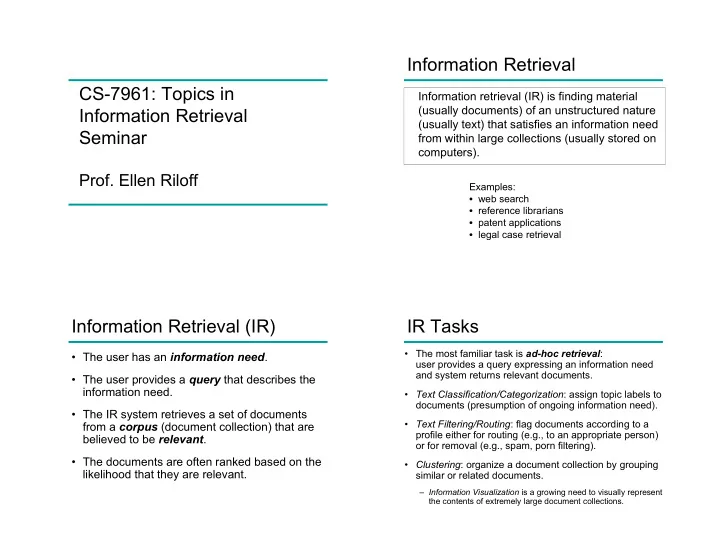
Information Retrieval

Information retrieval (IR) is finding material (usually documents) of an unstructured nature (usually text) that satisfies an information need from within large collections (usually stored on computers).

Examples:

  • web search
  • reference librarians
  • patent applications
  • legal case retrieval

Information Retrieval (IR)

  • The user has an information need.
  • The user provides a query that describes the

information need.

  • The IR system retrieves a set of documents

from a corpus (document collection) that are believed to be relevant.

  • The documents are often ranked based on the

likelihood that they are relevant.

IR Tasks

  • The most familiar task is ad-hoc retrieval:

user provides a query expressing an information need and system returns relevant documents.

  • Text Classification/Categorization: assign topic labels to

documents (presumption of ongoing information need).

  • Text Filtering/Routing: flag documents according to a

profile either for routing (e.g., to an appropriate person)

  • r for removal (e.g., spam, porn filtering).
  • Clustering: organize a document collection by grouping

similar or related documents.

– Information Visualization is a growing need to visually represent the contents of extremely large document collections.

slide-2
SLIDE 2

Types of Documents

  • Unstructured: natural language text

– There is linguistic structure, but little (if any) surface-level document structure.

  • Semi-structured: some natural language text, but also

some surface-level document structure.

– Examples: resumes, seminar announcements

  • Structured: data whose meaning is derived from the way

it is organized

– Databases are a common form of structured data.

Semi-Structured Text Examples

Laura Petitte Department of Psychology McGill University Thursday, May 4, 1995 12:00 pm Baker Hall 355

Seminar Announcement

Name: Dr. Jeffrey D. Hermes Affiliation: Department of AutoImmune Diseases Research & Biophysical Chemistry, Merck Research Laboratories Title: “MHC Class II: A Target for Specific Immunomodulation of the Immune Response” Host/e-mail: Robert Murphy, murph@a.crf.cmu.edu Date: Wednesday, May 3, 1995 Time: 3:30 p.m. Place: Mellon Institute Conference Room

Boolean Keyword Systems

  • The user provides a list of keywords that are

likely to appear in relevant documents.

– Example: to find documents about conspiracy theories involving the assassination of JFK, the user might list: JFK, conspiracy, assassination

  • By default, most systems use a Boolean and
  • perator, but advanced search options usually

support additional Boolean operators.

– Example: (AND (OR(JFK,Kennedy), conspiracy, (OR(assassination,murder,shooting)))

Major Issues in IR

  • Polysemy: many words have multiple meanings.
  • Synonymy: many words can mean the same

thing.

  • Size/Speed: IR systems must process huge

volumes of text, with instantaneous response time.

  • Broad Coverage: IR systems must be able to

handle queries about any topic whatsoever.

slide-3
SLIDE 3

Basic Evaluation Measures

  • Precision = percentage of returned documents

that are truly relevant.

– Intuition: hit rate. How often is the system correct?

  • Recall = percentage of all relevant documents

that the system finds.

– Intuition: coverage. How much of the desired material is found?

Inverted Index

  • Most IR systems use an inverted index

(inverted file) to represent the documents in the collection.

  • Each document is tokenized to identify

indivudal terms (normalized tokens).

  • A dictionary is created from the terms, and

each term is linked to a list of documents that contain the term (postings).

Inverted Index Example

Assassination Conspiracy JFK Kennedy d1, d5, d21, d73, d304, d511… d3, d4, d7, d54, d73, d288… d2, d21, d50, d73, d183, d288… d2, d5, d66, d89, d214, d288… The inverted index may also contain:

  • frequency count of each term
  • positional information

Stop Words

  • Most IR systems use a stop list (stop words),

which typically consist of closed class words that do not contain much semantic information.

  • Stop words are not included in the inverted

index, which dramatically reduces its size. Typical stop words: Articles: a, an, the Prepositions: of, to, from, by, with, for, at, in… Modals: would, could, should, can, will, must… etc.

slide-4
SLIDE 4

Disadvantages of Stop Words

  • Common strings can be used in uncommon ways.

– Example: "the" can be a Vietnamese name

  • Stop words can be crucial parts of a lexicalized phrase,

title, or quote.

– Example: "to be or not to be"

  • Some stopwords, such as prepositions, can provide

important information about relationships.

  • Disk space is much cheaper than it used to be, so

saving space may not be as important as it once was.

Stemming

  • Many IR systems use stemming to match query terms

with morphological variants in the documents.

– Example:

  • assassinate
  • assassinated
  • assassinates
  • assassinating
  • assassination
  • assassinations

Problems observed with the Porter Stemmer

Incorrect Conflation Errors of Omission

  • rganization
  • rgan

European Europe doing doe analysis analyze generalization generic matrices matrix numerical numerous noise noisy policy police sparse sparsity university universe explain explanation easy easily resolve resolution addition additive triangle triangular negligible negligent urgency urgent execute executive cylinder cylindrical

IR is not just web search!

  • There are some very important real-world challenges!

For example:

—Legal Search. Some real Westlaw information needs: Information on the legal theories involved in preventing the disclosure of trade secrets by employees formerly employed by a competing company. Cases about the host's responsibility for drunk guests. —Question Answering. NLP meets IR: most people really want computers to be able to return a specific answer to a question, not a set of documents. —Current IR systems do reasonably well with precision (for simple queries), but recall is still a major problem!